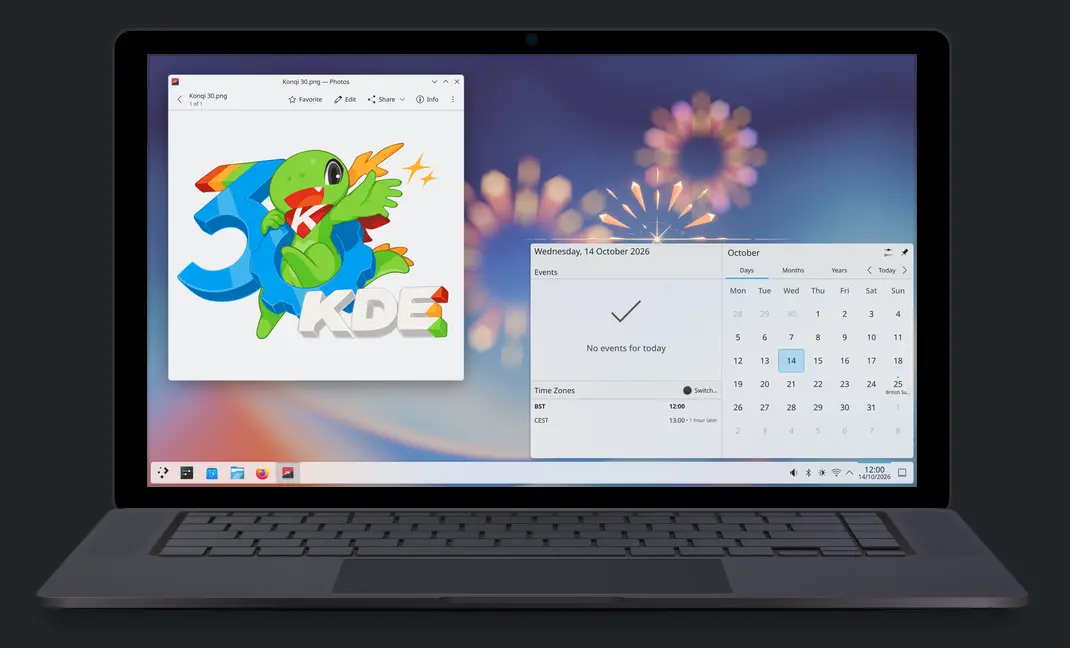
Marking three decades of innovation in open-source software development, desktop developer KDE officially celebrated its 30th anniversary on October 14 with the launch of Plasma 6.8. Characterized in the official announcement from KDE as the "30th Anniversary Edition," the major software update introduces a sweeping series of visual enhancements, graphical performance upgrades, and workflow improvements designed to prepare the Plasma desktop environment for the future. To celebrate thirty years of community-driven software engineering, the organization accompanied the milestone release with the debut of a dedicated movie chronicling the history, evolution, and community behind the project. Central to the launch of Plasma 6.8 is a momentous structural shift in open-source graphics architecture: the official retirement of native X11 session support in favor of a complete transition to the modern Wayland display server protocol.
The retirement of native X11 session support in Plasma 6.8 marks a major turning point for the Linux desktop ecosystem. The X Window System protocol, commonly referred to as X11, has served as the foundational graphical display architecture across Unix and Linux operating systems for 42 years. Originally engineered in an era of basic raster displays and networked terminal systems, X11 has faced mounting architectural challenges when adapting to modern display technologies. Issues surrounding high refresh rate monitors, variable refresh rate systems, per-monitor fractional display scaling, complex hardware-accelerated rendering pipelines, and modern display isolation security models have increasingly highlighted the limits of the aged protocol. By ending support for starting new native X11 sessions in Plasma 6.8, KDE is stepping away from 42 years of legacy display infrastructure to fully embrace Wayland as Plasma’s primary display compositor architecture.
To ensure that the transition away from native X11 sessions does not disrupt everyday user workflows or legacy software compatibility, KDE has incorporated robust compatibility layers and ongoing cross-platform support. Legacy applications designed specifically for the X11 display protocol will continue to function seamlessly within the new Plasma 6.8 Wayland environment by utilizing the XWayland compatibility layer. Operating as a translation bridge, XWayland creates an isolated X server instance inside the Wayland compositor environment, allowing legacy X11 application code to run without requiring developer rewrites or causing operational friction. Furthermore, individual KDE applications themselves will maintain continuous support for X11 execution, ensuring that KDE software suite applications remain fully functional when deployed on other desktop environments or Linux distributions that still maintain active X11 display sessions.