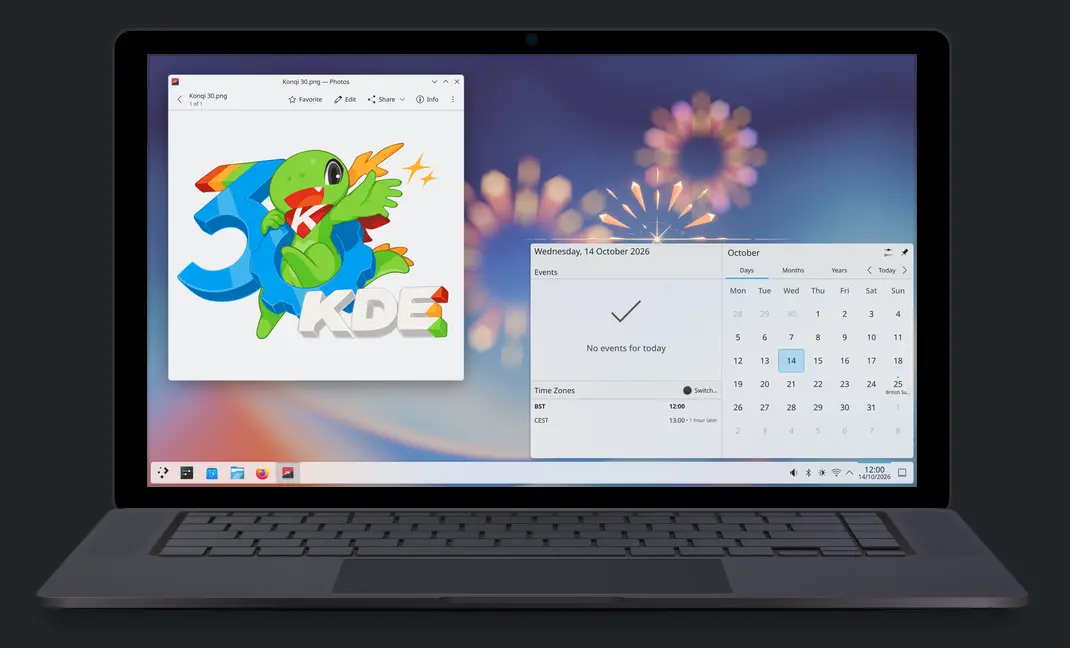
Marking three decades of innovation in open-source software development, desktop developer KDE officially celebrated its 30th anniversary on October 14 with the launch of Plasma 6.8. Characterized in the official announcement from KDE as the "30th Anniversary Edition," the major software update introduces a sweeping series of visual enhancements, graphical performance upgrades, and workflow improvements designed to prepare the Plasma desktop environment for the future. To celebrate thirty years of community-driven software engineering, the organization accompanied the milestone release with the debut of a dedicated movie chronicling the history, evolution, and community behind the project. Central to the launch of Plasma 6.8 is a momentous structural shift in open-source graphics architecture: the official retirement of native X11 session support in favor of a complete transition to the modern Wayland display server protocol.
The retirement of native X11 session support in Plasma 6.8 marks a major turning point for the Linux desktop ecosystem. The X Window System protocol, commonly referred to as X11, has served as the foundational graphical display architecture across Unix and Linux operating systems for 42 years. Originally engineered in an era of basic raster displays and networked terminal systems, X11 has faced mounting architectural challenges when adapting to modern display technologies. Issues surrounding high refresh rate monitors, variable refresh rate systems, per-monitor fractional display scaling, complex hardware-accelerated rendering pipelines, and modern display isolation security models have increasingly highlighted the limits of the aged protocol. By ending support for starting new native X11 sessions in Plasma 6.8, KDE is stepping away from 42 years of legacy display infrastructure to fully embrace Wayland as Plasma’s primary display compositor architecture.
To ensure that the transition away from native X11 sessions does not disrupt everyday user workflows or legacy software compatibility, KDE has incorporated robust compatibility layers and ongoing cross-platform support. Legacy applications designed specifically for the X11 display protocol will continue to function seamlessly within the new Plasma 6.8 Wayland environment by utilizing the XWayland compatibility layer. Operating as a translation bridge, XWayland creates an isolated X server instance inside the Wayland compositor environment, allowing legacy X11 application code to run without requiring developer rewrites or causing operational friction. Furthermore, individual KDE applications themselves will maintain continuous support for X11 execution, ensuring that KDE software suite applications remain fully functional when deployed on other desktop environments or Linux distributions that still maintain active X11 display sessions.
For desktop users, enterprise deployments, and hardware environments that require additional time to adapt to a pure Wayland desktop stack, KDE has provided clear operational choices and migration pathways. Desktop users who opt to remain on Plasma 6.7 will maintain their existing native X11 sessions for the time being. This grace period allows system administrators and users with specialized legacy hardware configurations or specific display driver requirements to preserve their existing setup without immediate disruption. However, the overarching strategy expressed in the official Plasma 6.8 release announcement makes clear that future development, architectural improvements, and feature additions will be focused entirely on the Wayland engine, signaling that native X11 session retention on earlier versions is a temporary transitional measure rather than a long-term deployment solution.
The decision to retire native X11 session support in Plasma 6.8 reflects a synchronized shift across the broader open-source desktop ecosystem. As display hardware and graphical workloads become increasingly sophisticated, key open-source desktop platforms have converged on Wayland as the path forward. This industry-wide alignment was previously demonstrated when GNOME, another major open-source desktop environment, officially announced its intention to drop native X11 sessions by default in 2025. With both GNOME and KDE moving decisively away from starting native X11 desktop sessions, display server maintainers, graphics driver developers, and software vendors are now firmly focused on optimizing their software stacks around the modern Wayland architecture.
Beyond its core display architecture shift, Plasma 6.8 introduces a rich collection of desktop interface upgrades aimed at providing a more consistent and polished graphical user experience. A prominent visual enhancement in the 30th Anniversary Edition is expanded support for applying window decorations to third-party applications. This feature allows users to render consistent visual frame elements—such as soft drop shadows, customized rounded window corners, title bar styling, and application borders—across software suites that do not natively utilize KDE’s client-side or server-side decoration frameworks. By standardizing window decorations across native and non-native applications alike, Plasma 6.8 delivers a significantly higher degree of visual cohesion across the entire desktop landscape.
In addition to enhanced window decorations, Plasma 6.8 incorporates a major overhaul of the Union theming system. Desktop personalization and customizability have long been defining characteristics of the Plasma desktop environment, allowing users to tweak every layer of their interface from window managers and taskbars to icon sets and color schemes. The streamlined Union theming system restructures how desktop themes integrate with core Plasma shell elements and system widgets. This structural refinement eliminates visual rendering discrepancies across custom interface themes, speeds up theme applying and desktop loading times, and provides a much more intuitive framework for third-party theme creators looking to build unified visual packages for the community.
On the graphical rendering and hardware acceleration side, Plasma 6.8 introduces an important default configuration change designed to elevate display smoothness for users running Nvidia graphics hardware. The 30th Anniversary Edition enables Nvidia triple buffering by default within the KWin compositing window manager. In graphical display pipelines, triple buffering provides an additional intermediate frame buffer between the GPU hardware rendering process and the display output compositor. This additional frame buffer helps balance frame timing, smoothing out stuttering during heavy desktop animations, eliminating screen tearing, and preventing frame drop lag during dynamic window movements. By enabling triple buffering natively out of the box for Nvidia hardware setups, Plasma 6.8 ensures a far fluid display experience on systems equipped with Nvidia graphics processors.
System maintenance and data preservation capabilities also receive a notable upgrade in Plasma 6.8 through the direct integration of Kup, KDE’s dedicated backup utility. Previously maintained as an independent backup application module, Kup is now embedded natively into the core Plasma desktop