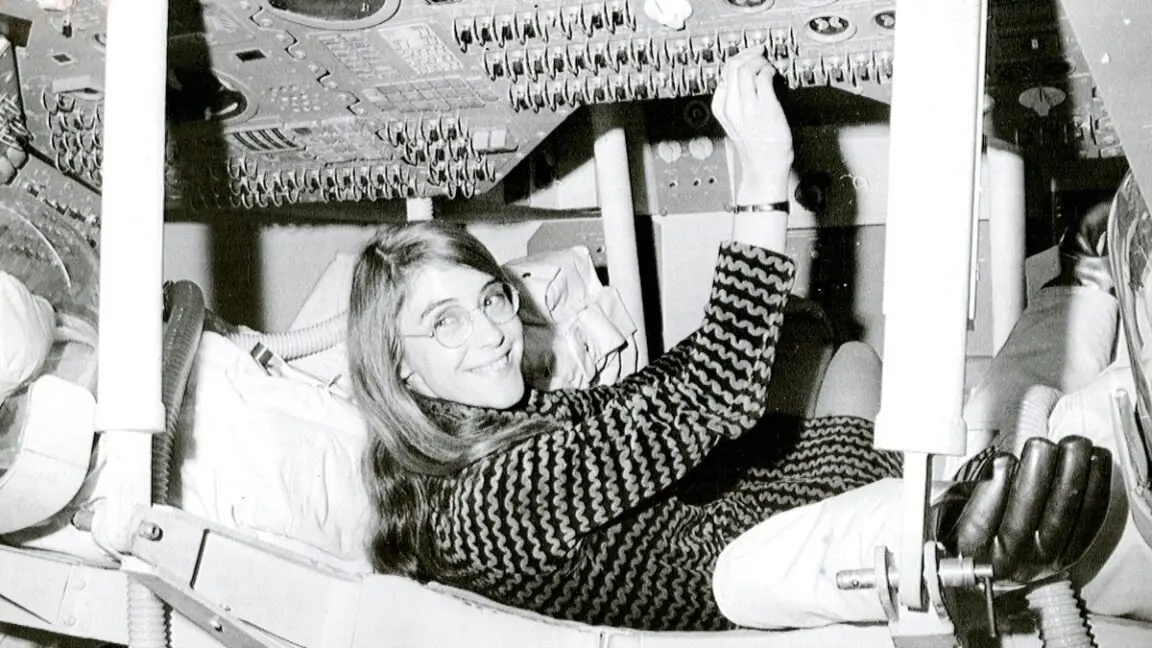
Margaret Hamilton, the visionary computer scientist whose pioneering work defined the field of modern software engineering and ensured the safe landing of Apollo 11 on the Moon, has died at the age of 90.
Hamilton, who famously coined the term "software engineering" at a time when programming was considered an art rather than a formal technical discipline, led the development of onboard flight software for NASA’s Apollo space program during the 1960s and 1970s. Her death marks the passing of one of computing’s most pivotal historical figures—a scientist whose focus on error prevention and system reliability laid the groundwork for modern computer science.
A recipient of the Presidential Medal of Freedom—the highest civilian honor in the United States—awarded by President Barack Obama in 2016, Hamilton’s legacy extends across space exploration, theoretical computer science, and commercial technology. She was immortalized in 2017 as part of LEGO’s "Women of NASA" set alongside trailblazing astronauts Mae Jemison and Sally Ride, cementing her legacy in popular culture as an enduring symbol for women in science, technology, engineering, and mathematics (STEM).
Tributes from the academic and aerospace communities underscored the historic magnitude of her achievements.
"To say Margaret Hamilton was a pioneer—to say she was ahead of her time—would be a dramatic understatement. She was a software engineer at a time when that field was in its infancy, and she not only developed advanced code herself but also led a team in using that nascent technology to develop one of the most complex systems humanity had ever achieved," said Olivier de Weck, interim head of the Massachusetts Institute of Technology (MIT) Department of Aeronautics and Astronautics. "The Apollo program still stands as one of our greatest testaments to the power of collaboration, ingenuity, and engineering, and Hamilton was a fundamental contributor to that program’s success."
Born in Paoli, Indiana, in 1936, Hamilton grew up in a family that valued literature, education, and analytical thought. Her father was a poet and her grandfather served as a school headmaster—influences that fostered her intellectual curiosity and led her to pursue a minor in philosophy alongside her primary major in mathematics. She graduated from Earlham College in 1958 with a Bachelor of Arts in mathematics, marrying her first husband, James Cox Hamilton, that same year.
The couple established a practical plan to support each other’s higher education: Hamilton would take a full-time position to support her husband while he completed his law degree, after which he would financially support her through graduate school so she could earn a PhD in mathematics.
That career pathway took an unexpected and historic turn when Hamilton took a job at MIT working with Edward Lorenz, the renowned mathematician and meteorologist. Lorenz was in the midst of pioneering the mathematical principles of weather forecasting using differential equations that accounted for continuously changing atmospheric variables such as temperature, barometric pressure, and wind velocity.
Lorenz’s famous research on his LGP-30 computer ultimately birthed chaos theory and the concept of "sensitivity to initial conditions"—often described as the "butterfly effect"—where infinitesimal variations in starting values produce drastically different mathematical outcomes. While history frequently highlights Lorenz’s discovery during a 1961 simulation run, it was Hamilton who was responsible for programming the LGP-30 computer that made those calculations possible.
At the time, formal coursework in computer programming did not exist; computers were massive, mechanical novelties, and both Lorenz and Hamilton had to teach themselves how to write code from scratch. Lorenz was frequently entertained by Hamilton’s inventive and pragmatic problem-solving tactics. To bypass the tedious and time-consuming process of debugging through standard machine protocols, Hamilton took to rolling long strips of paper tape down the hallways of MIT to inspect the binary routines visually.
Using a simple pencil, she would edit the code manually: poking physical holes in the paper tape to create binary "ones" and covering existing holes with bits of Scotch tape to turn them into binary "zeros." In 1961, when Hamilton transitioned to her next research project, she thoroughly trained her replacement—a recent Mount Holyoke mathematics graduate named Ellen Fetter. Lorenz later formally recognized the vital technical contributions of both women in his scientific papers, acknowledging their essential role in the dawn of chaos theory.
In 1961, Hamilton moved to MIT’s SAGE (Semi-Automatic Ground Environment) project, writing software for the prototype XD-1 computer used by the United States Air Force to process radar signals and search for potential enemy aircraft during the Cold War.