As Chief Executive Officer Tim Cook’s era at Apple draws to a close, the company is engaging in more hardware design experimentation than it has in years. Yet, looking strictly at the new iPhone 18 Pro, one might barely notice the shifting tides. While flashier, bolder form factors like the recently introduced iPhone Air and the impending iPhone Duo capture headlines and consumer curiosity, the iPhone 18 Pro quietly remains what the Pro line has long been: an extraordinarily fast, feature-dense workhorse designed to handle every demanding task tossed its way.
The iPhone 18 Pro does not represent a radical departure from last year’s iPhone 17 Pro. Instead, Apple has focused its engineering efforts beneath the surface, refining hardware architecture, heat dissipation, and raw processing throughput. Beyond a headline-grabbing variable aperture camera mechanism and subtle display panel alterations, the most consequential changes to this year’s flagship reside entirely under the hood. Driven by an advanced 2-nanometer A20 Pro system-on-a-chip, significantly improved thermal design, extended battery endurance, and enhanced onboard machine learning infrastructure, the iPhone 18 Pro solidifies the Pro line’s identity as an uncompromising tool for power users.
Design
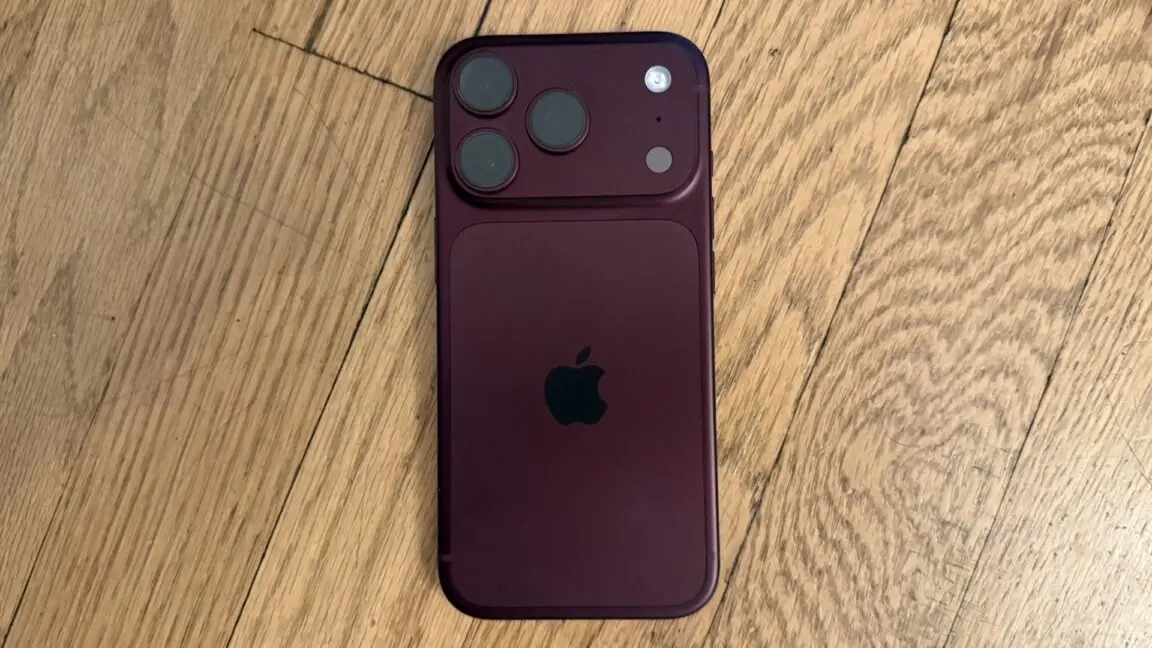
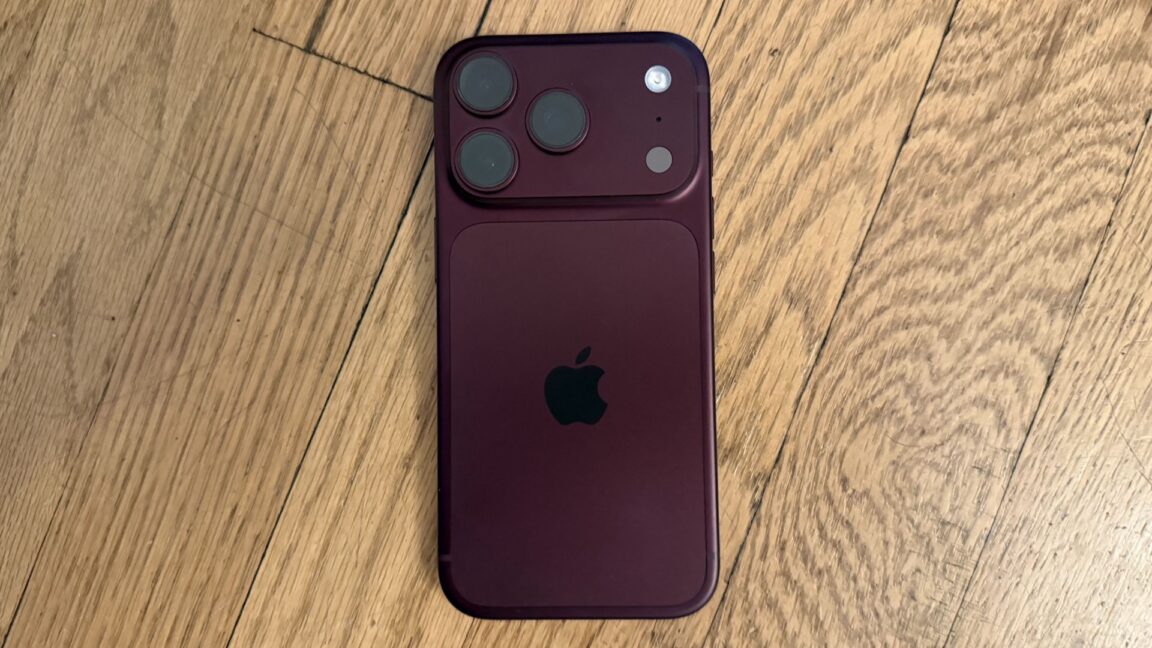
From an exterior perspective, the iPhone 18 Pro retains the function-over-form design philosophy established by its immediate predecessors. Constructed with premium materials built to endure daily wear, it carries a solid, familiar heft in the hand. While Apple boasts that this year’s dark option is its "blackest yet," the new review unit finish—a deep burgundy—stands out immediately. Although like many polished iPhone surfaces before it, the glass back remains somewhat susceptible to fingerprints, the burgundy tone offers a striking aesthetic option for a lineup that often leans strictly on industrial grays and muted metallic shades.
The most notable physical change on the front of the device centers around a further reduced Dynamic Island. Apple has shrunk the display cutout housing the front-facing sensor array by relocating the infrared (IR) camera entirely beneath the active OLED panel.
To achieve this under-display integration without sacrificing Face ID accuracy, Apple re-engineered the pixel layout in the upper-left corner of the screen. The revised pixel arrangement permits infrared light to pass directly through the panel to the sensor beneath it. To offset the lower pixel density in that localized spot, the surrounding display pixels operate at twice their standard brightness, effectively masking the sensor region during normal screen operation. Under close scrutiny, a trained eye can catch subtle optical artifacts in that specific corner when displaying uniform backgrounds, but for daily use, the under-display region blends seamlessly into the rest of the display.
Shrinking the Dynamic Island cutout yields immediate software benefits within iOS 27. With less physical real estate occupied by hardware sensors, Apple’s software team expanded the Dynamic Island’s multitasking capabilities. The interface can now accommodate up to three concurrent Live Activities at once, compared to the single activity limitation of earlier implementations. When displaying three activities, the central segment provides expanded status information, flanked by compact left and right indicators that offer glanceable cues. When reduced to two concurrent activities, the interface scales up to present rich, expanded data fields for both metrics, making the feature substantially more practical for tracking ongoing events like navigation, timers, or live scores.
Performance and Thermals
While the exterior design focuses on subtle refinements, the internal architecture of the iPhone 18 Pro has undergone an extensive overhaul aimed at tackling two intertwined challenges: processing speed and thermal management.
A20 Pro
At the heart of the handset is the new A20 Pro system-on-a-chip. Moving from the 3-nanometer process node utilized in the A19 Pro down to a cutting-edge 2-nanometer manufacturing process, the A20 Pro yields higher transistor density and improved power efficiency.
The chip retains a 6-core central processing unit (CPU) configuration consisting of four high-efficiency cores tasked with background processes and lightweight duties, alongside two high-performance cores built for intensive computational bursts. Graphics processing is handled by a 7-core graphics processing unit (GPU), with each core incorporating a dedicated Neural Accelerator designed specifically to accelerate GPU-based artificial intelligence workloads. The GPU also maintains hardware-accelerated ray-tracing support for complex lighting calculations in advanced mobile titles.
To handle local machine learning tasks—a central focal point of iOS 27—the A20 Pro features a dual 16-core Neural Engine architecture. Complementing this processing power is what Apple describes as the widest memory interface ever deployed in an iPhone, delivering a 50 percent boost in memory bandwidth over the previous generation. This expanded bandwidth plays a crucial role in maintaining low latency when running local Apple Intelligence models and complex Siri AI features entirely on-device. Furthermore, the elevated bandwidth provides substantial head-room for upcoming generative AI capabilities that may prove too demanding for older hardware generations.