As Chief Executive Officer Tim Cook’s era at Apple draws to a close, the company is engaging in more hardware design experimentation than it has in years. Yet, looking strictly at the new iPhone 18 Pro, one might barely notice the shifting tides. While flashier, bolder form factors like the recently introduced iPhone Air and the impending iPhone Duo capture headlines and consumer curiosity, the iPhone 18 Pro quietly remains what the Pro line has long been: an extraordinarily fast, feature-dense workhorse designed to handle every demanding task tossed its way.
The iPhone 18 Pro does not represent a radical departure from last year’s iPhone 17 Pro. Instead, Apple has focused its engineering efforts beneath the surface, refining hardware architecture, heat dissipation, and raw processing throughput. Beyond a headline-grabbing variable aperture camera mechanism and subtle display panel alterations, the most consequential changes to this year’s flagship reside entirely under the hood. Driven by an advanced 2-nanometer A20 Pro system-on-a-chip, significantly improved thermal design, extended battery endurance, and enhanced onboard machine learning infrastructure, the iPhone 18 Pro solidifies the Pro line’s identity as an uncompromising tool for power users.
Design
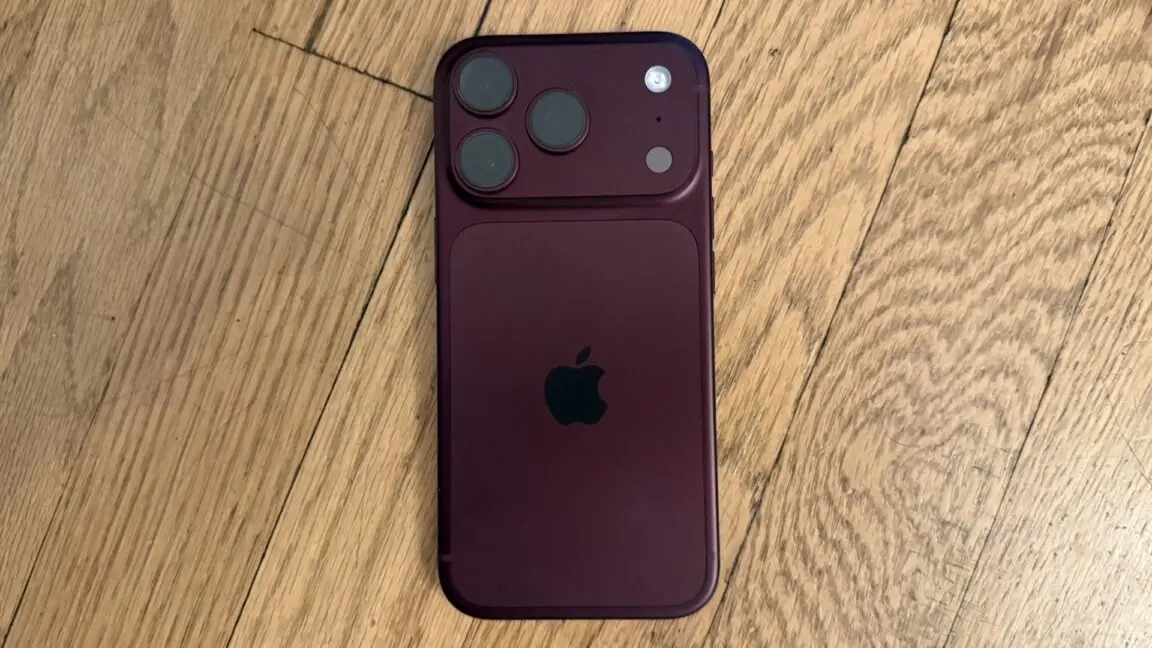
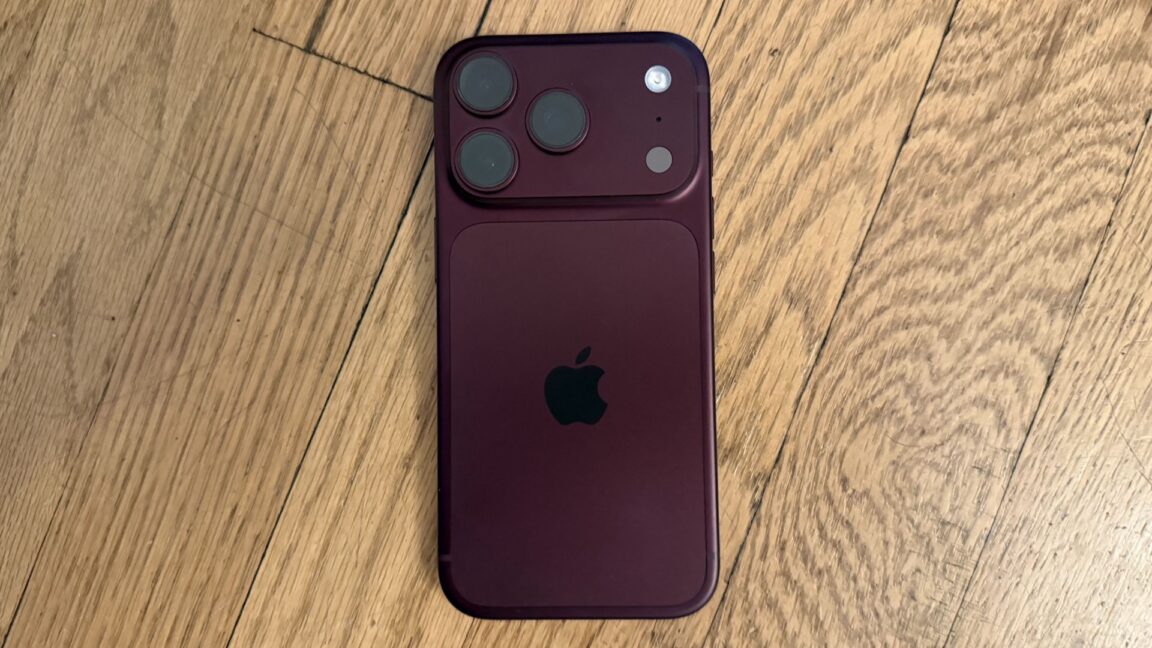
From an exterior perspective, the iPhone 18 Pro retains the function-over-form design philosophy established by its immediate predecessors. Constructed with premium materials built to endure daily wear, it carries a solid, familiar heft in the hand. While Apple boasts that this year’s dark option is its "blackest yet," the new review unit finish—a deep burgundy—stands out immediately. Although like many polished iPhone surfaces before it, the glass back remains somewhat susceptible to fingerprints, the burgundy tone offers a striking aesthetic option for a lineup that often leans strictly on industrial grays and muted metallic shades.
The most notable physical change on the front of the device centers around a further reduced Dynamic Island. Apple has shrunk the display cutout housing the front-facing sensor array by relocating the infrared (IR) camera entirely beneath the active OLED panel.
To achieve this under-display integration without sacrificing Face ID accuracy, Apple re-engineered the pixel layout in the upper-left corner of the screen. The revised pixel arrangement permits infrared light to pass directly through the panel to the sensor beneath it. To offset the lower pixel density in that localized spot, the surrounding display pixels operate at twice their standard brightness, effectively masking the sensor region during normal screen operation. Under close scrutiny, a trained eye can catch subtle optical artifacts in that specific corner when displaying uniform backgrounds, but for daily use, the under-display region blends seamlessly into the rest of the display.
Shrinking the Dynamic Island cutout yields immediate software benefits within iOS 27. With less physical real estate occupied by hardware sensors, Apple’s software team expanded the Dynamic Island’s multitasking capabilities. The interface can now accommodate up to three concurrent Live Activities at once, compared to the single activity limitation of earlier implementations. When displaying three activities, the central segment provides expanded status information, flanked by compact left and right indicators that offer glanceable cues. When reduced to two concurrent activities, the interface scales up to present rich, expanded data fields for both metrics, making the feature substantially more practical for tracking ongoing events like navigation, timers, or live scores.
Performance and Thermals
While the exterior design focuses on subtle refinements, the internal architecture of the iPhone 18 Pro has undergone an extensive overhaul aimed at tackling two intertwined challenges: processing speed and thermal management.
A20 Pro
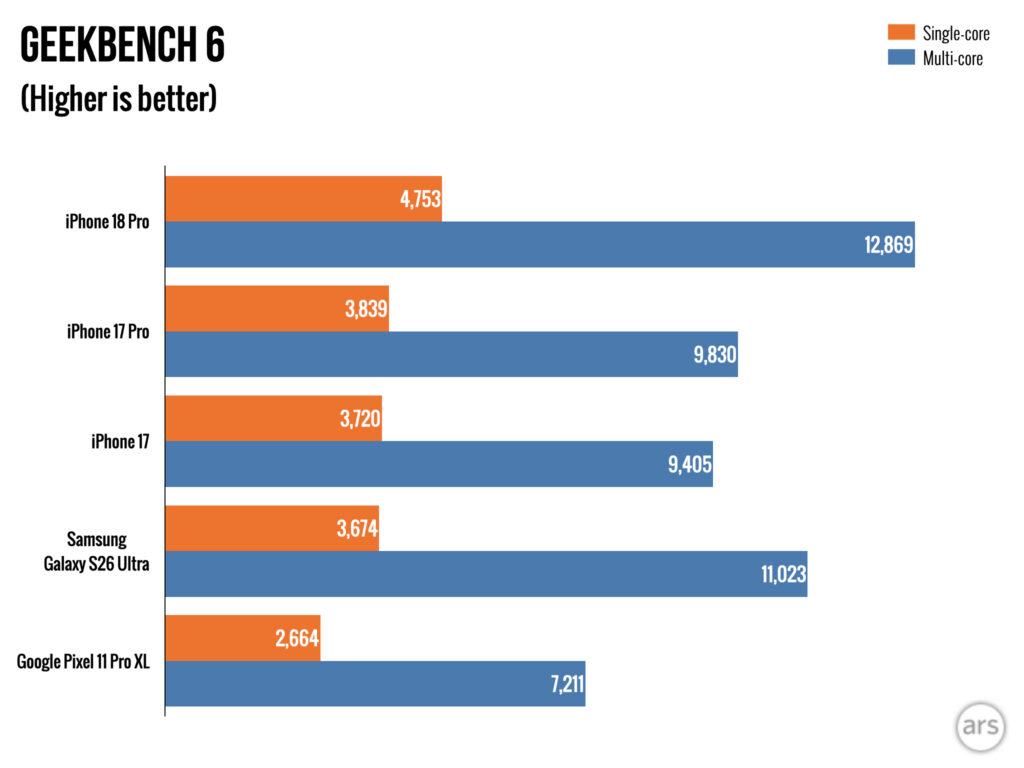
At the heart of the handset is the new A20 Pro system-on-a-chip. Moving from the 3-nanometer process node utilized in the A19 Pro down to a cutting-edge 2-nanometer manufacturing process, the A20 Pro yields higher transistor density and improved power efficiency.
The chip retains a 6-core central processing unit (CPU) configuration consisting of four high-efficiency cores tasked with background processes and lightweight duties, alongside two high-performance cores built for intensive computational bursts. Graphics processing is handled by a 7-core graphics processing unit (GPU), with each core incorporating a dedicated Neural Accelerator designed specifically to accelerate GPU-based artificial intelligence workloads. The GPU also maintains hardware-accelerated ray-tracing support for complex lighting calculations in advanced mobile titles.
To handle local machine learning tasks—a central focal point of iOS 27—the A20 Pro features a dual 16-core Neural Engine architecture. Complementing this processing power is what Apple describes as the widest memory interface ever deployed in an iPhone, delivering a 50 percent boost in memory bandwidth over the previous generation. This expanded bandwidth plays a crucial role in maintaining low latency when running local Apple Intelligence models and complex Siri AI features entirely on-device. Furthermore, the elevated bandwidth provides substantial head-room for upcoming generative AI capabilities that may prove too demanding for older hardware generations.
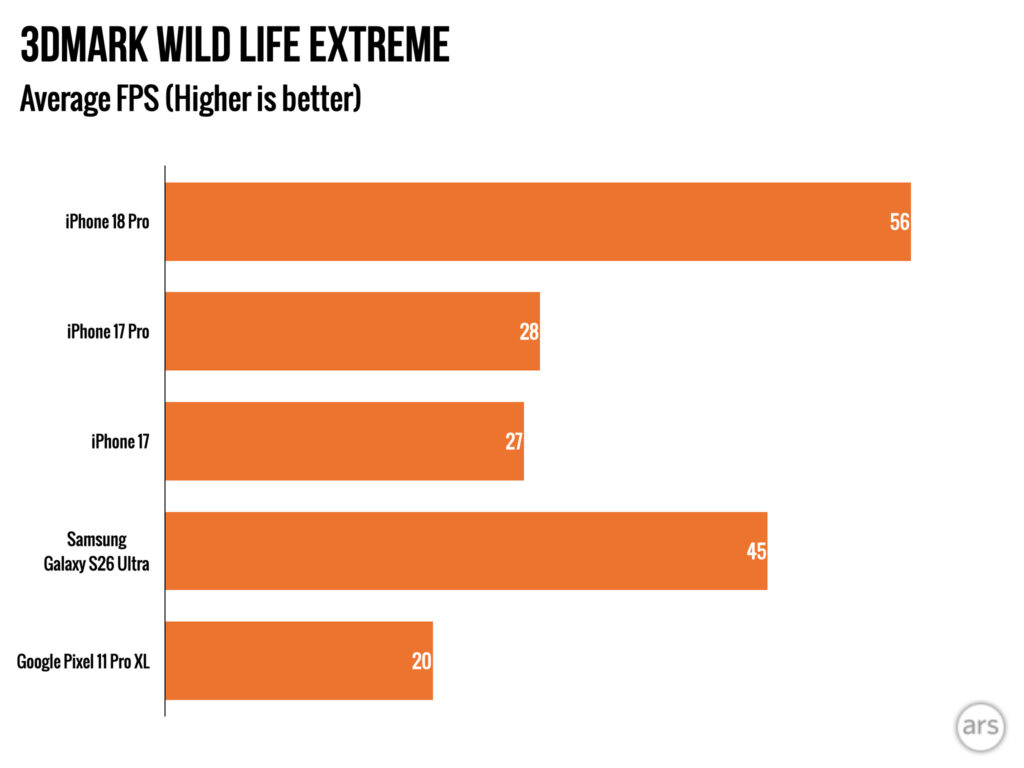
The real-world impact of these silicon changes is particularly evident in graphics benchmarks like 3DMark. High-end mobile games such as Genshin Impact and Diablo Immortal, which pushed older silicon to its limits, run with consistent frame rates and virtually zero graphical stuttering on the A20 Pro.
Improved Heat Management
Peak performance metrics mean little if a smartphone cannot maintain those speeds over extended periods due to thermal throttling. Addressing a long-standing point of friction for power users, Apple overhauled the physical layout and cooling mechanism inside the iPhone 18 Pro.
The architecture of the A20 Pro chip packaging itself was revised to optimize heat distribution. Rather than stacking the system-on-a-chip directly beneath the memory module as in past designs, Apple arranged the processor alongside the memory chip. This side-by-side positioning drastically reduces heat density in a single focal point.
This architectural shift works in tandem with a enlarged vapor chamber cooling system. Building on the initial vapor chamber implementation introduced in the iPhone 17 Pro, the expanded chamber spreads thermal energy across a broader internal surface area, supported by a specialized copper display plate that draws heat away from the screen panel.
According to Apple, these thermal interventions allow the iPhone 18 Pro to achieve up to a 40 percent improvement in sustained performance compared to the iPhone 17 Pro, and up to a 100 percent increase over the iPhone 16 Pro.
More importantly for everyday usage, the phone feels noticeably cooler to the touch during high-stress activities. Previous generations frequently generated uncomfortable ambient heat during intensive tasks like vehicle GPS navigation on sunlit dashboards, simultaneous 4K video recording, high-framerate gaming, or multitasking while charging. Under everyday conditions, the iPhone 18 Pro manages heat far more gracefully, keeping body temperatures low and preventing sudden screen dimming or feature lockouts caused by thermal overload.
A Beefy Battery (and Other Updates)
The energy efficiency gains realized by the 2-nanometer process node and improved thermals directly translate into elevated battery endurance. In standardized offline video playback tests, Apple rates the iPhone 18 Pro for up to 36 hours of continuous use on a single charge—a three-hour increase over the 33 hours delivered by the iPhone 17 Pro. (For comparison, the larger iPhone 18 Pro Max reaches up to 45 hours, compared to 39 hours on the 17 Pro Max.)
In practical daily use, the battery life performance stands out. Even compared to larger, older flagship models like an iPhone 16 Pro Max operating at slightly degraded battery health, the standard iPhone 18 Pro consistently retains a higher percentage of charge by the end of a full day of heavy usage, including screen-on media consumption, web browsing, and messaging.
Wireless connectivity also benefits from internal silicon shifts. The iPhone 18 Pro incorporates Apple’s proprietary C2 cellular modem, replacing the Qualcomm hardware utilized in the 17 Pro generation. The C2 modem draws less power during cellular data transmission, contributing directly to overall battery longevity when operating on 5G networks. For wireless charging enthusiasts, the handset now supports wireless power delivery speeds of up to 25 watts with compatible hardware.
Cameras
On the photography front, the iPhone 18 Pro relies on a familiar hardware foundation while adding targeted physical and computational controls. The device carries forward the triple 48-megapixel rear camera system introduced in the iPhone 17 Pro—encompassing main, ultrawide, and telephoto lenses—alongside an 18-megapixel front-facing sensor.
The headline camera hardware upgrade on the primary lens is a new physical variable aperture mechanism. Historically, iPhone cameras relied on a fixed aperture, leaving depth-of-field and light exposure adjustments entirely to computational post-processing algorithms. The inclusion of a variable aperture provides granular physical light control for photography enthusiasts who prefer manual shutter and aperture selection. By default, the system adjusts the aperture setting automatically based on real-time scene analysis, sharpening subjects and optimizing depth-of-field without requiring manual user intervention.
Complementing the mechanical camera controls is Photographic Styles 3, the newest iteration of Apple’s non-destructive image rendering pipeline. Unlike basic color balance overlays, Photographic Styles 3 enables direct manipulation of image texture alongside color hue and tone.
Users can select from four foundational texture presets within the stock Camera app:
- Film: Introduces subtle grain patterns and soft contrast transitions reminiscent of traditional analog film stock.
- Glow: Softens bright highlights to create an ethereal, atmospheric lighting effect.
- Soft Skin: Retains high subject clarity while gently smoothing skin tones to avoid harsh computational over-sharpening.
- Standard: Delivers Apple’s natural, baseline color balance and image detail rendering.
These additions directly address long-standing critiques that Apple’s camera software was overly rigid, hyper-processed, and heavily reliant on aggressive dynamic range adjustments. By giving users direct access to variable aperture control and granular texture rendering within the native Camera app, Apple offers a more flexible toolset that reduces the need for third-party manual camera utilities.

For Those Who Just Want a Good Phone
Marking the final flagship release of Tim Cook’s tenure as Apple’s Chief Executive Officer, the iPhone 18 Pro serves as a definitive summary of his approach to product development: highly practical, premium, packed with granular hardware solutions for specialized edge cases, and built to an exceptionally high standard of manufacturing consistency.
While mobile technology no longer sees the dramatic year-over-year architectural leaps that defined the smartphone market’s early decade, the accumulation of iterative refinements makes the iPhone 18 Pro a compelling package. Users upgrading from an iPhone 17 Pro will find little reason to make the leap immediately, as the performance and camera foundations remain broadly similar. Even owners of an iPhone 15 Pro or iPhone 16 Pro with healthy batteries will find their current devices more than capable of handling modern workflows and iOS 27 features.
However, for users transitioning from older hardware generations, the cumulative updates presented in the iPhone 18 Pro are undeniable. The combination of a brighter, lower-density Dynamic Island display integration, substantial battery longevity, efficient custom C2 cellular connectivity, expanded local AI memory bandwidth, flexible camera controls, and—above all—drastically superior thermal engineering results in a flagship device that operates smoothly under almost any workload.
For consumers seeking radical form-factor changes or folding display novelties, alternative options like the iPhone Duo or competing Android devices cater to those preferences. But for users who simply require a reliable, high-performance smartphone capable of handling heavy daily demands without thermal throttling or battery anxiety, the iPhone 18 Pro represents the refined apex of classic smartphone design.