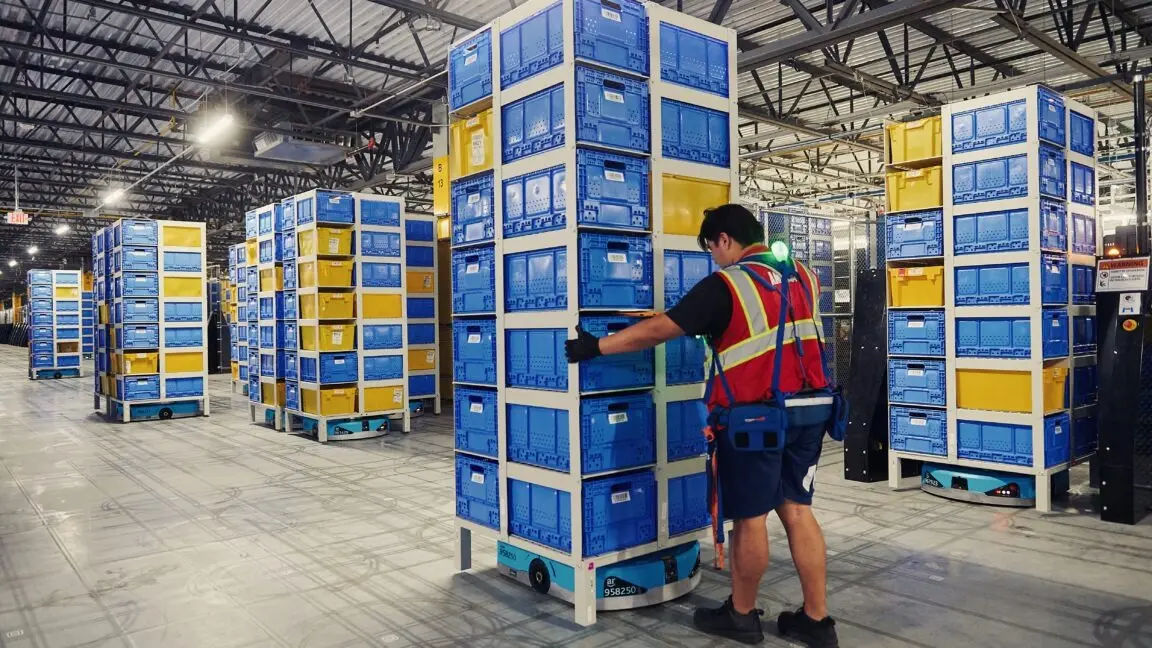
No organization on Earth operates a larger robotic footprint than Amazon. The e-commerce titan currently maintains a fleet of more than 1 million autonomous and semi-autonomous robots active across its global fulfillment network. Working around the clock, these machines help power the daily processing and delivery of tens of millions of same-day and one-day packages for the company’s more than 200 million Prime subscribers.
Yet, even as Amazon prepares to significantly expand this mechanized fleet through dedicated new manufacturing plants, it remains the world’s second-largest corporate employer. According to its 2025 annual report, Amazon employs over 1.5 million full-time and part-time human workers. The intersection of these two massive workforces—one constructed of steel, silicon, and AI, the other made of flesh and blood—has turned Amazon’s fulfillment centers into a testing ground for the future of human-robot collaboration.
Amazon executives maintain that automation serves to assist human employees by absorbing the most physically demanding, repetitive, and hazardous tasks in fulfillment centers. However, independent researchers, workplace safety advocates, and labor representatives argue that bringing AI-driven machinery into close proximity with people creates a distinct set of physical and psychological pressures, altering the fundamental nature of warehouse labor.
Historically, industrial automation occurred behind barriers or at a distance from human workers, taking dangerous tasks entirely out of human hands. Modern warehouse robotics, however, rely on collaborative systems that share the immediate workspace with people. As Brian Greenwood, a professor of business at George Mason University, points out, collaborative robots fundamentally alter workplace dynamics because they operate in direct physical proximity to human workers and frequently dictate the speed at which tasks must be performed.
This relentless pace is deeply linked to the logistics demand of modern e-commerce. Inside fulfillment facilities, hundreds of thousands of employees work to assemble, pack, and ship orders containing millions of distinct products. In the United States alone, the broader warehousing sector employs nearly 2 million people and has long been plagued by high turnover and workplace injury rates that OSHA metrics show are routinely more than double the national average across all private industries. While robots excel at predictable, high-speed repetitive tasks, humans remain essential for their adaptability and fine motor control. The resulting interplay between human agility and machine efficiency has reshaped logistics, while raising critical questions about workplace safety and employee well-being.
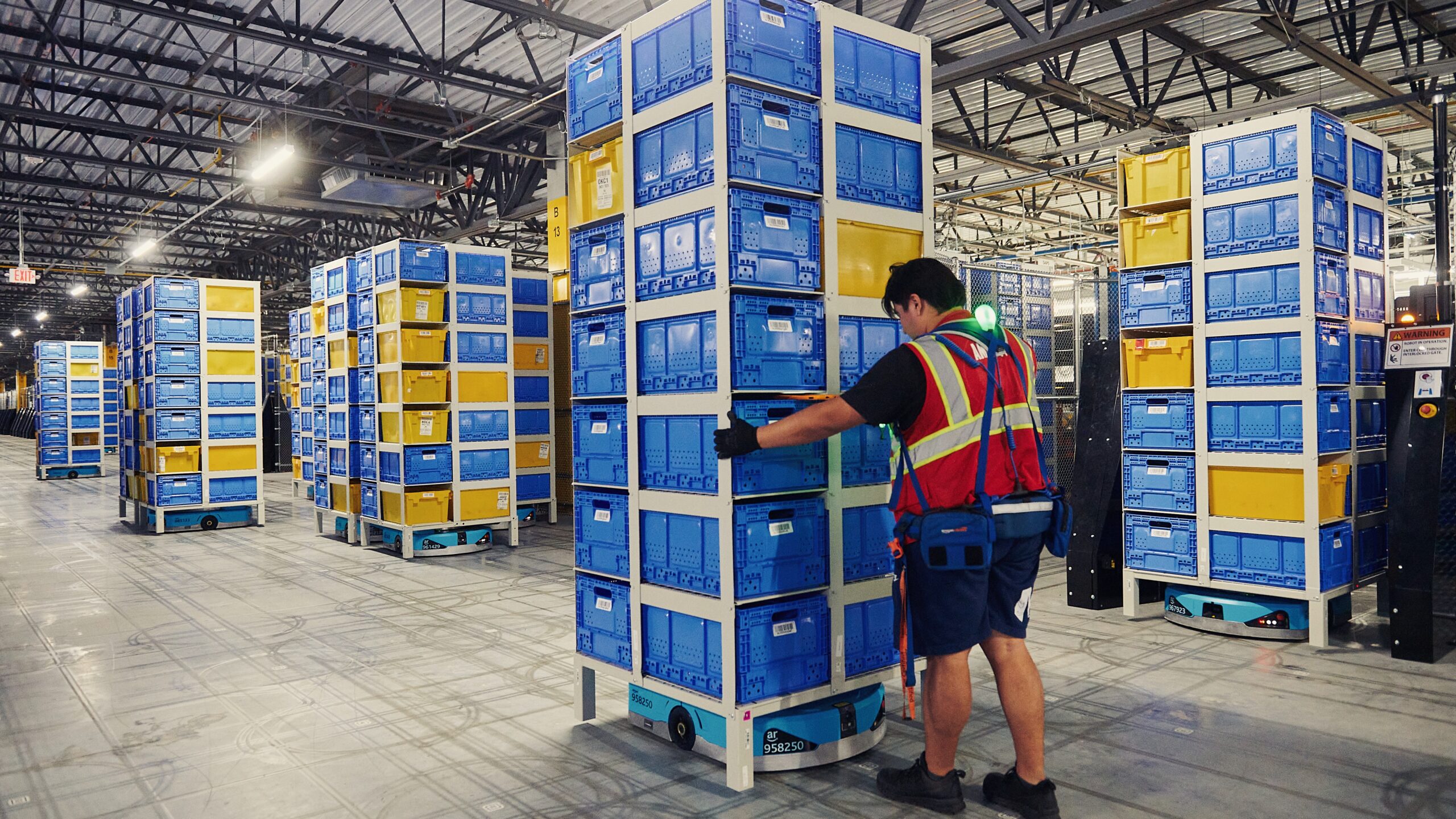
To sustain this vast technological footprint, Amazon has systematically built up its internal robotics engineering capabilities over the past decade. The foundation of this strategy was laid in 2012 when Amazon acquired Kiva Systems for $775 million. Kiva pioneered the use of low-profile, wheeled mobile robots designed to slide underneath tall inventory racks—known as "pods"—and transport them directly to stationary human workers, eliminating the need for employees to walk miles through fulfillment center aisles.
Rebranded as Amazon Robotics, the division has expanded from its initial base in Massachusetts into a major manufacturing operation. The company has announced plans to construct additional advanced production factories in Austin, Texas, and Greenwood, Indiana, to further expand its capacity to manufacture proprietary hardware.
The bulk of Amazon’s million-unit robotic workforce consists of wheeled mobile drive units, such as its Hercules and Titan models. Hercules units, roughly the size of a pool table, and Titan units, which approach the footprint of a baby grand piano, navigate along floor grids marked with specialized stickers. They retrieve fabric inventory pods filled with plastic tote crates and carry them to workstations. In newer deployments, Amazon’s Sequoia system orchestrates swarms of mobile drive units to identify and store inventory, a process the company claims can boost storage and identification speed by up to 75 percent.
While traditional mobile drive units operate within fenced areas separated from human workers, newer models like Proteus feature advanced visual and spatial sensors that allow them to move safely alongside humans in open warehouse areas. To prevent congestion among these vast fleets navigating tight grid corridors, Amazon orchestrates drive movements using DeepFleet, a suite of artificial intelligence foundation models engineered to predict traffic bottlenecks and optimize routing across fulfillment floors in real time.
The robotic arms race
While mobile drive units handle horizontal transport across warehouse floors, Amazon has increasingly focused on automating package sorting, lifting, and item manipulation. Initially, the company relied on third-party industrial robotic arms to move heavy pallets and containers. Over the past several years, however, Amazon Robotics has transitioned to custom-built in-house systems.
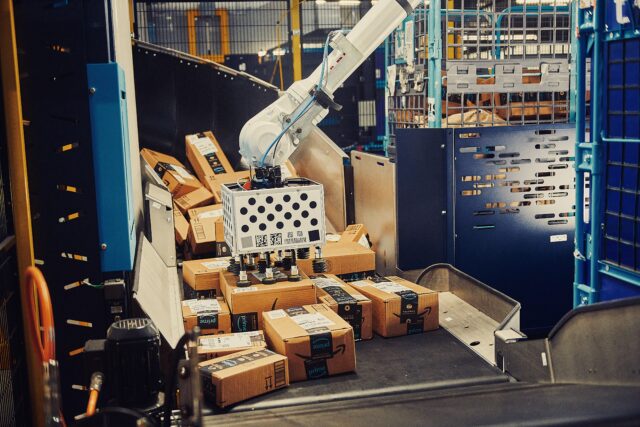
Amazon CFO Brian Olsavsky noted in a July earnings call that the company planned to more than double its fleet of robotic arms, with Scott Dresser, vice president of Amazon Robotics, clarifying that the current active footprint of these mechanical arms sits in the single-digit thousands.