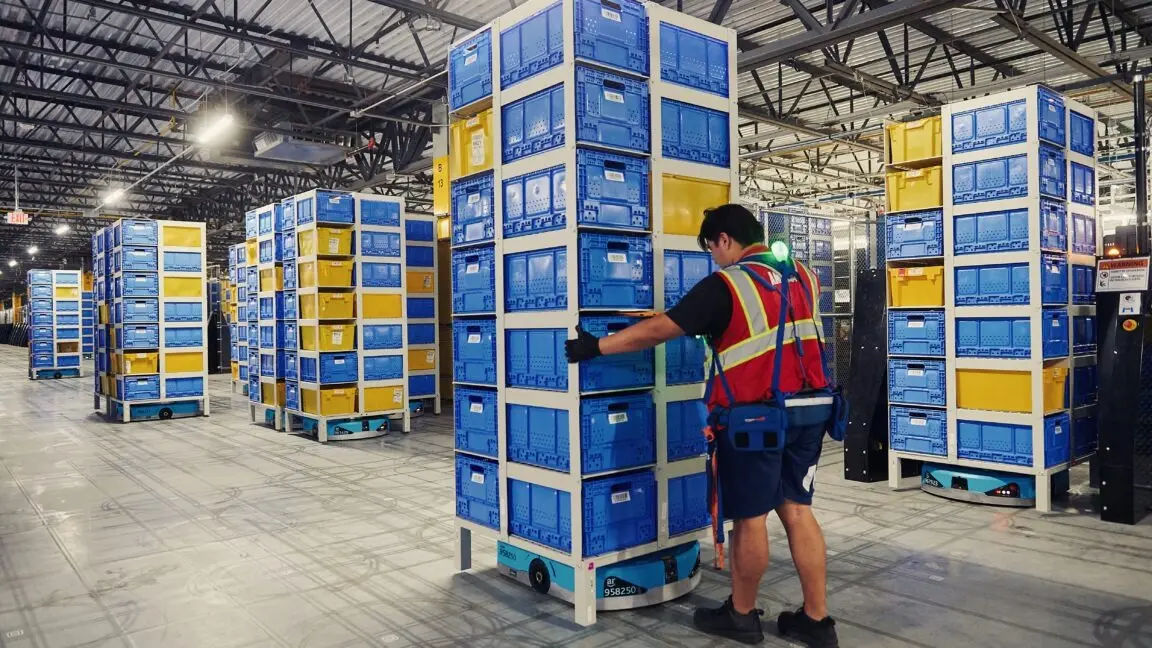
The division’s first custom package-handling arm, dubbed Robin, began field testing in 2021 before officially deploying at a fulfillment facility in Lakeland, Florida, in 2022. Designed to tackle piles of unsorted parcels, Robin utilizes an array of eight suction cups attached to a mechanical arm to pick up individual mailers and boxes from cluttered conveyor belts and place them onto mobile drive units.
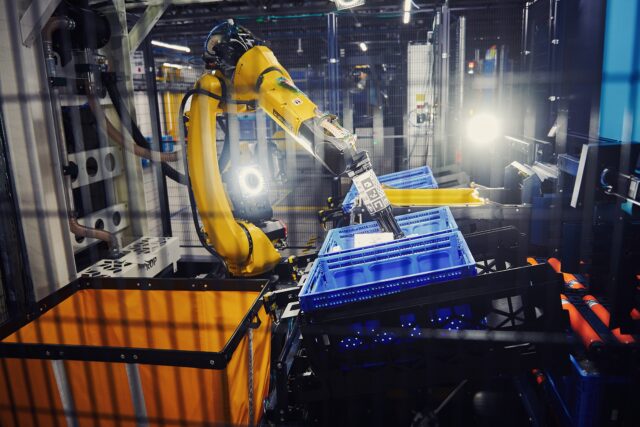
To successfully pick up items from chaotic piles, Robin relies on machine learning models rather than traditional, rigidly coded algorithms. Early algorithmic strategies created by Amazon engineers often failed when dealing with complex package arrangements—prioritizing large boxes under smaller ones, or repeatedly trying to pick partially covered, unreachable parcels. To resolve this, Amazon trained machine learning models on more than 394,000 live picking actions to calculate the probability of success for various pick strategies.
In field evaluations, this machine-learning approach raised picking success rates from 92.28 percent under traditional algorithms to 93.73 percent. While a percentage point gain might appear modest, at Amazon’s scale it translated to approximately 16,500 fewer failed picks over a test sample of one million items. Subsequent research presented by the Amazon Robotics team at the International Symposium on Experimental Robotics in July 2025 demonstrated that refined machine learning models could reduce failed pick rates by up to 20 percent across two million live trial pick attempts.
Building on Robin’s baseline manipulation capabilities, Amazon introduced Cardinal, a heavy-duty robotic arm capable of lifting items weighing up to 50 pounds. First deployed at a facility in Nashville, Tennessee, in November 2022, Cardinal selects packages from conveyor lines and stacks them tightly inside wheeled transport carts bound for delivery trucks. Using vision systems and spatial analysis, Cardinal determines optimal package placement to maximize cart density—an outcome that improves transport efficiency and reduces shipping emissions.
AI-driven robot successors
While Robin and Cardinal were engineered to move standard cardboard boxes and paper mailers, handling the unpackaged consumer goods stored in Amazon’s catalog presented a far more intricate technical hurdle. Items vary radically in shape, weight, flexibility, and surface texture, making rigid automation impractical.
To address this challenge, Amazon developed Sparrow, a sophisticated robotic arm built specifically to consolidate individual products from partially filled totes into high-density storage containers. Sparrow represented the first widespread integration of AI foundation models into Amazon’s physical manipulation systems. Rather than requiring hand-coded instructions for every product SKU, Sparrow utilizes vision and perception models to analyze unfamiliar items instantly and determine the safest, most effective grip.
Building on Sparrow’s capabilities, Amazon Robotics managers showcased recent breakthroughs at the IEEE International Conference on Intelligent Robots and Systems (IROS) in Pittsburgh on September 29, 2026. Senior Applied Science Manager Kapil Katyal detailed how the company developed a universal perception foundation model alongside a Generalized Action Model (GAM). This architecture allows disparate robotic arms—whether utilizing suction mechanisms, multi-fingered mechanical grippers, or hybrid hands—to recognize and manipulate previously unseen inventory without requiring task-specific software adjustments.
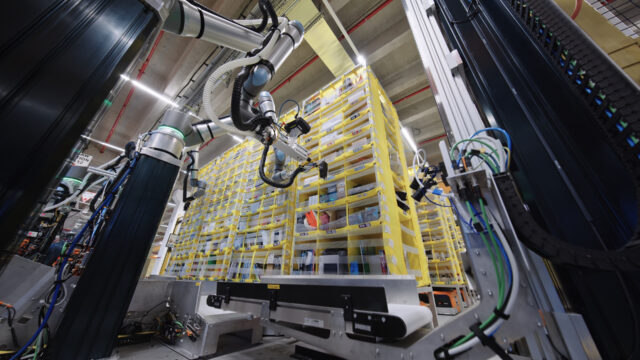
The newest addition to this line of manipulation hardware is Vulcan, a robotic arm introduced at facilities in Spokane, Washington, and Hamburg, Germany, starting in 2025. Unlike its predecessors, which rely almost entirely on computer vision, Vulcan incorporates touch-sensitive force-feedback sensors embedded within its manipulation end-effectors. This tactile sensing allows Vulcan to detect physical resistance, enabling it to carefully slide items into tightly packed, fabric-covered inventory pods or gently extract items without damaging adjacent products. Amazon plans a broader, network-wide rollout of Vulcan systems beginning in 2027.
Parsing the human impact
Amazon framed the development of systems like Vulcan as a direct ergonomic benefit for its human workforce. By assigning Vulcan to handle items on the highest shelves of inventory pods—which previously required employees to climb step-ladders—or items stored inches above the floor, the company says workers can focus on tasks within a comfortable physical reach zone.
However, labor organizations, independent researchers, and congressional investigators offer a more complex evaluation of workplace safety in automated facilities. Reports issued in May 2021 and April 2022 by the Strategic Organizing Center (SOC), a coalition of labor unions, analyzed federal workplace injury data and concluded that Amazon facilities equipped with mobile drive robotics recorded higher overall injury rates than non-robotic facilities.