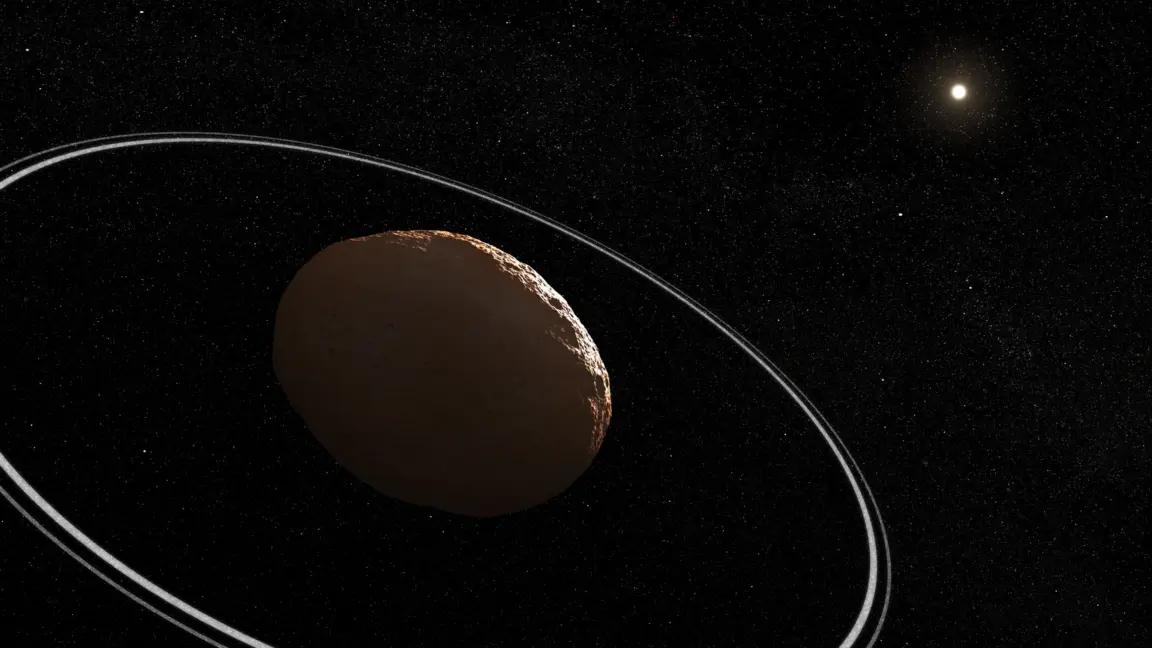
For decades, planetary rings were considered the exclusive territory of the Solar System’s giant planets. Saturn’s dazzling bands, along with the fainter, dustier systems encircling Jupiter, Uranus, and Neptune, suggested that immense gravitational mass was required to capture and hold vast disks of orbiting debris. That long-standing astronomical consensus shattered in 2013 when researchers observed a small, dark object drifting in the cold realm between Saturn and Uranus. As this distant body passed directly in front of a background star, the starlight blinked twice shortly before and after the main event, revealing two sharp, narrow rings surrounding an object barely 250 kilometers across.
"It was a surprise," recalls Pablo Santos-Sanz, an astronomer at the Instituto de Astrofísica de Andalucía in Granada, Spain, who was part of the discovery efforts.
Ever since that unexpected detection, planetary scientists have wrestled with fundamental questions: What are these improbable rings made of, how did they form, and how can a tiny body sustain them over extended periods without its weak gravity allowing them to disperse into space?
Now, groundbreaking observations made with NASA’s James Webb Space Telescope (JWST) have deepened the mystery while offering unprecedented insights into the dynamics of small-body ring systems. Observing Chariklo during another rare stellar occultation, Santos-Sanz and an international team of researchers discovered that its rings are not static features frozen in time. Instead, over less than a decade, one ring has grown significantly denser while the other has nearly disappeared. The findings, published in Science Advances, provide compelling evidence that rings around minor bodies undergo rapid structural evolution, fundamentally changing our understanding of how ring systems operate across the Solar System.
Shadowing a Distant Star
The technique used to study objects as small and distant as Chariklo relies on a straightforward observational principle known as stellar occultation. "We predict when a Solar System object passes in front of a star," Santos-Sanz explained. As the foreground object crosses the line of sight between Earth and the distant star, it momentarily blocks the light. By measuring the precise timing, duration, and shape of the resulting dip in brightness—the light curve—astronomers can reconstruct the target’s size, shape, atmospheric profile, and surrounding structure with remarkable precision.
"This is particularly challenging for minor bodies, and more challenging for distant minor bodies," Santos-Sanz said.
The primary difficulty lies in the infinitesimal scale of the geometry. From a vantage point hundreds of millions of kilometers away, Chariklo casts a silhouette on the sky that is tiny beyond easy visualization. Predicting exactly when and where that miniature shadow will fall requires ultra-precise orbital data for both the target object and the background star.
Despite these formidable technical hurdles, ground-based observatories successfully caught Chariklo blocking a star in 2013, exposing its secret ring system. Astronomers identified two distinct structures, designated C1R and C2R, located roughly 390 kilometers and 405 kilometers from the object’s center, respectively. The rings were remarkably thin—spanning only a few kilometers in width—and separated by a narrow gap of just 7 kilometers.
Replicating this observation with a space telescope, however, introduced an entirely new layer of complexity. JWST operates from the second Lagrange point (L2), roughly 1.5 million kilometers from Earth. Because the space observatory requires periodic thruster nudges every few weeks to maintain its stable halo orbit around L2, its precise position in space constantly shifts in ways that complicate ultra-fine target tracking.
"It’s a kind of tricky task," Santos-Sanz said.
Preparing for the Chariklo observation was a nerve-wracking exercise in orbital mechanics. Santos-Sanz’s team identified a promising alignment projected for October 2022, initiating candidate predictions as early as August of that year. Week by week, as new tracking data came in, the team recalculated the predicted line of sight. Over the course of these updates, the projected track shifted by approximately 110 kilometers—a distance larger than Chariklo’s total radius, and more than enough to miss the target entirely.
To make matters more challenging, JWST’s operational constraints require target command sequences to be finalized and locked into the scheduling system at least 14 days in advance. Astronomers could not wait until the last minute to make final orbital corrections.
"We did this maybe a bit blindly, because we didn’t know exactly where the line of sight was," Santos-Sanz noted. "I’m going to move one of the biggest, best telescopes in space, and we don’t know if finally we will catch this or not."
Despite the razor-thin margin for error, the high-stakes planning paid off. On October 18, 2022, JWST carried out the observation. Reconstructed geometry later revealed that the telescope’s sightline to the background star skimmed just 7.4 kilometers above Chariklo’s physical surface. While the solid body of the Centaur itself missed blocking the star directly, the alignment was perfect for catching its delicate surroundings: the line of sight sliced right through both rings.