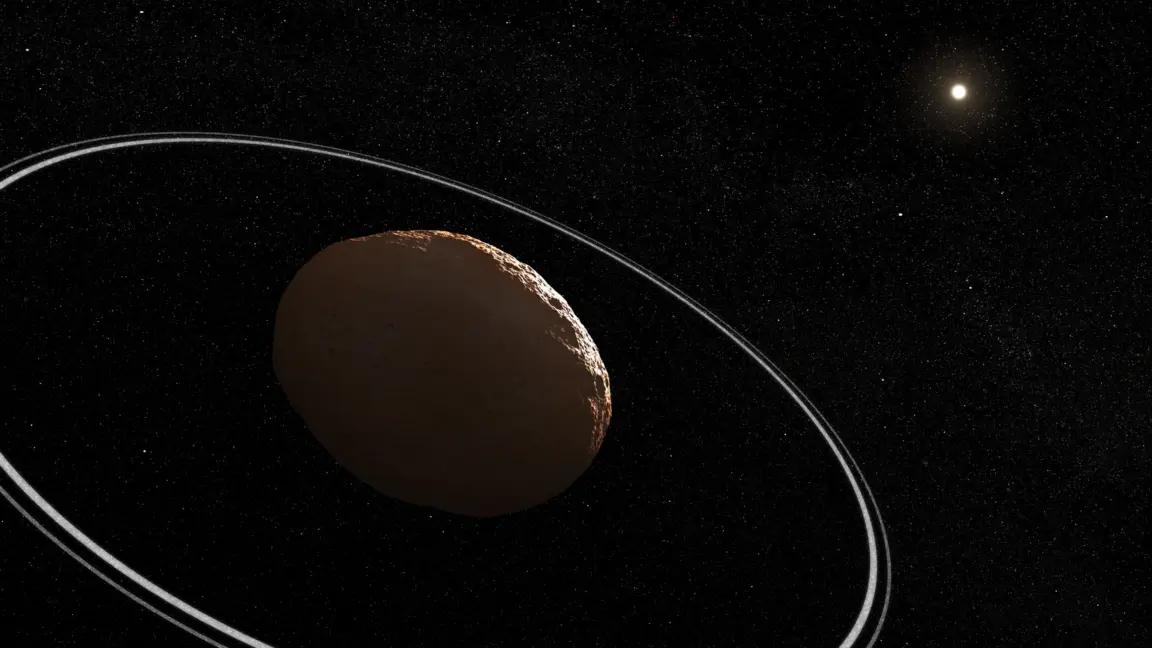
For decades, planetary rings were considered the exclusive territory of the Solar System’s giant planets. Saturn’s dazzling bands, along with the fainter, dustier systems encircling Jupiter, Uranus, and Neptune, suggested that immense gravitational mass was required to capture and hold vast disks of orbiting debris. That long-standing astronomical consensus shattered in 2013 when researchers observed a small, dark object drifting in the cold realm between Saturn and Uranus. As this distant body passed directly in front of a background star, the starlight blinked twice shortly before and after the main event, revealing two sharp, narrow rings surrounding an object barely 250 kilometers across.
"It was a surprise," recalls Pablo Santos-Sanz, an astronomer at the Instituto de Astrofísica de Andalucía in Granada, Spain, who was part of the discovery efforts.
Ever since that unexpected detection, planetary scientists have wrestled with fundamental questions: What are these improbable rings made of, how did they form, and how can a tiny body sustain them over extended periods without its weak gravity allowing them to disperse into space?
Now, groundbreaking observations made with NASA’s James Webb Space Telescope (JWST) have deepened the mystery while offering unprecedented insights into the dynamics of small-body ring systems. Observing Chariklo during another rare stellar occultation, Santos-Sanz and an international team of researchers discovered that its rings are not static features frozen in time. Instead, over less than a decade, one ring has grown significantly denser while the other has nearly disappeared. The findings, published in Science Advances, provide compelling evidence that rings around minor bodies undergo rapid structural evolution, fundamentally changing our understanding of how ring systems operate across the Solar System.
Shadowing a Distant Star
The technique used to study objects as small and distant as Chariklo relies on a straightforward observational principle known as stellar occultation. "We predict when a Solar System object passes in front of a star," Santos-Sanz explained. As the foreground object crosses the line of sight between Earth and the distant star, it momentarily blocks the light. By measuring the precise timing, duration, and shape of the resulting dip in brightness—the light curve—astronomers can reconstruct the target’s size, shape, atmospheric profile, and surrounding structure with remarkable precision.
"This is particularly challenging for minor bodies, and more challenging for distant minor bodies," Santos-Sanz said.
The primary difficulty lies in the infinitesimal scale of the geometry. From a vantage point hundreds of millions of kilometers away, Chariklo casts a silhouette on the sky that is tiny beyond easy visualization. Predicting exactly when and where that miniature shadow will fall requires ultra-precise orbital data for both the target object and the background star.
Despite these formidable technical hurdles, ground-based observatories successfully caught Chariklo blocking a star in 2013, exposing its secret ring system. Astronomers identified two distinct structures, designated C1R and C2R, located roughly 390 kilometers and 405 kilometers from the object’s center, respectively. The rings were remarkably thin—spanning only a few kilometers in width—and separated by a narrow gap of just 7 kilometers.
Replicating this observation with a space telescope, however, introduced an entirely new layer of complexity. JWST operates from the second Lagrange point (L2), roughly 1.5 million kilometers from Earth. Because the space observatory requires periodic thruster nudges every few weeks to maintain its stable halo orbit around L2, its precise position in space constantly shifts in ways that complicate ultra-fine target tracking.
"It’s a kind of tricky task," Santos-Sanz said.
Preparing for the Chariklo observation was a nerve-wracking exercise in orbital mechanics. Santos-Sanz’s team identified a promising alignment projected for October 2022, initiating candidate predictions as early as August of that year. Week by week, as new tracking data came in, the team recalculated the predicted line of sight. Over the course of these updates, the projected track shifted by approximately 110 kilometers—a distance larger than Chariklo’s total radius, and more than enough to miss the target entirely.
To make matters more challenging, JWST’s operational constraints require target command sequences to be finalized and locked into the scheduling system at least 14 days in advance. Astronomers could not wait until the last minute to make final orbital corrections.
"We did this maybe a bit blindly, because we didn’t know exactly where the line of sight was," Santos-Sanz noted. "I’m going to move one of the biggest, best telescopes in space, and we don’t know if finally we will catch this or not."
Despite the razor-thin margin for error, the high-stakes planning paid off. On October 18, 2022, JWST carried out the observation. Reconstructed geometry later revealed that the telescope’s sightline to the background star skimmed just 7.4 kilometers above Chariklo’s physical surface. While the solid body of the Centaur itself missed blocking the star directly, the alignment was perfect for catching its delicate surroundings: the line of sight sliced right through both rings.

The Inner Ring Thickens
JWST observed the occultation event simultaneously across two near-infrared channels, at wavelengths of 1.5 micrometers and 3.2 micrometers. This marked the first time astronomers had ever observed a minor body’s ring system at wavelengths beyond three micrometers—a infrared spectral region completely obscured to ground-based telescopes by the absorption of Earth’s atmosphere.
When the team analyzed the incoming light curves, the inner ring, C1R, registered with dramatic clarity. It created abrupt, sharp-edged drops in starlight during both ingress (as the star passed behind the ring system entering the event) and egress (as it emerged on the other side). However, the ring blocked far more starlight than it ever had in prior observations.
In astronomy, optical depth or opacity describes the proportion of light blocked by a structure. Averaged across roughly ten previous ground-based occultation observations recorded since 2013, the baseline opacity of C1R stood at 0.303. JWST’s instruments, however, measured C1R’s opacity at 0.431—a massive increase indicating that the inner ring had become far denser or more opaque.
"We didn’t believe it at the beginning, so we fought a lot with the data," Santos-Sanz said.
Initial skepticism led the research team to investigate whether the unexpected darkness of the ring could be explained by local clumping rather than a systemic change. Rings are rarely perfectly uniform ribbon structures; gravitational instabilities or embedded boulders can create localized regions of higher density. If JWST had simply happened to cut through an unusually dense knot of ring material, the high opacity measurement might be a localized fluke rather than proof of a changing system.
To evaluate that possibility, the team created a detailed computer model of a lumpy, non-uniform ring and conducted 10 million simulated occultations to test how often a random line of sight would yield such high opacity values. The statistical results were striking. The probability of hitting a clump dense enough to yield an opacity of 0.431 was roughly 1 in 1,000 at the 1.5-micrometer wavelength, and a vanishingly small 4 in 100,000 at 3.2 micrometers for a single measurement pass.
Crucially, JWST observed the inner ring twice—once on ingress and once on egress—and detected the heightened opacity on both sides of the target. The odds of randomly striking isolated dense clumps on opposite sides of the ring system simultaneously were so infinitesimally small that the team ruled out local clumping. The conclusion was clear: C1R as a whole had physically thickened over the intervening nine years.
A Fading Outer Structure and Mass Disparity
While the inner ring had grown noticeably denser, the outer ring, C2R, presented the opposite behavior. In the JWST data, C2R barely produced a detectable dip at 1.5 micrometers and was completely absent at 3.2 micrometers, despite the space telescope recording the exact same region of space across both spectral bands at the same time.
"At the beginning we didn’t even see the outer ring in the light curve," Santos-Sanz explained. "We had to use models. It was really barely visible, so we said, ‘What is happening here?’"
The researchers evaluated two competing hypotheses to explain the outer ring’s disappearance. The first was an optical effect: because JWST was observing in infrared wavelengths never before tested on small-body rings, particle scattering characteristics at 1.5 and 3.2 micrometers might make the ring appear invisible without any physical change having occurred. The second hypothesis was far more profound: the outer ring had physically lost material and was actively dissipating.
To distinguish between the two scenarios, the team performed extensive radiative transfer modeling. Previous visible-light observations gathered from Earth were well described by standard compositional models consisting of a balanced mixture of water ice and dark silicate minerals. However, when the new JWST infrared data points were integrated into these models, no static combination of grain sizes or material mixtures could account for the observed light curve across both wavelengths.
"We are witnessing a real evolution of the rings with time," Santos-Sanz said. "Of course it is not a certainty, but for me it is the preferred explanation."
Intriguingly, the data revealed that the changes were not simply the result of material migrating inward from the outer ring to feed the inner ring. By measuring the rings’ equivalent width—a structural metric that quantifies the total amount of light-blocking material present—the team discovered a significant mass imbalance. The material gained by the inner ring C1R was roughly ten times greater than the total amount lost by the fading outer ring C2R. The inner ring was receiving substantial material from an external source.
"We don’t know where the extra material is coming from, but there are some hypotheses," Santos-Sanz said.

The Search for a Shepherd Moon
The primary hypothesis put forward by the research team involves a hidden actor: a small, undiscovered "shepherd" moon operating within Chariklo’s ring system.
In planetary dynamics, narrow rings with sharp, clean boundaries are difficult to maintain. Without an external gravitational mechanism, particle collisions and orbital shear cause ring material to spread out and disperse over short cosmic timescales. In Saturn’s system, small shepherd moons orbiting near or within the rings supply the necessary gravitational nudges to keep ring particles confined within tight lanes.
A similar shepherd moon orbiting near Chariklo could explain both the long-term confinement of its sharp-edged rings and the recent dramatic structural evolution. Such a moon could be actively shedding surface material through micro-meteorite impacts or thermal shedding, continuously injecting new debris into C1R’s orbit while simultaneously sculpting C2R.
"This satellite has not been detected yet, if it exists," Santos-Sanz cautioned.
Preliminary computer modeling based on the JWST dataset also offers initial clues regarding the physical composition of the particles making up each ring. Santos-Sanz emphasizes that this aspect of the analysis remains ongoing work, but initial trends are emerging.
"Our feeling after this model is that the inner ring should be composed of bigger particles than the outer ring. The outer ring we think is more dusty," he said. "But this is a work in progress. I can’t say with certainty, well, this is dusty, this is not."
To definitively settle the question of whether the observed transformations stem from physical ring evolution or subtle wavelength-dependent scattering effects, astronomers need cross-validation. The definitive test will require capturing another stellar occultation by Chariklo in visible light using ground-based instruments, allowing direct comparison with pre-2022 optical data.
"We are searching for new occultations," Santos-Sanz said, noting that predicting future events with high precision remains an ongoing priority for the team.
A Changing Paradigm for Small Planetary Rings
The discovery that Chariklo’s rings are dynamic, evolving structures marks an important milestone in modern planetary science. For decades after ring systems were discovered around Jupiter, Uranus, and Neptune in the late 20th century, astronomer models assumed that small bodies like Centaurs and asteroids lacked the gravitational hold required to retain ring material over meaningful spans of time.
That view began shifting in 2013 with Chariklo, and the list of ringed minor bodies has grown steadily since. Today, rings are known to exist around Chiron (another Centaur object sharing characteristics with both asteroids and comets), the dwarf planet Haumea in the Kuiper Belt, and the trans-Neptunian object Quaoar.
While giant-planet ring systems are well known to exhibit short-term dynamic shifts—Saturn’s faint inner D ring has shown measurable structural variations over recent decades, and the curved ring arcs of Neptune’s Adams ring regularly rearrange themselves—the JWST observations of Chariklo prove that rapid, large-scale evolution is equally characteristic of small-body systems.
Understanding the lifespan, particle dynamics, and evolutionary trajectories of minor-body rings provides scientists with a accessible laboratory for studying fundamental celestial mechanics. The processes governing how material collects, clumps, migrates, and dissipates around a 250-kilometer body reflect the same physical laws that governed the primordial protoplanetary disk from which the Solar System’s planets originally coalesced.
"I think this work is just a piece of the puzzle," Santos-Sanz said, "but it could be an important clue for broader studies about the rings around minor bodies and around giant planets."