In a quiet corner of central Florida, a woman named Coretta sits at her kitchen table, the steam rising from a cup of tea as she reflects on two decades of life in her community. For Coretta—a Black mother of three whose professional background in real estate gives her a keen eye for property dynamics—the neighborhood she calls home has become a source of profound weariness. While she has lived in this mostly Hispanic community for more than 20 years, the initial frustrations she felt regarding the local homeowners association (HOA) have long since calcified into a quiet, steady apathy.
Coretta’s experience is not an isolated one, nor is it merely a dispute over lawn maintenance or house paint. According to her, the very structure of the community feels designed to filter out those who do not fit a specific mold. "I don’t think the community developers intended for it to be a heavily Hispanic population," she observed during an interview. "They were expecting a certain economic class to come here. I think they were trying to push out the ones that they felt didn’t belong. I think they’re doing that and have done that."
This sentiment captures a growing concern among sociologists and housing advocates: that HOAs, while appearing to be neutral administrative bodies, may be functioning as "racialized organizations." These private governments, which now oversee the lives of tens of millions of Americans, possess the power to shape the demographics, culture, and financial stability of neighborhoods in ways that often disadvantage people of color.
The Sociological Framework of Private Oversight
Stephanie A. Dhuman, an Assistant Professor of Sociology at Hamilton College, spent years investigating these dynamics. Between 2017 and 2020, Dhuman interviewed 47 residents of a central Florida community, including Coretta, to understand how people of color navigate the complexities of HOA governance. All of the participants identified as Latino, Caribbean, or Black, and their testimonies revealed a consistent theme: a pervasive sense that they were being signaled by governing officials that they did not truly belong.
The research suggests that HOAs meet the criteria for what sociologists define as racialized organizations. These are entities that, despite maintaining a veneer of neutrality or colorblindness, often create and sustain systemic inequality. By their very nature, they can diminish the agency of racialized groups—those perceived as different from the white majority—and legitimize an unequal distribution of community resources. In many of these organizations, "whiteness" remains an unspoken standard for belonging, and the gap between formal rules and actual enforcement is often bridged by racial bias.
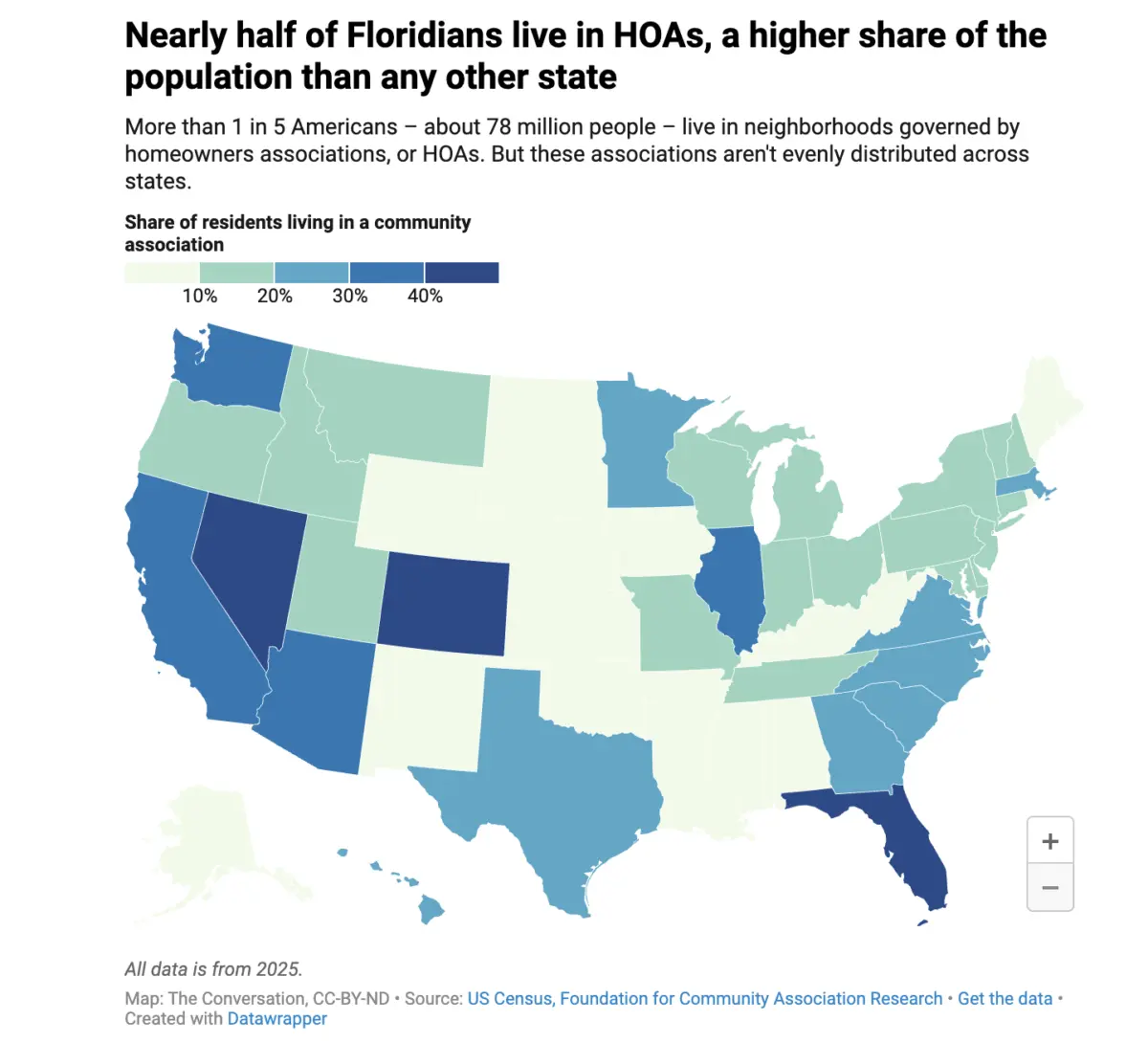
The stakes of this issue are particularly high in Florida. Nearly half of the state’s residents live in communities governed by HOAs, the highest proportion in the United States. For families like Coretta’s, moving is rarely a viable solution. Not only have surging housing prices made relocation financially prohibitive, but the ubiquity of HOAs means that any new home would likely come with a similar set of restrictive covenants. Nationally, 80% of new single-family homes in subdivisions and 60% of all new single-family homes are governed by HOAs, making them an inescapable feature of modern American homeownership.
The Reach of Rules and Regulations
HOAs function as a form of private government, overseen by an elected board of volunteer directors. While many homeowners associate these boards with aesthetic choices—ensuring that every mailbox looks the same or that lawns are mowed to a specific height—their legal authority extends far deeper. HOA boards act as policymakers with the power to pass and enforce community restrictions, levy fines, and issue sanctions.