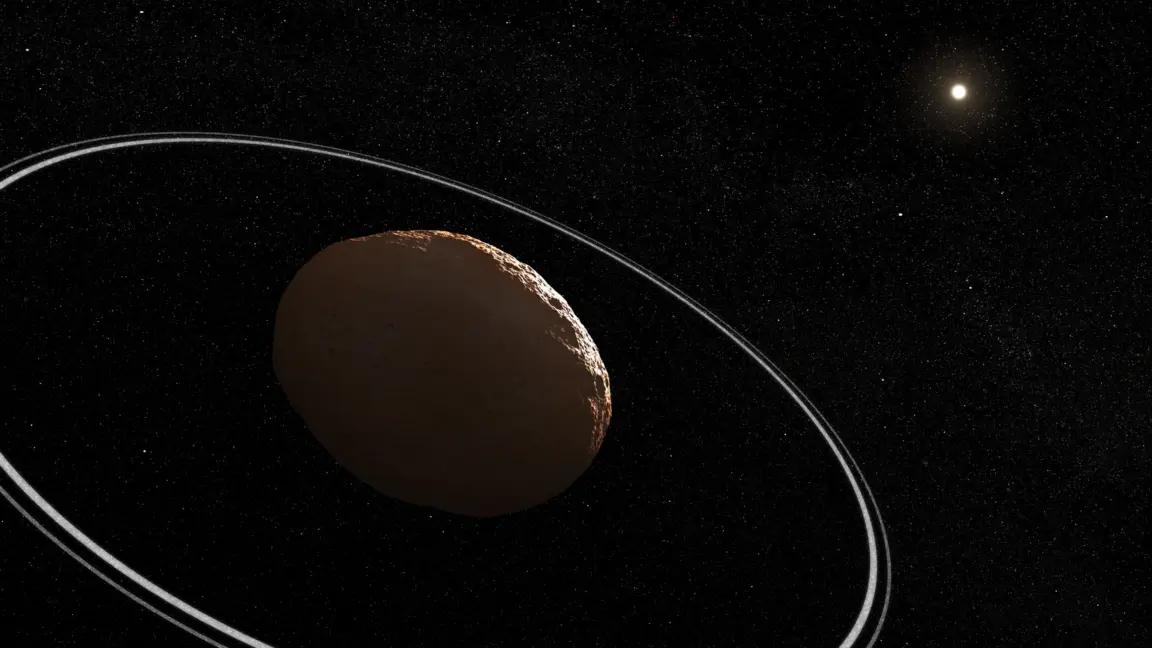

The Search for a Shepherd Moon
The primary hypothesis put forward by the research team involves a hidden actor: a small, undiscovered "shepherd" moon operating within Chariklo’s ring system.
In planetary dynamics, narrow rings with sharp, clean boundaries are difficult to maintain. Without an external gravitational mechanism, particle collisions and orbital shear cause ring material to spread out and disperse over short cosmic timescales. In Saturn’s system, small shepherd moons orbiting near or within the rings supply the necessary gravitational nudges to keep ring particles confined within tight lanes.
A similar shepherd moon orbiting near Chariklo could explain both the long-term confinement of its sharp-edged rings and the recent dramatic structural evolution. Such a moon could be actively shedding surface material through micro-meteorite impacts or thermal shedding, continuously injecting new debris into C1R’s orbit while simultaneously sculpting C2R.
"This satellite has not been detected yet, if it exists," Santos-Sanz cautioned.
Preliminary computer modeling based on the JWST dataset also offers initial clues regarding the physical composition of the particles making up each ring. Santos-Sanz emphasizes that this aspect of the analysis remains ongoing work, but initial trends are emerging.
"Our feeling after this model is that the inner ring should be composed of bigger particles than the outer ring. The outer ring we think is more dusty," he said. "But this is a work in progress. I can’t say with certainty, well, this is dusty, this is not."
To definitively settle the question of whether the observed transformations stem from physical ring evolution or subtle wavelength-dependent scattering effects, astronomers need cross-validation. The definitive test will require capturing another stellar occultation by Chariklo in visible light using ground-based instruments, allowing direct comparison with pre-2022 optical data.
"We are searching for new occultations," Santos-Sanz said, noting that predicting future events with high precision remains an ongoing priority for the team.
A Changing Paradigm for Small Planetary Rings
The discovery that Chariklo’s rings are dynamic, evolving structures marks an important milestone in modern planetary science. For decades after ring systems were discovered around Jupiter, Uranus, and Neptune in the late 20th century, astronomer models assumed that small bodies like Centaurs and asteroids lacked the gravitational hold required to retain ring material over meaningful spans of time.
That view began shifting in 2013 with Chariklo, and the list of ringed minor bodies has grown steadily since. Today, rings are known to exist around Chiron (another Centaur object sharing characteristics with both asteroids and comets), the dwarf planet Haumea in the Kuiper Belt, and the trans-Neptunian object Quaoar.
While giant-planet ring systems are well known to exhibit short-term dynamic shifts—Saturn’s faint inner D ring has shown measurable structural variations over recent decades, and the curved ring arcs of Neptune’s Adams ring regularly rearrange themselves—the JWST observations of Chariklo prove that rapid, large-scale evolution is equally characteristic of small-body systems.
Understanding the lifespan, particle dynamics, and evolutionary trajectories of minor-body rings provides scientists with a accessible laboratory for studying fundamental celestial mechanics. The processes governing how material collects, clumps, migrates, and dissipates around a 250-kilometer body reflect the same physical laws that governed the primordial protoplanetary disk from which the Solar System’s planets originally coalesced.
"I think this work is just a piece of the puzzle," Santos-Sanz said, "but it could be an important clue for broader studies about the rings around minor bodies and around giant planets."