
As low-Earth orbit grows increasingly crowded with commercial internet constellations, scientific platforms, and military assets, space has enough physical room to accommodate massive numbers of new satellites—provided that every entity operating in orbit is willing to transparently share precise location data and planned flight paths. That warning was delivered by a top executive representing both SpaceX and its artificial intelligence affiliate during a major industry gathering.
Speaking at the International Astronautical Congress in Antalya, Turkey, Michael Nicolls—vice president for Starlink at SpaceX and president of Elon Musk’s AI venture, xAI—issued a call for immediate, widespread improvements in orbital data-sharing among global satellite operators. Highlighting a series of troubling near-misses involving active spacecraft, Nicolls emphasized that unannounced maneuvers in orbit pose a growing hazard to space sustainability.
SpaceX’s Starlink network currently encompasses more than 11,000 active satellites, representing roughly two-thirds of all operational spacecraft in low-Earth orbit. Beyond these functional platforms, ground-based radars and optical tracking networks monitor thousands of fragments of orbital space debris.
While Starlink stands as the single largest satellite constellation ever deployed, industry projections indicate that low-Earth orbit is on the threshold of an even larger surge in launch traffic. SpaceX recently unveiled long-term concepts for a project called Starmind, an ambitious initiative aimed at placing up to one million satellites into low-Earth orbit to provide high-density artificial intelligence computing infrastructure directly from space. At the same time, major competitors are accelerating their own deployments. Amazon is actively scaling its own satellite broadband constellation, while two major state-backed Chinese megaconstellations are moving forward with full-scale orbital deployment.
Law of large numbers
The rapid expansion of commercial and national satellite fleets has rekindled long-standing concerns regarding the risk of high-velocity orbital collisions. A single catastrophic impact between two large objects in orbit could generate thousands of untracked fragments, creating the potential for a cascading chain reaction of debris generation that could render specific orbital shells hazardous for decades.
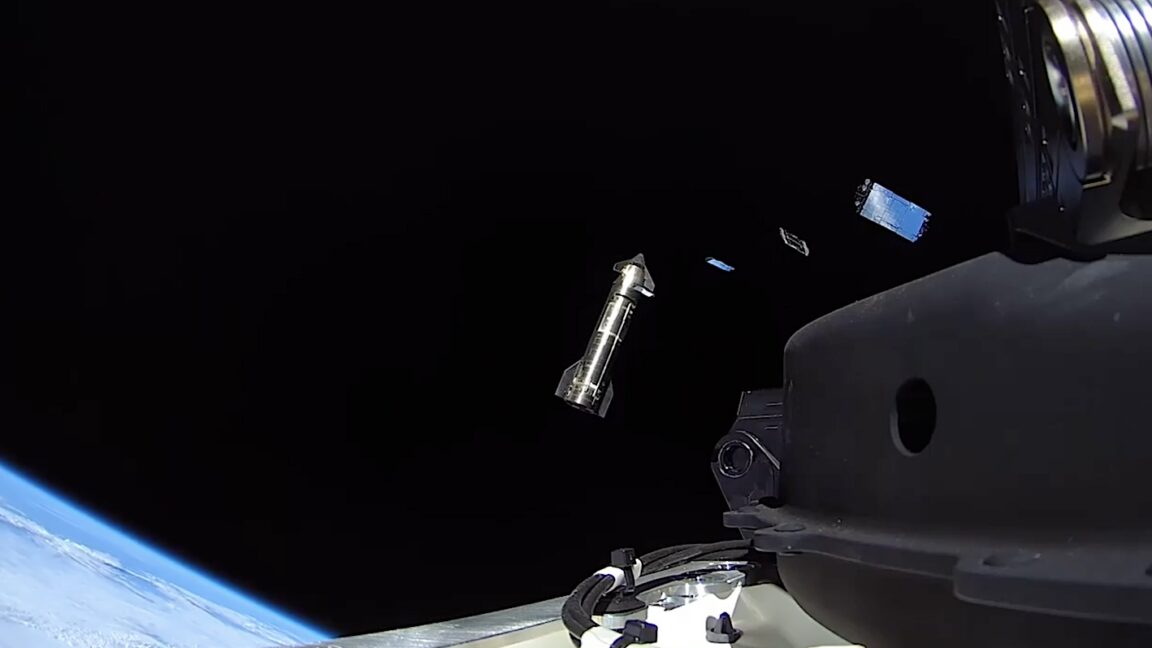
Engineers and orbital mechanics experts generally emphasize that the probability of a collision on any single day remains extremely low. Space is extraordinarily vast, and low-Earth orbit is nowhere near physical saturation. Furthermore, SpaceX and most other Western commercial operators intentionally design their missions to de-orbit spent rocket upper stages and end-of-life satellites quickly, using atmospheric reentry to minimize long-term space junk.
Nevertheless, as the sheer quantity of hardware in orbit grows, the statistical reality changes. "That said, the law of large numbers says that if it can happen, it will happen," Nicolls noted during his presentation.
Despite the growing volume of orbital traffic, space traffic management remains largely fragmented and decentralized. No universal international treaties or legally binding global regulations require satellite operators to broadcast their exact positions in real time, publish their planned maneuvers, or coordinate trajectory adjustments with other spacecraft operators. In the absence of a centralized regulatory authority, maintaining a safe operating environment depends heavily on voluntary coordination and established industry norms.
"Once you can track this debris, and if you can track it well, these are like obstacles on a road. If you can measure them, you can predict where they’re going to be, and you can avoid them," Nicolls said. "What you can’t avoid is other operators who maneuver without telling you where they’re going to go. We have many examples of this on Starlink, unfortunately."
Nicolls presented specific case studies illustrating active satellites from other operators approaching Starlink spacecraft at close range while traveling at orbital velocities of approximately 5 miles per second. These close approaches did not appear to stem from deliberate aggressive behavior, such as orbital reconnaissance or anti-satellite tests. Rather, they were the result of routine operational maneuvers conducted without advance notification to the broader space tracking community.