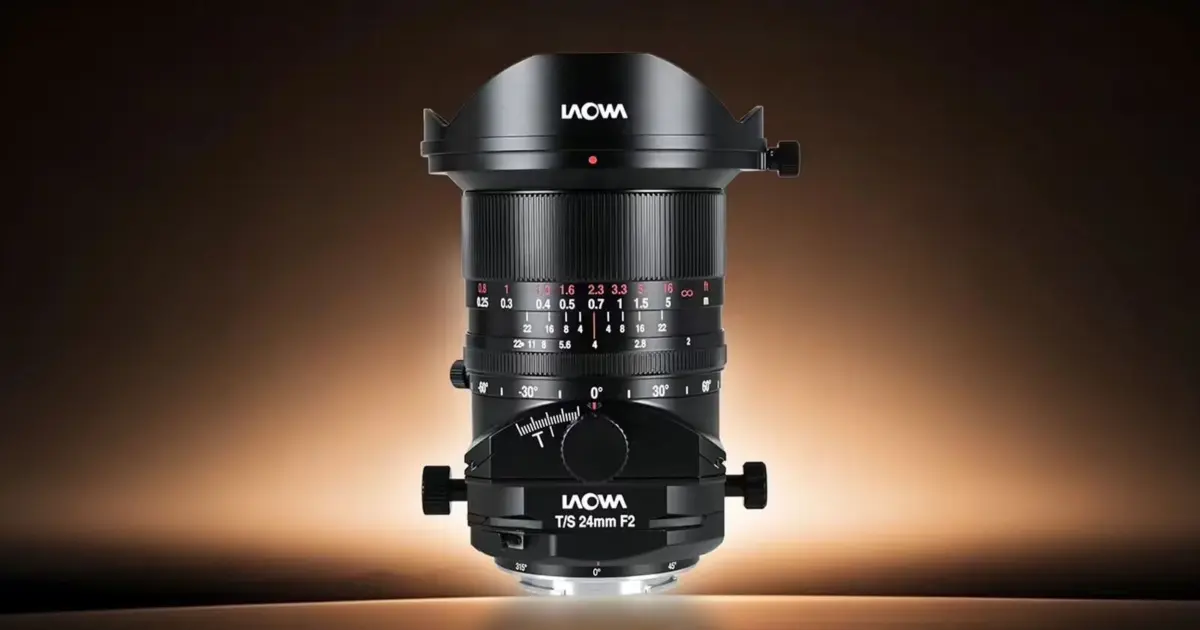
Venus Optics is preparing to expand its already impressive lineup of specialized optics with the upcoming release of a new tilt-shift lens that promises to break traditional aperture boundaries. While the manufacturer has not yet issued an official announcement for the North American or European markets, the Laowa T/S 24mm f/2 is rapidly approaching a global debut. The lens has already begun appearing in the Chinese market, signaling that a wider release is imminent for photographers who have been waiting for a modern, high-performance tilt-shift solution designed specifically for mirrorless systems.
The first signs of the lens’s arrival were documented by Canon Addict, which noted that the product has already been listed by various online retailers in China. For international buyers eager to get their hands on the hardware early, listings have surfaced on platforms such as AliExpress. However, these early listings often carry a significant premium over the expected retail price, a common occurrence when regional releases precede a global rollout. Despite the current gray-market pricing, the technical specifications of the lens suggest it will be a formidable competitor in a niche that has long been dominated by aging DSLR-era designs.
The resurgence of interest in tilt-shift photography can be attributed in large part to the persistent innovation of Venus Optics under its Laowa brand. For years, tilt-shift lenses were considered highly specialized tools reserved for architectural and product photographers, often coming with high price tags and limited availability. Laowa has worked to democratize these tools, but the 24mm f/2 T/S represents a significant leap forward in terms of raw specifications. Most notably, the f/2 maximum aperture is remarkably fast for a lens of this type. To put this into perspective, the industry standards for this focal length have historically been much slower. Nikon’s venerable PC-E Nikkor 24mm f/3.5 and Canon’s EF 24mm f/3.5L II were the benchmarks for decades, but both are limited by an f/3.5 aperture.
An f/2 aperture is more than a full stop faster than the f/3.5 offerings from the major camera manufacturers. This increase in light-gathering capability is not merely a marginal improvement; it fundamentally changes how a tilt-shift lens can be utilized in the field. Beyond the traditional uses of perspective correction in architecture, the wider aperture opens the door to creative depth-of-field effects that were previously difficult to achieve at 24mm. Perhaps most exciting for many photographers is the potential for astrophotography. Typically, tilt-shift lenses are too slow for capturing the night sky effectively, but an f/2 maximum aperture allows for shorter shutter speeds and lower ISO settings, making it a viable tool for "shift-stitched" panoramic starscapes or corrected foregrounds in milky way photography.