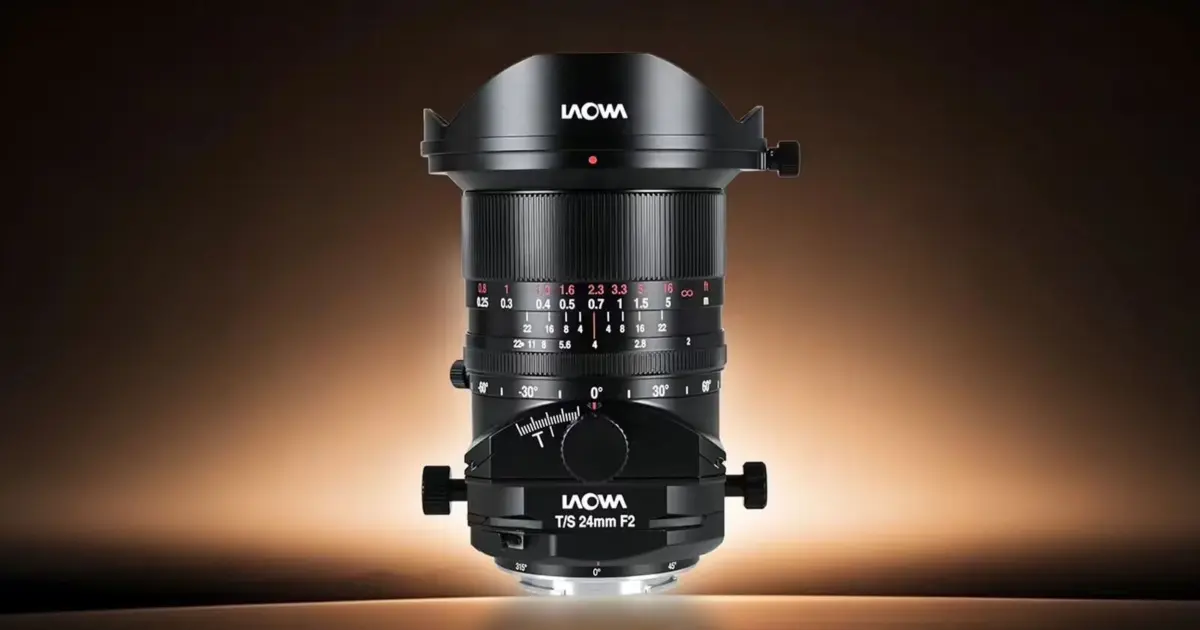
Venus Optics is preparing to expand its already impressive lineup of specialized optics with the upcoming release of a new tilt-shift lens that promises to break traditional aperture boundaries. While the manufacturer has not yet issued an official announcement for the North American or European markets, the Laowa T/S 24mm f/2 is rapidly approaching a global debut. The lens has already begun appearing in the Chinese market, signaling that a wider release is imminent for photographers who have been waiting for a modern, high-performance tilt-shift solution designed specifically for mirrorless systems.
The first signs of the lens’s arrival were documented by Canon Addict, which noted that the product has already been listed by various online retailers in China. For international buyers eager to get their hands on the hardware early, listings have surfaced on platforms such as AliExpress. However, these early listings often carry a significant premium over the expected retail price, a common occurrence when regional releases precede a global rollout. Despite the current gray-market pricing, the technical specifications of the lens suggest it will be a formidable competitor in a niche that has long been dominated by aging DSLR-era designs.
The resurgence of interest in tilt-shift photography can be attributed in large part to the persistent innovation of Venus Optics under its Laowa brand. For years, tilt-shift lenses were considered highly specialized tools reserved for architectural and product photographers, often coming with high price tags and limited availability. Laowa has worked to democratize these tools, but the 24mm f/2 T/S represents a significant leap forward in terms of raw specifications. Most notably, the f/2 maximum aperture is remarkably fast for a lens of this type. To put this into perspective, the industry standards for this focal length have historically been much slower. Nikon’s venerable PC-E Nikkor 24mm f/3.5 and Canon’s EF 24mm f/3.5L II were the benchmarks for decades, but both are limited by an f/3.5 aperture.
An f/2 aperture is more than a full stop faster than the f/3.5 offerings from the major camera manufacturers. This increase in light-gathering capability is not merely a marginal improvement; it fundamentally changes how a tilt-shift lens can be utilized in the field. Beyond the traditional uses of perspective correction in architecture, the wider aperture opens the door to creative depth-of-field effects that were previously difficult to achieve at 24mm. Perhaps most exciting for many photographers is the potential for astrophotography. Typically, tilt-shift lenses are too slow for capturing the night sky effectively, but an f/2 maximum aperture allows for shorter shutter speeds and lower ISO settings, making it a viable tool for "shift-stitched" panoramic starscapes or corrected foregrounds in milky way photography.
The compatibility of the new Laowa 24mm f/2 T/S is equally ambitious. Venus Optics intends to bring this lens to a wide array of mounts, covering nearly every major modern system. This includes the "big four" full-frame mirrorless mounts: Sony E, Nikon Z, Canon RF, and the L-Mount alliance. Furthermore, the lens is designed to accommodate the larger sensors of medium-format systems, specifically the Fujifilm GFX and Hasselblad XCD mounts. This is a crucial detail, as wide-angle tilt-shift lenses often struggle to provide enough coverage for medium-format sensors without severely limiting the range of movement. While some of Laowa’s previous tilt-shift efforts required a trade-off in movement when mounted on a GFX body, early reports suggest that the 24mm f/2 maintains its full functionality across these larger formats, providing a massive image circle that should satisfy even the most demanding architectural photographers.
Under the hood, the optical construction of the Laowa 24mm f/2 T/S is complex, reflecting the challenges of designing a fast lens that must also maintain a massive image circle for shifting. The lens features 13 elements arranged in 10 groups. To ensure high image quality and minimize the aberrations that often plague wide-angle lenses, Venus Optics has incorporated a variety of specialized glass elements. The design includes five Extra-low Dispersion (ED) elements to combat chromatic aberration and ensure color accuracy. Additionally, two aspherical elements are used to reduce spherical aberrations and distortion, while four high-refractive-index glass elements help keep the lens relatively compact while maintaining sharpness across the frame.
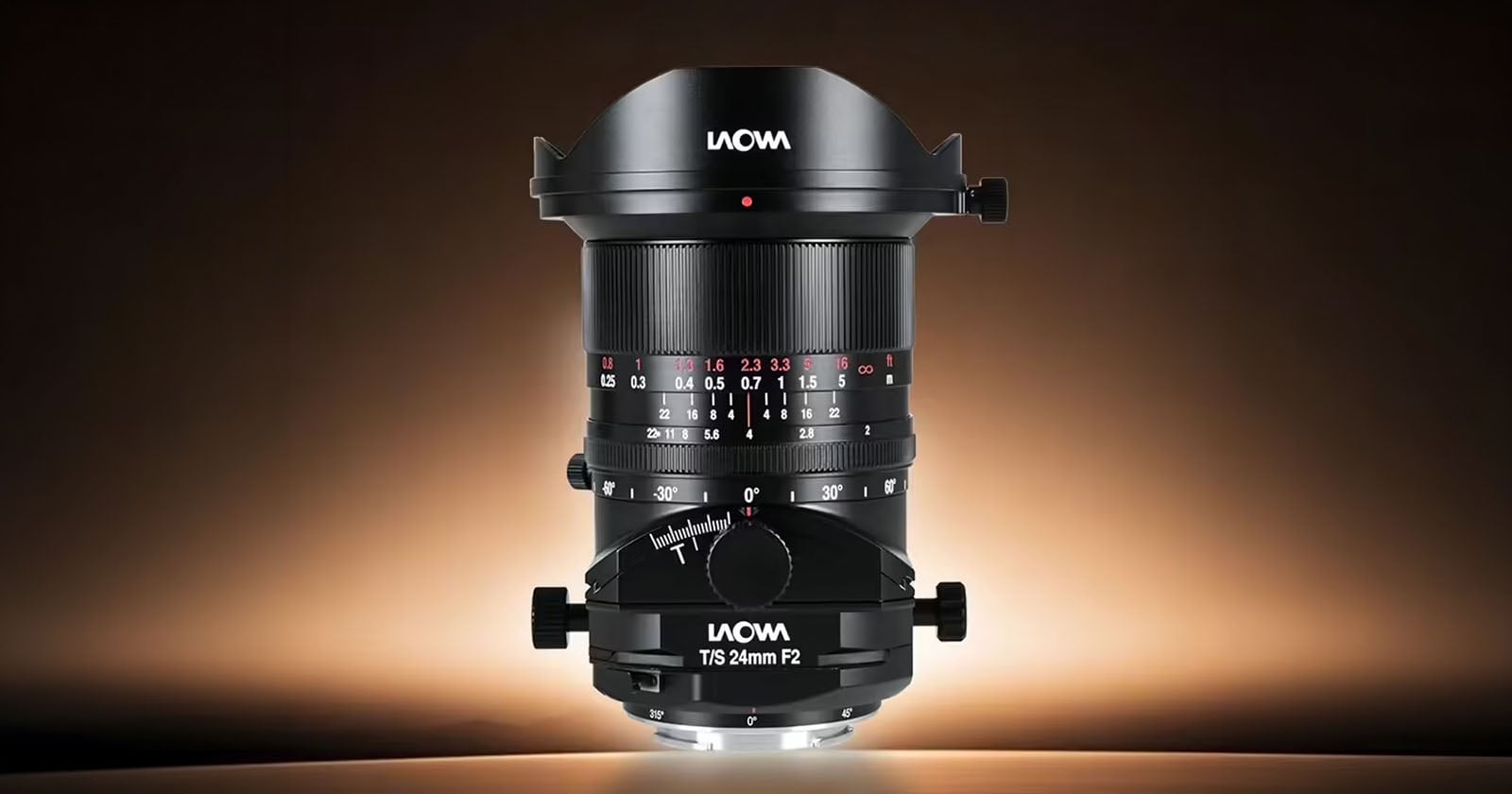
Aperture rendering is also a point of focus for this new model. The lens utilizes a 14-bladed aperture diaphragm, which is designed to produce smooth, circular bokeh and pleasing out-of-focus highlights. This is particularly relevant given the f/2 aperture, as photographers using the "tilt" function to create a thin slice of focus will want the surrounding blurred areas to appear as natural as possible. For those who prefer a "sunstar" effect in their architectural or landscape work, the high blade count will likely produce a distinct star pattern when stopped down.
Physically, the lens is a substantial piece of equipment, weighing in at 860 grams (approximately 30.3 ounces). This weight is a testament to the amount of glass required to achieve an f/2 aperture while maintaining a large enough image circle for shift movements. Despite its heft, the lens remains practical for field use, featuring a standard 77mm front filter thread. This allows photographers to use common circular polarizers and neutral density filters without the need for bulky, expensive adapter systems that are often required for ultra-wide lenses with bulbous front elements.
The mechanical capabilities of the Laowa 24mm f/2 T/S are in line with professional expectations. It offers a shift range of +/- 12mm and a tilt range of +/- 10mm. These movements allow photographers to correct converging vertical lines in architectural shots or to manipulate the plane of focus to either keep an entire subject sharp at an oblique angle or to create the popular "miniature" effect. To further enhance usability, the lens features a rotating mount mechanism. This allows the user to change the orientation of the tilt and shift movements independently and to switch between landscape and portrait shooting modes quickly. This is a vital feature for tripod-based work, as it eliminates the need to readjust the tripod head when changing the composition.
Pricing remains one of the most compelling aspects of the Laowa brand. Reports from the Chinese market indicate an official price of RMB 7,650, which translates to approximately $1,140 at current exchange rates. If this pricing holds true for the global market, it would place the 24mm f/2 in a very competitive position. For comparison, the Laowa 17mm f/4 Zero-D Tilt-Shift currently retails for around $1,249 in the United States. While the final U.S. price may be adjusted to account for shipping, import duties, and local taxes, it is likely to remain significantly more affordable than the specialized tilt-shift lenses offered by first-party manufacturers, many of which retail for well over $2,000 and require adapters to work on mirrorless bodies.
The arrival of the Laowa 24mm f/2 T/S highlights a shift in the industry where third-party manufacturers are no longer just providing budget alternatives, but are instead leading the way in technical innovation. While Canon and Nikon have focused heavily on their standard zoom and prime lens lineups for their respective mirrorless systems, they have yet to release native, dedicated tilt-shift lenses for the RF and Z mounts. This has left a vacuum in the market that Venus Optics is more than happy to fill. By offering a lens that is not only native to mirrorless mounts but also faster and more versatile than the DSLR predecessors, Laowa is positioning itself as the primary choice for professional architectural and creative photographers.
As the photography community waits for the official global announcement, the anticipation continues to build. The combination of a wide 24mm focal length, a fast f/2 aperture, and comprehensive tilt-shift movements makes this lens a unique tool in the current marketplace. For mirrorless users who have been making do with adapted DSLR lenses or software-based perspective corrections, the Laowa 24mm f/2 T/S represents a significant upgrade in both optical quality and creative potential. When it finally hits the international shelves, it is poised to become a staple in the bags of photographers who require precision, speed, and flexibility in their wide-angle work.