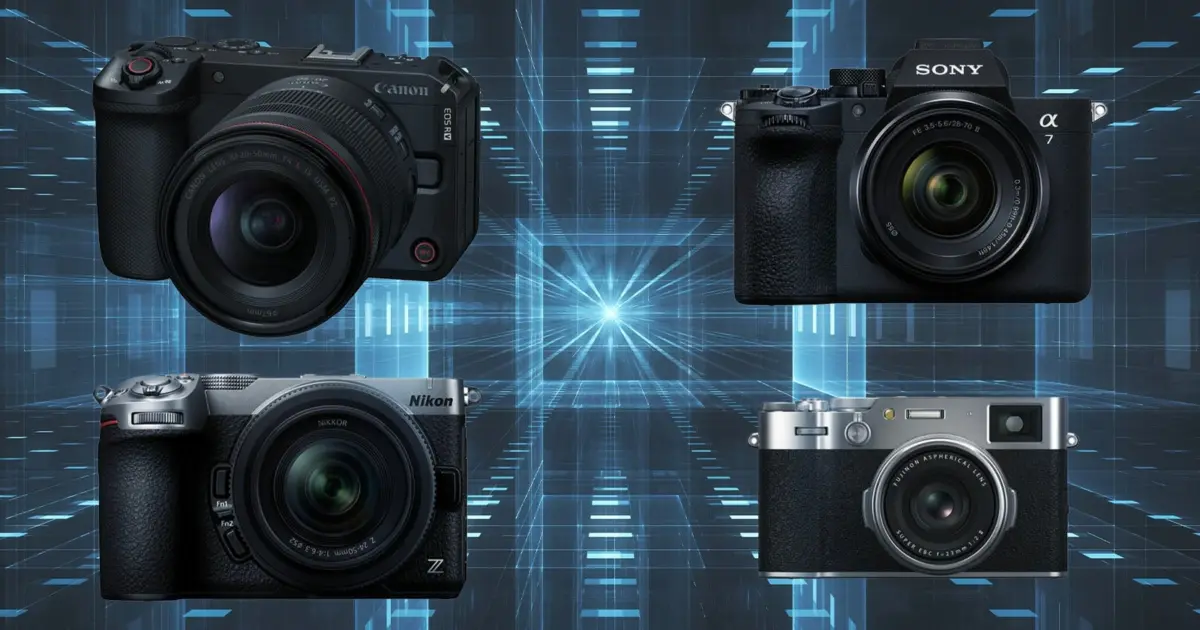
In a rapidly evolving technological landscape where artificial intelligence and smartphone ubiquity have fundamentally altered the way images are captured and consumed, the world’s leading camera manufacturers are charting distinct and often contrasting paths forward. A series of recent interviews conducted by the Japanese publication Nikkei has provided a rare, high-level glimpse into the strategic thinking of the industry’s four dominant players: Canon, Nikon, Sony, and Fujifilm. The conversations, featuring key executives Go Tokura of Canon, Hiroyuki Ikegami of Nikon, Kenji Tanaka of Sony, and Koji Matsumoto of Fujifilm, reveal an industry that is no longer moving in a single direction. Instead, each brand is leaning into a unique philosophy, ranging from the pursuit of "Spatial AI" and digital twins to a renewed focus on the tactile, analog-inspired joy of the shooting experience.
For decades, the competition between these companies was defined largely by a "spec war"—a race to produce the highest megapixel counts, the fastest burst rates, and the most robust autofocus systems. While performance remains a baseline requirement, the Nikkei interviews suggest that the industry has reached a point of maturation where raw power is no longer the sole differentiator. As the market stabilizes following years of contraction due to the rise of the smartphone, these manufacturers are now looking toward specialized niches, the shifting demographics of "creators," and the integration of advanced software to define their next decade of growth.
Canon, the long-standing market leader, is currently observing a significant shift in who is buying cameras and why. Go Tokura, the head of Canon’s Image Communication Business Operations, pointed out that the current resurgence in compact digital cameras is being driven not by veteran professionals, but by a younger generation. This demographic, often referred to as Gen Z, is gravitating toward dedicated cameras for reasons that defy traditional marketing logic. According to Tokura, these users aren’t necessarily seeking the highest technical image quality; rather, they are drawn to the experience of using a dedicated device.
Tokura noted that the "minor inconveniences" of a standalone camera—the physical act of carrying it, the deliberate nature of its controls, and the separation from the distractions of a smartphone—are actually part of the appeal. This has prompted Canon to rethink its product lineup. While the company has historically structured its offerings based on price and performance tiers, it is now attempting to "weave in elements of style and feel." This shift suggests that the aesthetic of the camera itself and the tactile feedback it provides are becoming as important as the sensor inside.
Furthermore, Canon is doubling down on its commitment to video. The company’s "V Series" of video-oriented cameras is slated for expansion, driven by the explosive growth of vlogging and social media content creation. Tokura emphasized that this expansion must be supported by a lens ecosystem that is truly hybrid. The goal is to develop lenses that can transition seamlessly between high-end video production and traditional still photography without compromising on the specific requirements of either medium. For Canon, the future is a blend of lifestyle-oriented design and a robust, video-first technical foundation.