The trajectory of the 30-year fixed-rate mortgage has served as a relentless metronome for the housing industry over the past several months, setting a rhythm that few executives find comfortable. When a recent series of industry analyses began in late August, the rate sat at 6.66%. By the time mortgage professionals gathered in Dallas for the HousingWire Mortgage Banking Summit, that figure had climbed to 7.03%. On the very morning leaders took the stage to discuss the future of the American dream, Freddie Mac printed a weekly average of 7.28%—the highest level seen in nearly three years.
This "rate clock" has become the organizing principle for an industry in transition. As the summit concluded, the central question facing every attendee was no longer when rates would fall, but whether their organizations were structured to survive a reality where they might not. The sentiment in the room was captured through a live survey of executives on October 1, providing a real-time verdict on the state of mortgage banking. The results of that survey suggest an industry moving past hope and toward a gritty, tech-driven pragmatism. The verdict carries more urgency than any forecast, signaling a fundamental shift in how mortgage companies will be managed through 2027 and beyond.
No one is waiting for the Fed
For years, the mortgage industry has operated on the assumption that relief is just one Federal Reserve meeting away. That era of optimism appears to have ended. The survey conducted in Dallas suggests that mortgage executives are now drafting their 2027 budgets with the expectation that high rates are a structural, rather than cyclical, fixture of the market.
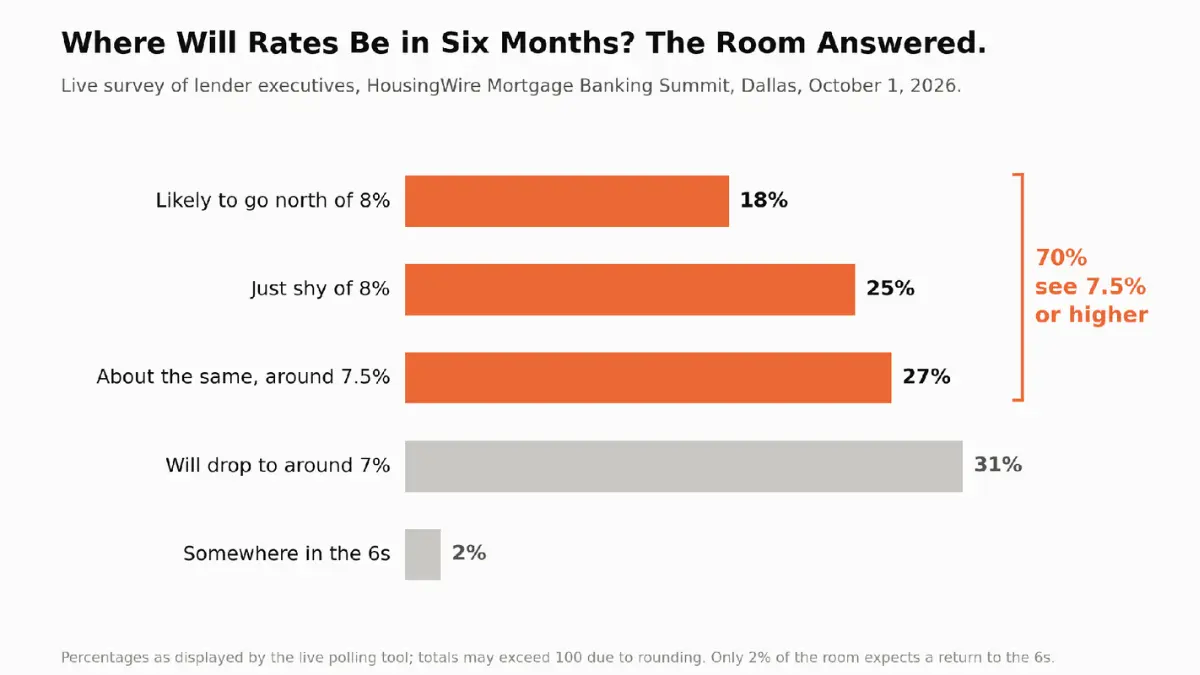
When asked where they believe rates will stand six months from now, the responses were tellingly somber. Approximately 27% of the executives in the room expect rates to remain near their current levels of 7.5%. Another 25% believe rates will climb further, settling just shy of the 8% mark, while 18% project that rates will break north of 8%. Combined, these figures reveal that seven in ten mortgage executives in the United States expect rates to remain at 7.5% or higher well into 2027. Only 31% anticipate a move toward 7%, and a mere 2%—essentially a rounding error—expect a return to the 6% range.
These internal industry expectations align closely with broader economic forecasts. The Mortgage Bankers Association (MBA) currently projects roughly $2.12 trillion in originations for 2026, followed by a slight dip to $2.10 trillion for 2027. While these dollar amounts may seem substantial, they represent a flat market consisting of approximately 5.5 million loans per year. To put that in perspective, this unit volume is lower than what the industry produced in 2009, during the deepest troughs of the Great Financial Crisis.
The headwinds are multi-faceted. Single-family housing permits are currently running 25% below the levels seen in the late 1990s, and homebuilder sentiment has turned increasingly negative looking toward 2027. Today, between 80% and 90% of new-home sales require expensive rate buydowns just to reach the closing table. The strategic picture is unambiguous: there is no wave of rate relief on the horizon, and there is no hidden reserve of volume waiting to be unlocked. Mortgage companies cannot rely on a surge of new loans to dilute their fixed costs. Whatever it costs a company to originate a loan today is the cost they will likely carry into 2027, unless they take radical steps to remove that cost themselves.
2027–2028, the real truth confronting IMBs: LOs are migrating
To understand the severity of the current market, one must look back a full generation. The last time the 30-year fixed-rate mortgage averaged between 7.5% and 8% for a full year was 1997. However, the industry that existed then was fundamentally different from the one operating today. In 1997, the mortgage industry originated roughly $860 billion. Because the average loan balance was approximately $115,000, those dollars represented 7.5 million closed loans.
Fast forward to the 2026 forecast: the industry expects to originate $2.1 trillion—two and a half times the dollar volume of 1997—yet it will close only 5.5 million loans. When adjusted for the growth of the country, the contraction is even more startling. The United States has 33% more households today than it did in 1997. Consequently, the transaction rate has plummeted from 74 closings per 1,000 households in 1997 to roughly 41 today. We are facing the same price of money, but with nearly half the market activity on a per-household basis.