
Furthermore, the "refinance valve" that historically saved the industry during purchase-market slumps has been welded shut. In the 1990s, most outstanding mortgages carried coupons from the 8% to 10% era. Any slight dip in rates triggered a refinance wave. Today, roughly seven in ten outstanding mortgages carry rates below 5%. This confines the pool of potential refinances to a very narrow slice of loans originated between 2023 and 2026.
Even within that narrow pool, traditional retail lenders face a new threat: AI-powered digital lenders and servicers. These tech-forward entities sit on the servicing data and see credit inquiries or payoff requests in real-time. They are increasingly able to "recapture" the borrower before a traditional loan officer even realizes an opportunity exists. In a market with fewer transactions and no refinance relief, consolidation is not just a possibility; it is a mathematical certainty.
Loan officers (LOs) are already reacting to this arithmetic, often moving faster than their employers. Over the past nine months, a significant migration has occurred. Loan officers moving their NMLS registrations have made the broker and wholesale channel the only segment of the industry with net positive production growth, gaining more than $8 billion. Meanwhile, independent mortgage banks (IMBs) lost nearly $2 billion in production to this migration, and traditional banks lost more than $5 billion.
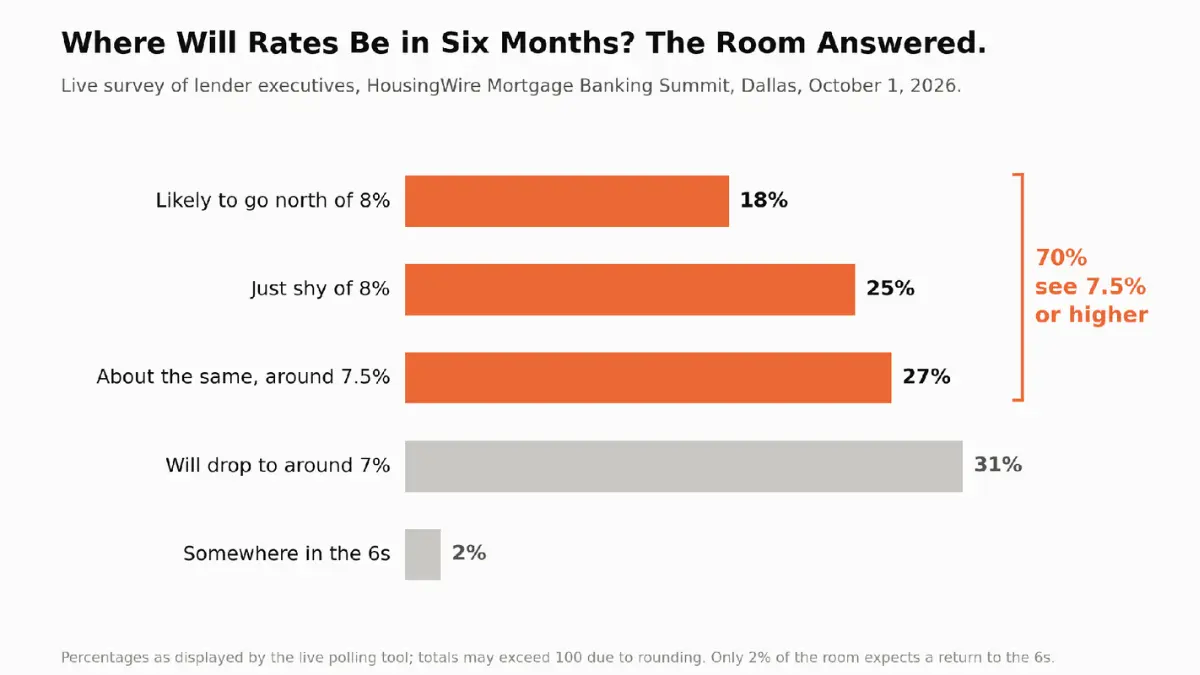
This is not a simple case of LOs chasing a slightly better rate sheet. It is a fundamental shift away from the traditional employment model. Originators are moving toward non-delegated and broker platforms where massive wholesalers provide a high-tech "manufacturing floor" that smaller, individual companies simply cannot afford to build. Despite this, only 8% of executives at the summit named brokers as a competitive worry. Forty percent were more concerned with consumer-direct digital platforms. This suggests many leaders are watching the "front door" for digital disruptors while their actual production inventory is quietly leaving through the "warehouse" of the wholesale channel.
Seventy-eight percent agree. Zero percent will touch the biggest line.
The survey revealed a striking contradiction in how mortgage executives plan to handle their cost structures. When asked about their organizational plans, 78% of the executives—the most lopsided result of the summit—said they intended to reduce operating costs to offer more competitive pricing. When asked how they would defend their market share, 45% cited cost reduction, 30% pointed to partnerships with Realtors and builders, and 21% mentioned broadening their product mix. Only 4% said they would consider paying loan officers more.
However, the other side of the ledger tells a different story. Exactly zero percent of the executives said they were willing to pay loan officers less. This creates a massive strategic bottleneck. Compensation currently accounts for 62% to 65% of the direct production cost of a loan, yet it is viewed as politically untouchable. If the largest cost line cannot be moved, and 78% of the industry is committed to lowering overall costs, only one lever remains: everything below the loan officer.
This includes fulfillment, production support, and general corporate overhead. This is precisely where Artificial Intelligence is beginning to perform substantive work. AI is no longer a futuristic concept in mortgage banking; it is currently being used to read files, clear conditions, balance disclosures, and conduct quality control reviews across entire loan populations.
Modeling suggests that if the gains already seen in production are extended across an entire company, the cost per closed loan could drop from the current average of roughly $11,900 toward $8,000. This would require cutting the operating stack below the loan officer by more than half. The 78% of executives who want to lower costs have essentially issued a mandate for their operations teams. However, a mandate is not a strategy. The winners of the next two years will be those who bridge the gap between the intention to lower costs and the actual execution of a lower-cost operating model.