The trajectory of the 30-year fixed-rate mortgage has served as a relentless metronome for the housing industry over the past several months, setting a rhythm that few executives find comfortable. When a recent series of industry analyses began in late August, the rate sat at 6.66%. By the time mortgage professionals gathered in Dallas for the HousingWire Mortgage Banking Summit, that figure had climbed to 7.03%. On the very morning leaders took the stage to discuss the future of the American dream, Freddie Mac printed a weekly average of 7.28%—the highest level seen in nearly three years.
This "rate clock" has become the organizing principle for an industry in transition. As the summit concluded, the central question facing every attendee was no longer when rates would fall, but whether their organizations were structured to survive a reality where they might not. The sentiment in the room was captured through a live survey of executives on October 1, providing a real-time verdict on the state of mortgage banking. The results of that survey suggest an industry moving past hope and toward a gritty, tech-driven pragmatism. The verdict carries more urgency than any forecast, signaling a fundamental shift in how mortgage companies will be managed through 2027 and beyond.
No one is waiting for the Fed
For years, the mortgage industry has operated on the assumption that relief is just one Federal Reserve meeting away. That era of optimism appears to have ended. The survey conducted in Dallas suggests that mortgage executives are now drafting their 2027 budgets with the expectation that high rates are a structural, rather than cyclical, fixture of the market.
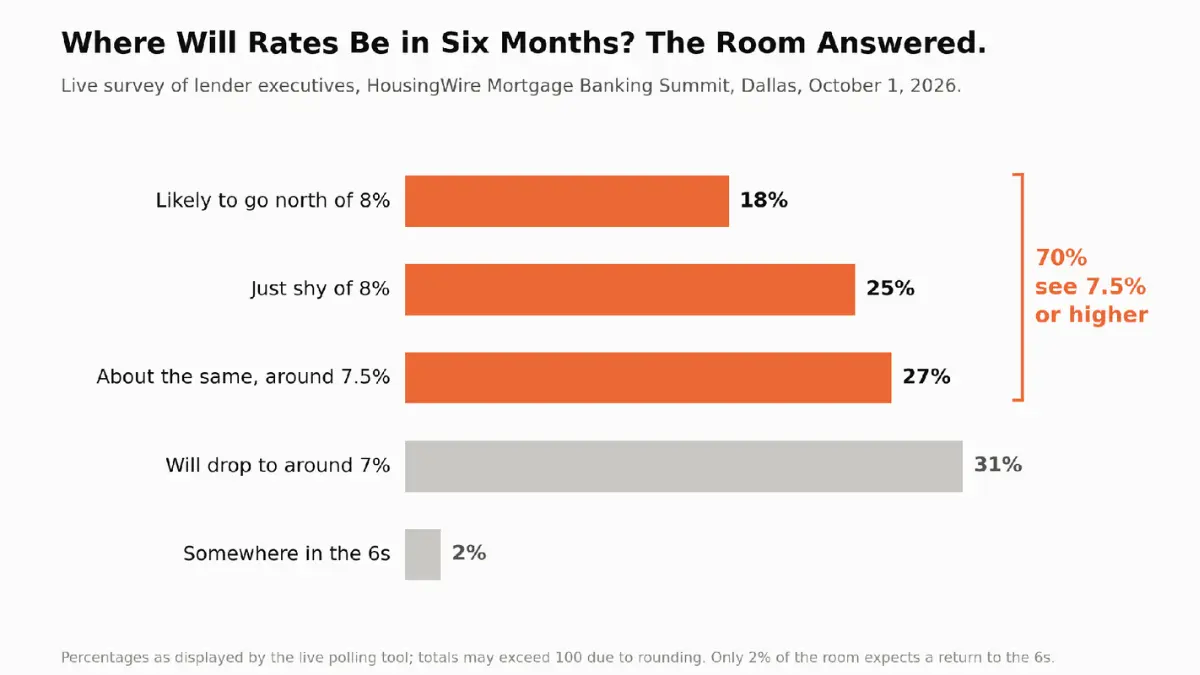
When asked where they believe rates will stand six months from now, the responses were tellingly somber. Approximately 27% of the executives in the room expect rates to remain near their current levels of 7.5%. Another 25% believe rates will climb further, settling just shy of the 8% mark, while 18% project that rates will break north of 8%. Combined, these figures reveal that seven in ten mortgage executives in the United States expect rates to remain at 7.5% or higher well into 2027. Only 31% anticipate a move toward 7%, and a mere 2%—essentially a rounding error—expect a return to the 6% range.
These internal industry expectations align closely with broader economic forecasts. The Mortgage Bankers Association (MBA) currently projects roughly $2.12 trillion in originations for 2026, followed by a slight dip to $2.10 trillion for 2027. While these dollar amounts may seem substantial, they represent a flat market consisting of approximately 5.5 million loans per year. To put that in perspective, this unit volume is lower than what the industry produced in 2009, during the deepest troughs of the Great Financial Crisis.
The headwinds are multi-faceted. Single-family housing permits are currently running 25% below the levels seen in the late 1990s, and homebuilder sentiment has turned increasingly negative looking toward 2027. Today, between 80% and 90% of new-home sales require expensive rate buydowns just to reach the closing table. The strategic picture is unambiguous: there is no wave of rate relief on the horizon, and there is no hidden reserve of volume waiting to be unlocked. Mortgage companies cannot rely on a surge of new loans to dilute their fixed costs. Whatever it costs a company to originate a loan today is the cost they will likely carry into 2027, unless they take radical steps to remove that cost themselves.
2027–2028, the real truth confronting IMBs: LOs are migrating
To understand the severity of the current market, one must look back a full generation. The last time the 30-year fixed-rate mortgage averaged between 7.5% and 8% for a full year was 1997. However, the industry that existed then was fundamentally different from the one operating today. In 1997, the mortgage industry originated roughly $860 billion. Because the average loan balance was approximately $115,000, those dollars represented 7.5 million closed loans.
Fast forward to the 2026 forecast: the industry expects to originate $2.1 trillion—two and a half times the dollar volume of 1997—yet it will close only 5.5 million loans. When adjusted for the growth of the country, the contraction is even more startling. The United States has 33% more households today than it did in 1997. Consequently, the transaction rate has plummeted from 74 closings per 1,000 households in 1997 to roughly 41 today. We are facing the same price of money, but with nearly half the market activity on a per-household basis.

Furthermore, the "refinance valve" that historically saved the industry during purchase-market slumps has been welded shut. In the 1990s, most outstanding mortgages carried coupons from the 8% to 10% era. Any slight dip in rates triggered a refinance wave. Today, roughly seven in ten outstanding mortgages carry rates below 5%. This confines the pool of potential refinances to a very narrow slice of loans originated between 2023 and 2026.
Even within that narrow pool, traditional retail lenders face a new threat: AI-powered digital lenders and servicers. These tech-forward entities sit on the servicing data and see credit inquiries or payoff requests in real-time. They are increasingly able to "recapture" the borrower before a traditional loan officer even realizes an opportunity exists. In a market with fewer transactions and no refinance relief, consolidation is not just a possibility; it is a mathematical certainty.
Loan officers (LOs) are already reacting to this arithmetic, often moving faster than their employers. Over the past nine months, a significant migration has occurred. Loan officers moving their NMLS registrations have made the broker and wholesale channel the only segment of the industry with net positive production growth, gaining more than $8 billion. Meanwhile, independent mortgage banks (IMBs) lost nearly $2 billion in production to this migration, and traditional banks lost more than $5 billion.
This is not a simple case of LOs chasing a slightly better rate sheet. It is a fundamental shift away from the traditional employment model. Originators are moving toward non-delegated and broker platforms where massive wholesalers provide a high-tech "manufacturing floor" that smaller, individual companies simply cannot afford to build. Despite this, only 8% of executives at the summit named brokers as a competitive worry. Forty percent were more concerned with consumer-direct digital platforms. This suggests many leaders are watching the "front door" for digital disruptors while their actual production inventory is quietly leaving through the "warehouse" of the wholesale channel.
Seventy-eight percent agree. Zero percent will touch the biggest line.
The survey revealed a striking contradiction in how mortgage executives plan to handle their cost structures. When asked about their organizational plans, 78% of the executives—the most lopsided result of the summit—said they intended to reduce operating costs to offer more competitive pricing. When asked how they would defend their market share, 45% cited cost reduction, 30% pointed to partnerships with Realtors and builders, and 21% mentioned broadening their product mix. Only 4% said they would consider paying loan officers more.
However, the other side of the ledger tells a different story. Exactly zero percent of the executives said they were willing to pay loan officers less. This creates a massive strategic bottleneck. Compensation currently accounts for 62% to 65% of the direct production cost of a loan, yet it is viewed as politically untouchable. If the largest cost line cannot be moved, and 78% of the industry is committed to lowering overall costs, only one lever remains: everything below the loan officer.
This includes fulfillment, production support, and general corporate overhead. This is precisely where Artificial Intelligence is beginning to perform substantive work. AI is no longer a futuristic concept in mortgage banking; it is currently being used to read files, clear conditions, balance disclosures, and conduct quality control reviews across entire loan populations.
Modeling suggests that if the gains already seen in production are extended across an entire company, the cost per closed loan could drop from the current average of roughly $11,900 toward $8,000. This would require cutting the operating stack below the loan officer by more than half. The 78% of executives who want to lower costs have essentially issued a mandate for their operations teams. However, a mandate is not a strategy. The winners of the next two years will be those who bridge the gap between the intention to lower costs and the actual execution of a lower-cost operating model.
The four tests of strategic optionality
To navigate this environment, mortgage companies must pass four critical tests of their business model. These tests determine whether a company has "strategic optionality"—the ability to make attractive choices before they are forced by necessity.

- Scale: Size alone is no longer a safeguard. A cost gap of roughly $6,350 per loan separates the top-performing lenders from those in the bottom quintile. If a company’s next billion dollars in production does not demonstrably lower the unit cost of each loan, the company is merely getting larger, not stronger.
- The Customer: A database is not the same as a franchise. In an era of strict privacy laws and the Homebuyers Privacy Protection Act, only permissioned, durable relationships create true value. Companies must move beyond lists of names to create actual affinity and recapture value.
- Defensibility: Relying on "great people" and "local service" is admirable but insufficient as a competitive moat. A true moat must be a deliberately selected and fully funded capability, whether that is a low-cost manufacturing advantage, a specific product niche, or superior servicing recapture.
- Technology: Software licenses are merely an expense until they change the economic model. True technology value is measured by operating leverage—the ability to handle more volume without a proportional increase in headcount.
A lender that passes these tests has the freedom to grow, acquire other firms, raise capital, or remain independent. A lender that fails them may still have choices, but those choices are unlikely to be favorable.
Two doors: Dramatic cost reduction or strategic combination
As the industry looks toward a 2027 market characterized by flat volume and rates that could touch 8%, lenders are standing before two credible doors. Standing still is not an option.
The first door is dramatic cost reduction. This is not the standard "right-sizing" that occurs after volume misses a forecast; that is simply reactive arithmetic. Instead, this involves rebuilding the entire operating model around "straight-through processing" and "exception-based staffing." The goal is to use tools that attack the cost stack from both the sales and operational sides.
On the sales side, outbound voice AI platforms are beginning to automate the early stages of client acquisition and prequalification, lowering the cost of marketing—a category that traditional headcount cuts rarely touch. On the operational side, platforms are creating efficiencies that allow processors and loan officer assistants to handle higher throughput with higher quality. Digital closing and eNote infrastructures are also being used to deliver cleaner loans, which in turn earns better pricing from investors. Together, these tools can offer savings of 50 to 70 basis points per loan—roughly $1,900 to $2,700 on an average loan balance.
The second door is a strategic combination. If a company’s balance sheet or management bandwidth cannot fund the technological overhaul required for the first door, the most prudent move is to join forces with a lender that already possesses scale and a larger balance sheet. This should be done while the company still commands a premium, rather than waiting for the market to dictate terms.
With a $6,350 gap between the most and least efficient operators, the industry is primed for the strong to absorb the weak. While only 4% of executives at the summit said they plan to sell, the market will likely force the hand of many others. The difference between a merger from a position of strength in 2026 and a merger out of necessity in 2027 is the difference between choosing a partner and being chosen by one.
The executives in Dallas made it clear that they understand the gravity of the situation. There is no rescue coming from the Federal Reserve, and there is no hidden volume in the wings. The decisions made in the next two quarters will determine which companies enter 2027 with a range of options and which ones will find their choices increasingly limited by the relentless tick of the rate clock.