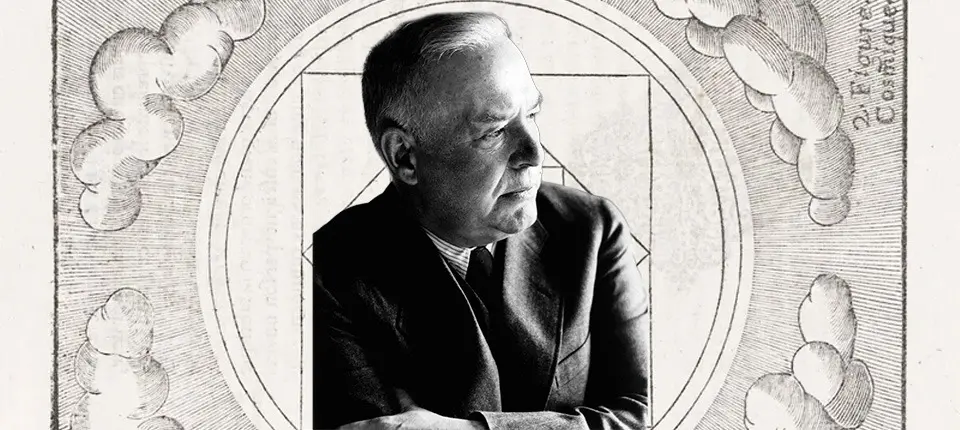
On this day in 1879, the literary world saw the birth of Wallace Stevens, a figure who would eventually become one of the most significant and enigmatic voices in American Modernism. As noted by the latest edition of Lit Hub Daily, October 2 marks the anniversary of the birth of a man who managed to balance a high-level career in the insurance industry with a poetic output that redefined the boundaries of the English language. Stevens was not a traditional bohemian; he did not frequent the cafes of Paris or the salons of London. Instead, he spent the better part of his life in Hartford, Connecticut, walking to work and composing some of the most complex, aurally stunning, and philosophically profound verses of the twentieth century.
The legacy of Wallace Stevens remains a cornerstone of the literary internet, where his poems are frequently dissected, shared, and celebrated for their unique intersection of reality and imagination. In an era where the "starving artist" trope remains a dominant cultural narrative, Stevens stands as a striking counterpoint—a man who found the rigors of the corporate world not a hindrance to his creativity, but perhaps the very structure that allowed it to flourish. His birth in Reading, Pennsylvania, 147 years ago, set in motion a life that would ultimately be dedicated to the pursuit of what he called the "Supreme Fiction."
Stevens’ journey into the pantheon of American literature was not immediate. After a brief and somewhat restless period at Harvard University, where he contributed to the Harvard Advocate and sought the counsel of George Santayana, he briefly attempted a career in journalism in New York City. However, the instability of the newsroom did not suit him. He eventually pivoted to law, graduating from New York Law School in 1903. This transition into the legal and corporate spheres was the beginning of the dual life that would define him. By 1916, he had joined the Hartford Accident and Indemnity Company, where he would remain for the rest of his life, eventually rising to the position of Vice President.
The fascination with Stevens often begins with this dichotomy. How could a man who spent his days evaluating surety bonds and insurance claims spend his evenings and commutes composing "The Emperor of Ice-Cream" or "Thirteen Ways of Looking at a Blackbird"? For Stevens, the two worlds were not as disparate as they might appear to an outsider. He famously noted that money was a kind of poetry, and he viewed his professional stability as the bedrock upon which he could build his elaborate intellectual cathedrals. He was a late bloomer in the literary world, not publishing his first major collection, Harmonium, until 1923, when he was already forty-four years old.
Harmonium was a revelation, though it was not an immediate commercial success. It introduced a voice that was strikingly different from the wasteland of T.S. Eliot or the jagged edges of Ezra Pound. Stevens’ early work was characterized by a lush, tropical vocabulary and a preoccupation with the sensory details of the world. Yet, beneath the vibrant imagery of "sea-surfaces full of clouds" and "the palms at the end of the mind," there was a rigorous philosophical inquiry. Stevens was deeply concerned with the role of the imagination in a world that had largely moved past traditional religious belief. He sought a way for poetry to provide the spiritual and aesthetic nourishment that had once been the province of the church.