The four tests of strategic optionality
To navigate this environment, mortgage companies must pass four critical tests of their business model. These tests determine whether a company has "strategic optionality"—the ability to make attractive choices before they are forced by necessity.

- Scale: Size alone is no longer a safeguard. A cost gap of roughly $6,350 per loan separates the top-performing lenders from those in the bottom quintile. If a company’s next billion dollars in production does not demonstrably lower the unit cost of each loan, the company is merely getting larger, not stronger.
- The Customer: A database is not the same as a franchise. In an era of strict privacy laws and the Homebuyers Privacy Protection Act, only permissioned, durable relationships create true value. Companies must move beyond lists of names to create actual affinity and recapture value.
- Defensibility: Relying on "great people" and "local service" is admirable but insufficient as a competitive moat. A true moat must be a deliberately selected and fully funded capability, whether that is a low-cost manufacturing advantage, a specific product niche, or superior servicing recapture.
- Technology: Software licenses are merely an expense until they change the economic model. True technology value is measured by operating leverage—the ability to handle more volume without a proportional increase in headcount.
A lender that passes these tests has the freedom to grow, acquire other firms, raise capital, or remain independent. A lender that fails them may still have choices, but those choices are unlikely to be favorable.
Two doors: Dramatic cost reduction or strategic combination
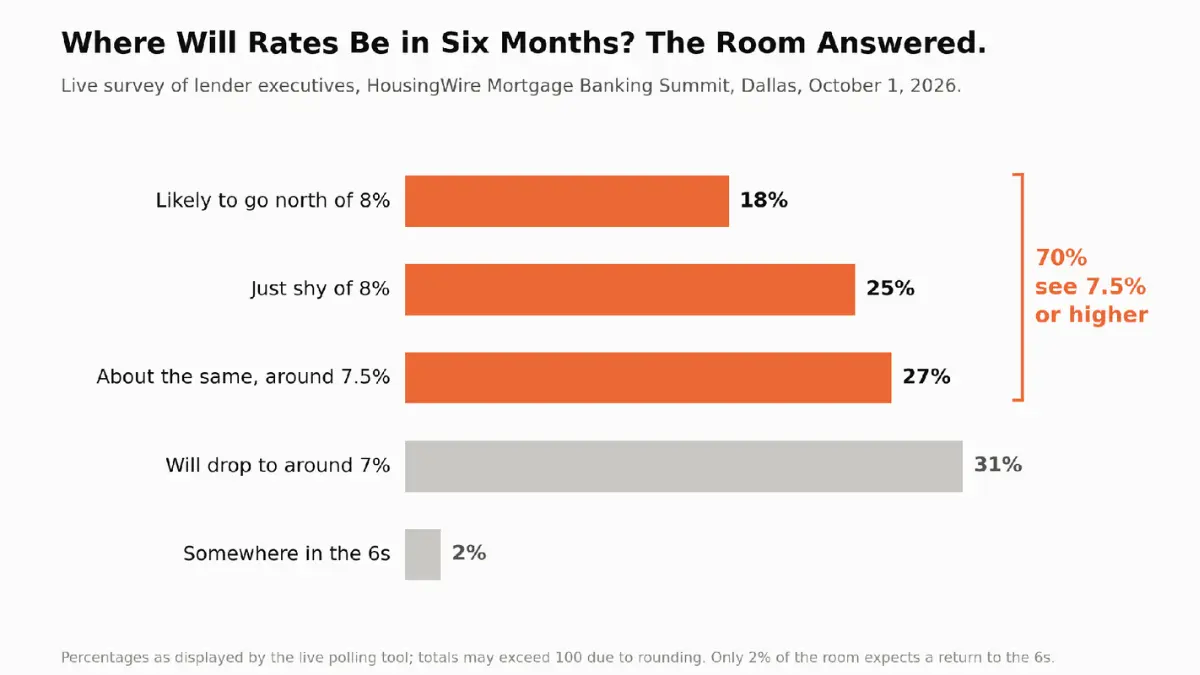
As the industry looks toward a 2027 market characterized by flat volume and rates that could touch 8%, lenders are standing before two credible doors. Standing still is not an option.
The first door is dramatic cost reduction. This is not the standard "right-sizing" that occurs after volume misses a forecast; that is simply reactive arithmetic. Instead, this involves rebuilding the entire operating model around "straight-through processing" and "exception-based staffing." The goal is to use tools that attack the cost stack from both the sales and operational sides.
On the sales side, outbound voice AI platforms are beginning to automate the early stages of client acquisition and prequalification, lowering the cost of marketing—a category that traditional headcount cuts rarely touch. On the operational side, platforms are creating efficiencies that allow processors and loan officer assistants to handle higher throughput with higher quality. Digital closing and eNote infrastructures are also being used to deliver cleaner loans, which in turn earns better pricing from investors. Together, these tools can offer savings of 50 to 70 basis points per loan—roughly $1,900 to $2,700 on an average loan balance.
The second door is a strategic combination. If a company’s balance sheet or management bandwidth cannot fund the technological overhaul required for the first door, the most prudent move is to join forces with a lender that already possesses scale and a larger balance sheet. This should be done while the company still commands a premium, rather than waiting for the market to dictate terms.
With a $6,350 gap between the most and least efficient operators, the industry is primed for the strong to absorb the weak. While only 4% of executives at the summit said they plan to sell, the market will likely force the hand of many others. The difference between a merger from a position of strength in 2026 and a merger out of necessity in 2027 is the difference between choosing a partner and being chosen by one.
The executives in Dallas made it clear that they understand the gravity of the situation. There is no rescue coming from the Federal Reserve, and there is no hidden volume in the wings. The decisions made in the next two quarters will determine which companies enter 2027 with a range of options and which ones will find their choices increasingly limited by the relentless tick of the rate clock.