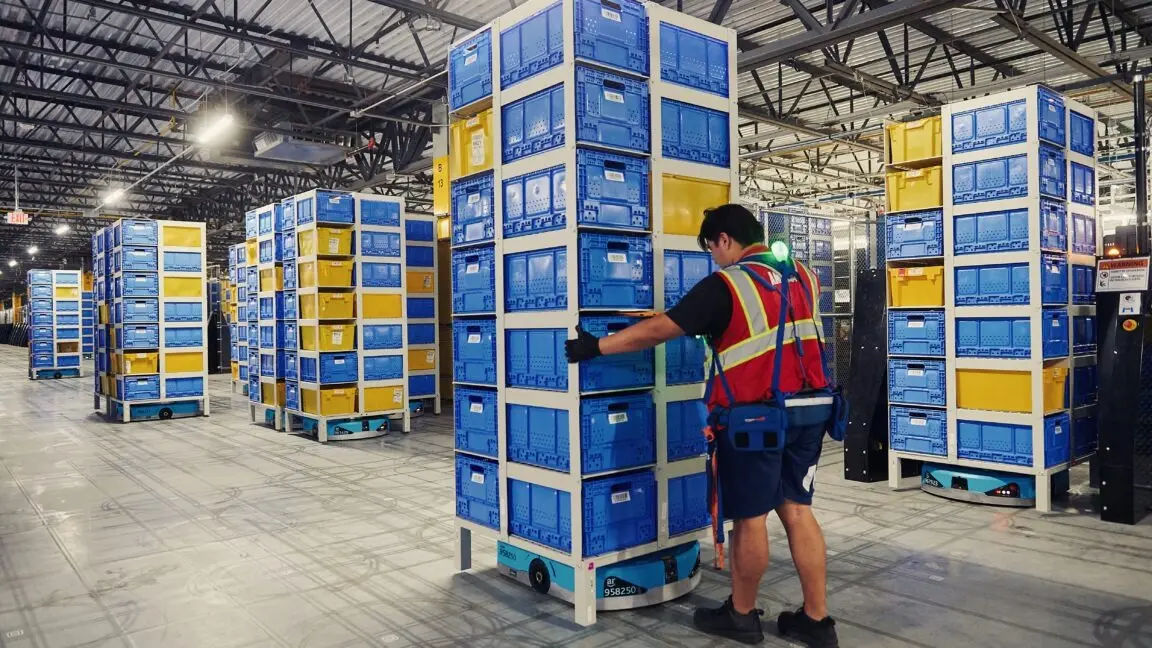
No organization on Earth operates a larger robotic footprint than Amazon. The e-commerce titan currently maintains a fleet of more than 1 million autonomous and semi-autonomous robots active across its global fulfillment network. Working around the clock, these machines help power the daily processing and delivery of tens of millions of same-day and one-day packages for the company’s more than 200 million Prime subscribers.
Yet, even as Amazon prepares to significantly expand this mechanized fleet through dedicated new manufacturing plants, it remains the world’s second-largest corporate employer. According to its 2025 annual report, Amazon employs over 1.5 million full-time and part-time human workers. The intersection of these two massive workforces—one constructed of steel, silicon, and AI, the other made of flesh and blood—has turned Amazon’s fulfillment centers into a testing ground for the future of human-robot collaboration.
Amazon executives maintain that automation serves to assist human employees by absorbing the most physically demanding, repetitive, and hazardous tasks in fulfillment centers. However, independent researchers, workplace safety advocates, and labor representatives argue that bringing AI-driven machinery into close proximity with people creates a distinct set of physical and psychological pressures, altering the fundamental nature of warehouse labor.
Historically, industrial automation occurred behind barriers or at a distance from human workers, taking dangerous tasks entirely out of human hands. Modern warehouse robotics, however, rely on collaborative systems that share the immediate workspace with people. As Brian Greenwood, a professor of business at George Mason University, points out, collaborative robots fundamentally alter workplace dynamics because they operate in direct physical proximity to human workers and frequently dictate the speed at which tasks must be performed.
This relentless pace is deeply linked to the logistics demand of modern e-commerce. Inside fulfillment facilities, hundreds of thousands of employees work to assemble, pack, and ship orders containing millions of distinct products. In the United States alone, the broader warehousing sector employs nearly 2 million people and has long been plagued by high turnover and workplace injury rates that OSHA metrics show are routinely more than double the national average across all private industries. While robots excel at predictable, high-speed repetitive tasks, humans remain essential for their adaptability and fine motor control. The resulting interplay between human agility and machine efficiency has reshaped logistics, while raising critical questions about workplace safety and employee well-being.
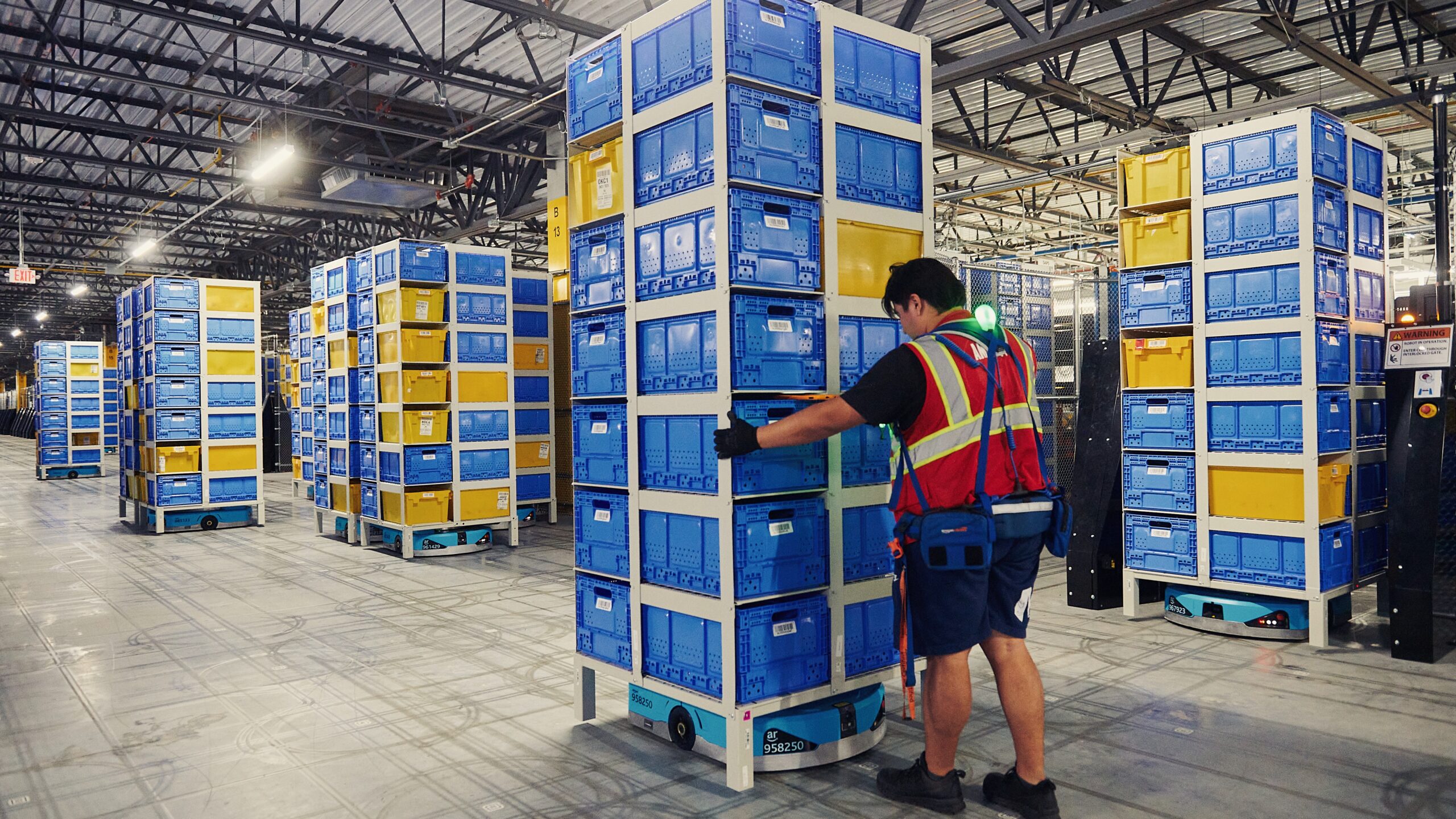
To sustain this vast technological footprint, Amazon has systematically built up its internal robotics engineering capabilities over the past decade. The foundation of this strategy was laid in 2012 when Amazon acquired Kiva Systems for $775 million. Kiva pioneered the use of low-profile, wheeled mobile robots designed to slide underneath tall inventory racks—known as "pods"—and transport them directly to stationary human workers, eliminating the need for employees to walk miles through fulfillment center aisles.
Rebranded as Amazon Robotics, the division has expanded from its initial base in Massachusetts into a major manufacturing operation. The company has announced plans to construct additional advanced production factories in Austin, Texas, and Greenwood, Indiana, to further expand its capacity to manufacture proprietary hardware.
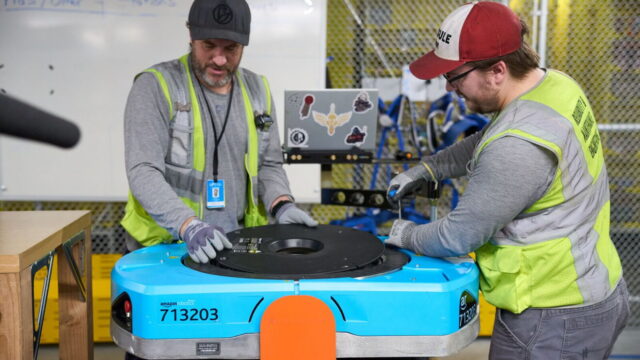
The bulk of Amazon’s million-unit robotic workforce consists of wheeled mobile drive units, such as its Hercules and Titan models. Hercules units, roughly the size of a pool table, and Titan units, which approach the footprint of a baby grand piano, navigate along floor grids marked with specialized stickers. They retrieve fabric inventory pods filled with plastic tote crates and carry them to workstations. In newer deployments, Amazon’s Sequoia system orchestrates swarms of mobile drive units to identify and store inventory, a process the company claims can boost storage and identification speed by up to 75 percent.
While traditional mobile drive units operate within fenced areas separated from human workers, newer models like Proteus feature advanced visual and spatial sensors that allow them to move safely alongside humans in open warehouse areas. To prevent congestion among these vast fleets navigating tight grid corridors, Amazon orchestrates drive movements using DeepFleet, a suite of artificial intelligence foundation models engineered to predict traffic bottlenecks and optimize routing across fulfillment floors in real time.
The robotic arms race
While mobile drive units handle horizontal transport across warehouse floors, Amazon has increasingly focused on automating package sorting, lifting, and item manipulation. Initially, the company relied on third-party industrial robotic arms to move heavy pallets and containers. Over the past several years, however, Amazon Robotics has transitioned to custom-built in-house systems.
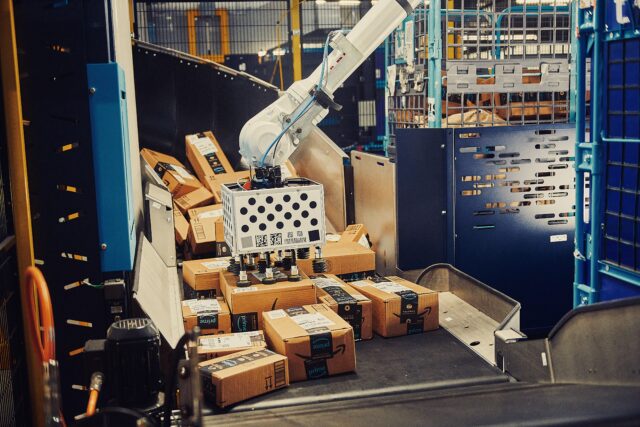
Amazon CFO Brian Olsavsky noted in a July earnings call that the company planned to more than double its fleet of robotic arms, with Scott Dresser, vice president of Amazon Robotics, clarifying that the current active footprint of these mechanical arms sits in the single-digit thousands.
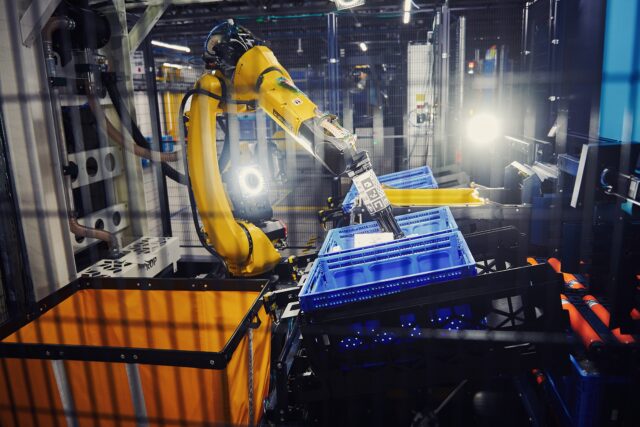
The division’s first custom package-handling arm, dubbed Robin, began field testing in 2021 before officially deploying at a fulfillment facility in Lakeland, Florida, in 2022. Designed to tackle piles of unsorted parcels, Robin utilizes an array of eight suction cups attached to a mechanical arm to pick up individual mailers and boxes from cluttered conveyor belts and place them onto mobile drive units.
To successfully pick up items from chaotic piles, Robin relies on machine learning models rather than traditional, rigidly coded algorithms. Early algorithmic strategies created by Amazon engineers often failed when dealing with complex package arrangements—prioritizing large boxes under smaller ones, or repeatedly trying to pick partially covered, unreachable parcels. To resolve this, Amazon trained machine learning models on more than 394,000 live picking actions to calculate the probability of success for various pick strategies.
In field evaluations, this machine-learning approach raised picking success rates from 92.28 percent under traditional algorithms to 93.73 percent. While a percentage point gain might appear modest, at Amazon’s scale it translated to approximately 16,500 fewer failed picks over a test sample of one million items. Subsequent research presented by the Amazon Robotics team at the International Symposium on Experimental Robotics in July 2025 demonstrated that refined machine learning models could reduce failed pick rates by up to 20 percent across two million live trial pick attempts.
Building on Robin’s baseline manipulation capabilities, Amazon introduced Cardinal, a heavy-duty robotic arm capable of lifting items weighing up to 50 pounds. First deployed at a facility in Nashville, Tennessee, in November 2022, Cardinal selects packages from conveyor lines and stacks them tightly inside wheeled transport carts bound for delivery trucks. Using vision systems and spatial analysis, Cardinal determines optimal package placement to maximize cart density—an outcome that improves transport efficiency and reduces shipping emissions.
AI-driven robot successors
While Robin and Cardinal were engineered to move standard cardboard boxes and paper mailers, handling the unpackaged consumer goods stored in Amazon’s catalog presented a far more intricate technical hurdle. Items vary radically in shape, weight, flexibility, and surface texture, making rigid automation impractical.
To address this challenge, Amazon developed Sparrow, a sophisticated robotic arm built specifically to consolidate individual products from partially filled totes into high-density storage containers. Sparrow represented the first widespread integration of AI foundation models into Amazon’s physical manipulation systems. Rather than requiring hand-coded instructions for every product SKU, Sparrow utilizes vision and perception models to analyze unfamiliar items instantly and determine the safest, most effective grip.
Building on Sparrow’s capabilities, Amazon Robotics managers showcased recent breakthroughs at the IEEE International Conference on Intelligent Robots and Systems (IROS) in Pittsburgh on September 29, 2026. Senior Applied Science Manager Kapil Katyal detailed how the company developed a universal perception foundation model alongside a Generalized Action Model (GAM). This architecture allows disparate robotic arms—whether utilizing suction mechanisms, multi-fingered mechanical grippers, or hybrid hands—to recognize and manipulate previously unseen inventory without requiring task-specific software adjustments.
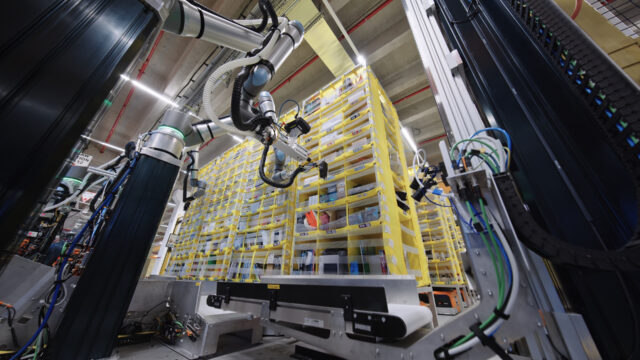
The newest addition to this line of manipulation hardware is Vulcan, a robotic arm introduced at facilities in Spokane, Washington, and Hamburg, Germany, starting in 2025. Unlike its predecessors, which rely almost entirely on computer vision, Vulcan incorporates touch-sensitive force-feedback sensors embedded within its manipulation end-effectors. This tactile sensing allows Vulcan to detect physical resistance, enabling it to carefully slide items into tightly packed, fabric-covered inventory pods or gently extract items without damaging adjacent products. Amazon plans a broader, network-wide rollout of Vulcan systems beginning in 2027.
Parsing the human impact
Amazon framed the development of systems like Vulcan as a direct ergonomic benefit for its human workforce. By assigning Vulcan to handle items on the highest shelves of inventory pods—which previously required employees to climb step-ladders—or items stored inches above the floor, the company says workers can focus on tasks within a comfortable physical reach zone.
However, labor organizations, independent researchers, and congressional investigators offer a more complex evaluation of workplace safety in automated facilities. Reports issued in May 2021 and April 2022 by the Strategic Organizing Center (SOC), a coalition of labor unions, analyzed federal workplace injury data and concluded that Amazon facilities equipped with mobile drive robotics recorded higher overall injury rates than non-robotic facilities.
Joan Moriarty, director of strategic research and campaigns at the SOC, argues that while robotics eliminate certain manual transport tasks, they simultaneously raise production quotas for human workers. According to worker surveys conducted by the organization, the relentless delivery of inventory pods by mobile drive units forces stationary human pickers and packers to perform fast, highly repetitive movements over long shifts, heightening the risk of musculoskeletal injuries.
A 2024 investigation by the U.S. Senate Committee on Health, Education, Labor and Pensions (HELP), led by Senator Bernie Sanders (I-Vt.), similarly pointed to internal company documents indicating that elevated productivity expectations at automated sites correlated with higher injury numbers.
Amazon strongly disputes these assessments, arguing that union-sponsored reports rely on outdated statistics that precede the deployment of modern, ergonomically focused robotic arms. The company points to steady improvements in overall workplace safety metrics across its network. According to an Amazon spokesperson, the company’s Global Recordable Incident Rate improved by 43 percent between 2019 and recent reporting periods, while its Global Lost Time Incident Rate—which measures severe injuries requiring time away from work—dropped by 70 percent over the same timeframe.
A rigorous independent study published in the peer-reviewed journal ILR Review in April 2025 provided a nuanced look into these competing claims. Co-authored by Brian Greenwood and based on detailed warehouse data covering the years 2016 through 2019, the study revealed a sharp divergence in injury types between traditional and automated facilities.
On one hand, Amazon’s robotic fulfillment centers demonstrated a 40 percent drop in severe, life-altering injuries compared to non-automated warehouses, proving that offloading heavy material transport to machines significantly reduces catastrophic accidents. On the other hand, the study documented a 77 percent increase in less severe injuries, such as muscle strains and repetitive motion sprains, among workers in robotic facilities.
Greenwood noted that this uptick in repetitive strain injuries appears to be directly linked to the rapid pace dictated by automated delivery systems. When mobile drive units arrive continuously at human workstations, hourly pick-rate targets increase substantially. Analyzing online discussions among fulfillment center workers confirmed this trade-off: employees frequently reported that working alongside robots alleviated heavy physical lifting, but increased mental stress and physical exhaustion due to the sustained speed and monotony of the work.
The future of work
As Amazon continues to expand its robotic capabilities, questions remain regarding the long-term implications for overall employment levels. Amazon maintains that automation creates high-skilled employment opportunities rather than eliminating jobs. The company notes that facilities operating advanced robotics require approximately 30 percent more engineering, reliability, and maintenance personnel to maintain the hardware. Furthermore, Amazon’s expanding robot manufacturing facilities in Texas and Indiana are projected to add hundreds of technical and manufacturing jobs.
Scott Dresser emphasized that Amazon offers internal upskilling initiatives to help entry-level warehouse workers transition into technical fields. The company reports a 30 percent increase in the number of robotic maintenance technicians employed across its fulfillment network, noting that these roles carry significantly higher compensation than standard entry-level associate positions.
Despite these upskilling initiatives, internal corporate projections suggest Amazon has actively evaluated the potential for robotics to constrain future hiring growth. In October 2025, The New York Times reported on internal strategy documents indicating that aggressive deployment of warehouse automation could allow Amazon to reduce its projected U.S. hiring needs by more than 160,000 workers by 2027, and up to 600,000 workers by 2033. Amazon responded to the report by stating that the documents reflected conceptual proposals from an internal planning group rather than finalized executive policy.

As the company prepares to scale up its fleet beyond the one-million-robot mark, the balance between technological efficiency and human labor management will remain a central focus for regulators, labor leaders, and the logistics industry. The Amazon Labor Union, which successfully organized workers at a Staten Island, New York facility in April 2022, continues to advocate for workplace changes through its proposed "Safety Bill of Rights"—a campaign underscored by a core message aimed directly at management: "We are not robots."