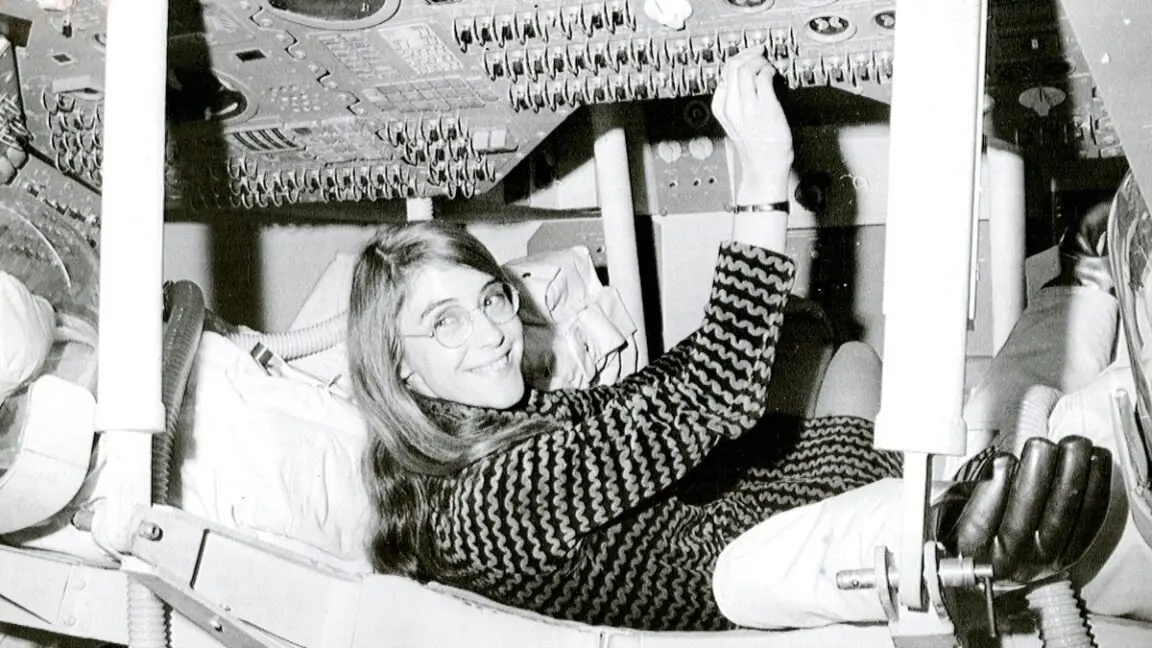
This design proved to be the difference between success and catastrophic failure on July 20, 1969, during the historic descent of Apollo 11’s Lunar Module, the Eagle.
As astronauts Neil Armstrong and Buzz Aldrin approached the lunar surface, Aldrin entered radar codes that caused the system to become overloaded with extraneous calculations. The guidance computer was quickly overwhelmed, forced to process more computations than its memory could handle simultaneously. Just minutes before reaching the surface, the computer’s display screen flashed emergency "1201" and "1202" alarm codes. Inside Mission Control in Houston, flight controllers faced an agonizing decision over whether to abort the landing.
Hamilton’s software architecture performed precisely as designed. Recognizing that it was under severe processing stress, the system activated its priority recovery software. It automatically interrupted lower-priority tasks—such as updating telemetry displays—and redirected processing power exclusively to the highest-priority task: calculating the thruster firings and guidance trajectories required to land the spacecraft safely.
Because the software was able to recover gracefully without crashing, Mission Control recognized that the guidance system was functioning properly, allowing Armstrong and Aldrin to proceed. The Eagle touched down safely on the Sea of Tranquility, marking humanity’s first steps on another celestial body.
In a 1971 letter reflecting on the event, Hamilton detailed the sophisticated self-healing capabilities she and her team built into the flight code:
"The computer (or rather the software in it) was smart enough to recognize that it was being asked to perform more tasks than it should be performing. It then sent out an alarm, which meant to the astronaut, ‘I’m overloaded with more tasks than I should be doing at this time and I’m going to keep only the more important tasks’; i.e., the ones needed for landing… Actually, the computer was programmed to do more than recognize error conditions. A complete set of recovery programs was incorporated into the software. The software’s action, in this case, was to eliminate lower priority tasks and re-establish the more important ones… If the computer hadn’t recognized this problem and taken recovery action, I doubt if Apollo 11 would have been the successful Moon landing it was."
Following the conclusion of the Apollo program, MIT’s Instrumentation Laboratory became the independent Draper Laboratory. Hamilton worked there until 1976, when she decided to transition her flight-proven methodologies of fault tolerance, error prevention, and software reliability into the private sector.
She co-founded Higher Order Software in 1976 to commercialize software design tools focused on systemic error prevention. In 1985, she founded Hamilton Technologies, serving as its Chief Executive Officer. There, she created the Universal Systems Language (USL) for developing complex software systems, emphasizing defensive programming, error prevention, and rigorous architectural design to eliminate bugs before code execution.
In the decades following her work on Apollo, Hamilton’s contributions received widespread global recognition. In 2015, the complete source code for the Apollo Guidance Computer was uploaded to GitHub, where a new generation of software developers dissected and celebrated her team’s engineering techniques. In July 2019, on the 50th anniversary of the Apollo 11 landing, Google honored Hamilton’s crucial role by training over 100,000 motorized mirrors at its Mojave Desert solar power farm to reflect moonlight into a massive portrait of Hamilton across the desert floor.
Hamilton’s coining of the term "software engineering" originally faced skepticism from traditional engineers who viewed software development as secondary to hardware design. However, her work on Apollo proved that software was just as critical to complex engineering systems as physical machinery, establishing software development as an essential scientific discipline.
Hamilton is survived by her daughter, Lauren Hamilton; her son-in-law, Richard Selesnick; two grandsons; four great-grandchildren; and her siblings John, David, and Kathryn.