In the modern culinary landscape, trends often move with the speed of a social media scroll. For the past several years, the home kitchen market was dominated by a specific aesthetic: pastel-hued, ceramic-coated nonstick pans that promised effortless cleanup and a "clean" alternative to traditional coatings. Driven by the post-pandemic online shopping boom and the aggressive marketing of direct-to-consumer brands, these pans became the darlings of Instagram and TikTok. However, as the dust settles on that era of ephemeral kitchenware, a significant shift is occurring. Consumers, weary of the short lifespan of "slippery" coatings, are looking backward to move forward. Stainless steel cookware, the undisputed backbone of the professional kitchen for decades, is experiencing a major cultural renaissance.
This resurgence is not merely a nostalgia trip but a calculated pivot toward longevity, performance, and craftsmanship. As the global economy grapples with a skyrocketing cost of living, the appeal of a "buy it once, use it forever" product has become increasingly enticing. For those who make their living behind a stove, this is not news; it is a return to a standard that never truly left. In the professional world, where equipment must withstand eighteen-hour shifts and the brutal heat of commercial ranges, the reliability of stainless steel is the gold standard.
To understand why this material is reclaiming its throne, one must look at the demands of a high-pressure kitchen. Eater spoke with Carlye Lester, the sous chef at HAGS, a queer fine dining destination in New York’s East Village, about why she and her peers consistently reach for the steel. HAGS, known for its meticulous attention to detail and creative approach to fine dining, requires tools that offer both precision and stamina. For Lester, the primary draw of stainless steel is its fundamental reliability.
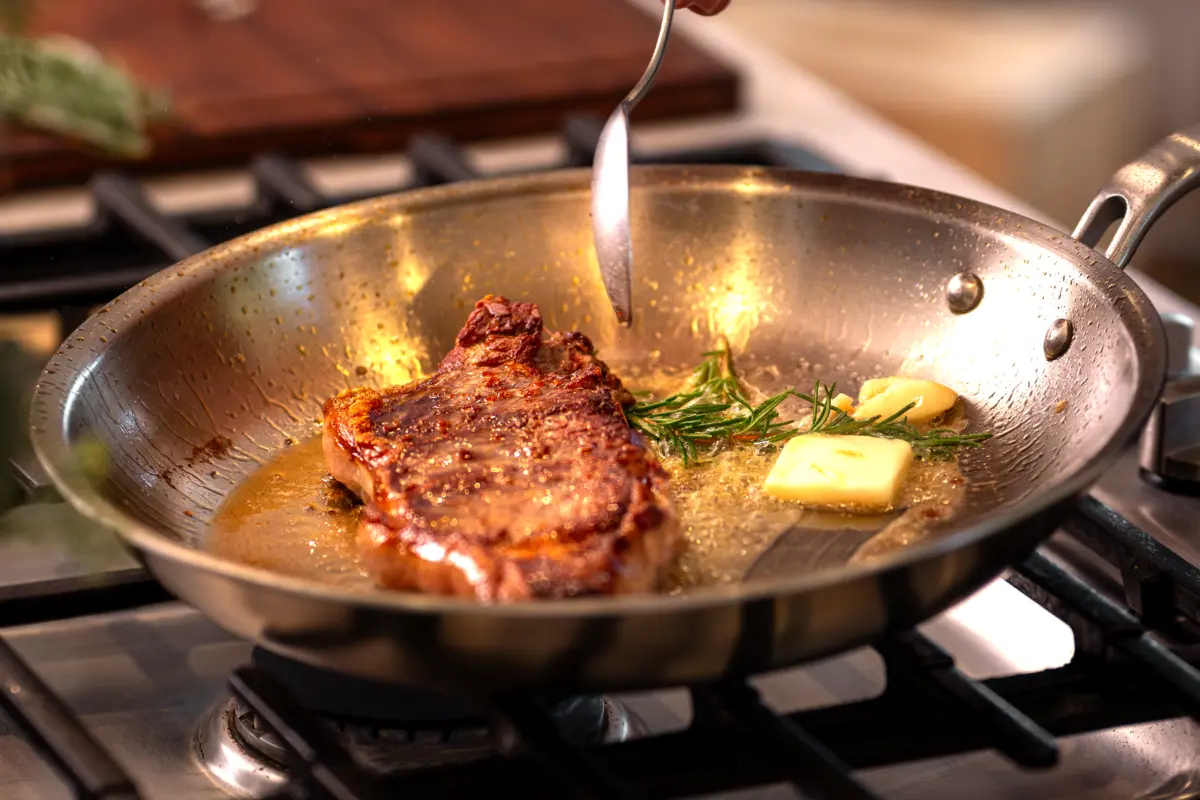
"I love that it gets super hot and heats evenly; it is [easy] to get a good sear on whatever you are making," Lester says. At HAGS, this performance is put to the test daily. Lester describes using stainless steel pans to achieve the perfect sear and crisp texture on a mustard-marinated cod—a dish that requires delicate handling but high heat to develop the necessary crust. The ability to trust that a pan will distribute heat predictably across its surface is what separates a professional tool from a consumer-grade novelty. "[And] I love that stainless steel can be more reliable than a nonstick if you’re using the correct methods," she adds.
The "correct methods" Lester refers to are often the biggest hurdle for home cooks. Perhaps the most persistent misconception regarding stainless steel is that it is inherently difficult to use because food "sticks" to it. In reality, the sticking is rarely a fault of the material and almost always a result of temperature management. When stainless steel is heated to the correct threshold—typically around 400 degrees Fahrenheit—it undergoes a physical transformation that allows it to behave with nearly the same ease as a nonstick surface.
This phenomenon is known as the Leidenfrost effect. It occurs when a liquid comes into contact with a surface significantly hotter than its boiling point, creating an insulating layer of vapor that prevents the liquid from boiling rapidly. In a culinary context, when a cook drops a few beads of water onto a properly preheated stainless steel pan, the water does not evaporate immediately. Instead, the droplets bead up and glide across the surface like marbles. When oil is added at this precise moment, it creates a microscopic barrier that allows proteins to sear without bonding to the metal. It is a marriage of physics and flavor that provides a superior crust—the Maillard reaction—that nonstick pans struggle to replicate.