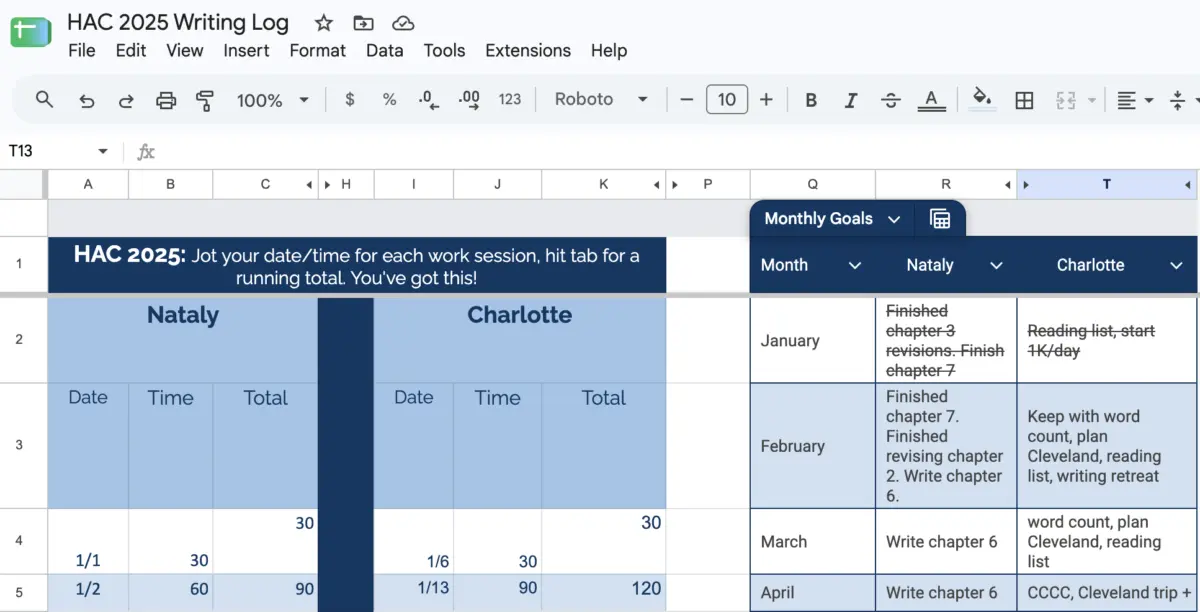
Because my career had already conditioned me to view time-tracking as a tool for surveillance and performance evaluation, the idea of logging my dissertation hours felt like an extension of that pressure. I feared the log would become a place where I would constantly be reminded of how little I was getting done.
However, the HAC log turned out to be the opposite of a corporate audit. It became a collaborative space where our collective labor was made visible. Seeing my progress—or lack thereof—alongside the progress of my peers and my adviser changed my perspective. I began to see that there were many different ways to use time and that "productivity" did not have a singular definition.
The group organically cultivated a sense of "our time" rather than just "my time." It was no longer about whether I had billed enough hours to a project; it was about being part of a shared effort. This communal aspect transformed the act of logging from a constraining requirement into a freeing experience. It allowed me to see that even on the days when the dissertation felt stagnant, the act of showing up and recording those minutes was a form of progress.

Nataly
For me, the writing log was a lesson in self-compassion. It forced me to rethink how I valued my time and what I defined as "work." Before the HAC, I tended to believe that if I couldn’t sit down for a two-hour block of deep work, the time wasn’t worth recording. The log changed that.
I began to record everything: five minutes, fifteen minutes, twenty minutes. Seeing those small increments on the Google Sheet made them feel legitimate. It validated the idea that every minute spent engaging with the project mattered. This shift in mindset became crucial when I became a mother. Suddenly, my time was no longer my own, and the large blocks of work I had once craved were non-existent. Because the log had already taught me to value small chunks of time, I didn’t get discouraged. I knew I could still move the needle, even in the margins of my day.
The log also challenged my definition of "writing." We often fixate on the production of new pages as the only metric of success. But through the HAC, I realized that looking for sources, refining an argument on the back of an electric bill, or simply thinking through a difficult transition were all "work worthy of logging."
The dissertation process is long, and when life intervenes—whether through career shifts or a new baby—the "prize" at the end can feel very far away. The writing log served as a tether. It reminded me that I was moving forward, even when the path included detours. It allowed me to see the continuity of my effort during a time of immense personal change.
Ashley
As a researcher, I am naturally inclined toward data. When we started the HAC, I assumed that more data would lead to a better understanding of my writing habits. In addition to tracking my time, I often added my word count for each session, adhering to traditional productivity metrics. However, looking back at that data now, I see the limitations of that approach.