My logs revealed a pattern where I overemphasized quantifiable output at the expense of intellectual quality. On the days when I had significant breakthroughs—the moments where I sat with the project for hours and finally distilled a complex thought into a few concise sentences—my "productivity" on paper looked low. The word count didn’t reflect the depth of the labor.
I noticed that I often stopped tracking my word count altogether during these intensive, breakthrough sessions. My measurement practices collapsed precisely when my perceived productivity decreased, even though those were often my most important days. This suggests that traditional productivity models can actually reinforce burnout by making us feel unsuccessful during the most demanding phases of intellectual labor.
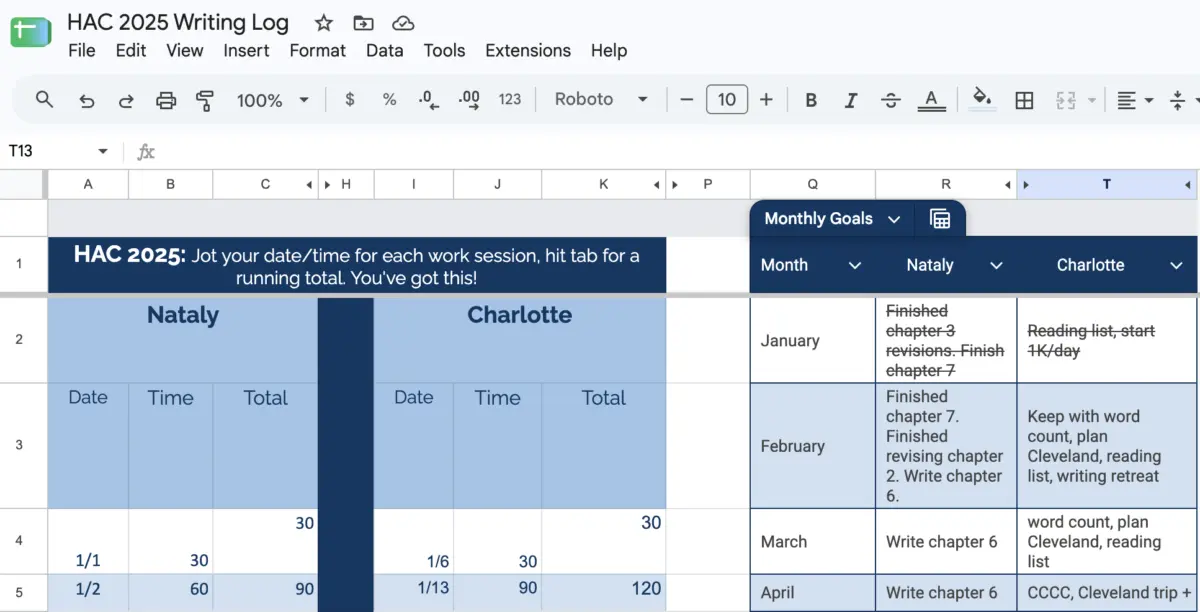
The solution, I’ve realized, is to shift toward metrics that capture the quality of the work and prioritize purpose over pure output. The shared Google Sheet was most effective not as a tracker of words, but as a tool for motivation. It made the invisible, isolated labor of the dissertation visible to a community.
Ultimately, the sheet was like a handprint on a cave wall. It was a mark of our presence across different spaces and times. We returned to it to record our efforts, finding evidence that we were not alone in the struggle. It was a simple, elegant, and reliable tool that provided a small nudge to keep writing for another day. In the best moments, we would even see each other entering our minutes in real-time, a silent acknowledgment that we were all in the trenches together.
Nataly Dickson is a visiting lecturer in the Department of English at Texas Christian University and a recent graduate of TCU’s Ph.D. program in rhetoric and composition.
Ashley Hughes is a former Ph.D. candidate in TCU’s Ph.D. program in rhetoric and composition.
Sean McCullough is a recent graduate of TCU’s Ph.D. program in rhetoric and composition.
Charlotte Hogg is a professor of rhetoric and composition in the Department of English at Texas Christian University.