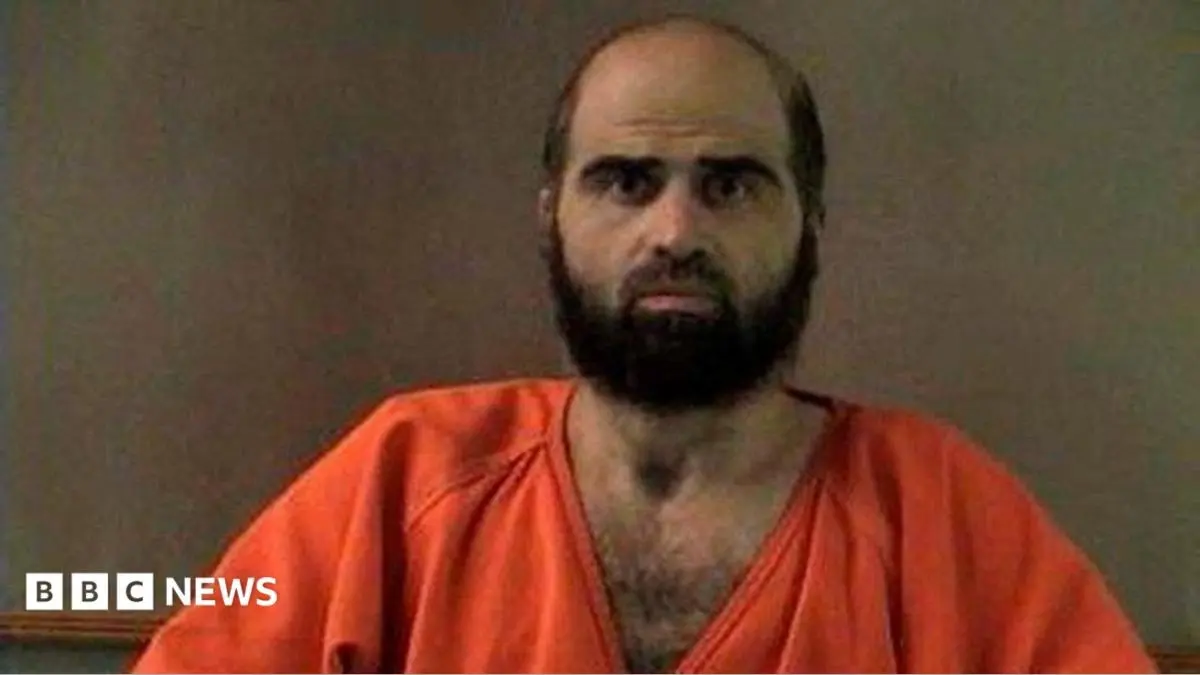
United States President Donald Trump has officially reversed his decision to publicly livestream the upcoming execution of former United States Army psychiatrist Nidal Hasan, backing away from a controversial proposal that had ignited intense national debate over the ethics, propriety, and optics of broadcasting capital punishment to a global audience.
While the unprecedented plan to broadcast the lethal event online has been formally abandoned, President Trump reaffirmed that Hasan will still be executed by firing squad as originally scheduled. The upcoming capital punishment will mark a historical milestone in American jurisprudence and military history, as it stands to be the first military execution conducted by the United States armed forces in more than six decades.
The decision to cancel the digital broadcast comes following days of escalating pushback from legal experts, ethicists, political observers, and members of the public who raised significant concerns regarding the sensationalization of state-sanctioned violence. In a public statement addressing the policy reversal on Thursday, President Trump acknowledged the widespread disquiet surrounding the prospect of a publicly streamed execution, noting that "many very good and well meaning people would rather not watch him die."
The retreat from a public broadcast marks a notable shift in the administration’s public posture regarding the high-profile case. Previously, President Trump had openly expressed his endorsement of the plan, approving the concept of broadcasting the condemned man’s final moments on an online platform for the public to observe. Proponents of the idea within the president’s sphere had framed the proposed broadcast as a ultimate display of state accountability and a visceral warning to enemies of the nation.
In his Thursday remarks, President Trump articulated his original rationale for advocating a broadcasted execution, reiterating his belief that the graphic display of justice could have served a broader geopolitical purpose as a stark warning to violent actors worldwide. The president maintained that making the execution accessible to a global audience would have demonstrated the unrelenting resolve of the American justice system when confronting acts of mass violence and terrorism.
"I think streaming the execution for all to see might have been a strong deterrent for the World to witness how America deals with Terrorists and SCUM like Hasan," President Trump said, reaffirming his unyielding stance on the condemnation of the former Army officer.
Despite his conviction regarding the potential power of such a display as a global deterrent, President Trump conceded to the mounting public and moral discomfort associated with televising or streaming a human death. By formally rescinding the livestream directive, the president effectively drew a line between public justice and public spectacle, while simultaneously reassuring the country that the ultimate punishment itself remains fully on track.
"He will die, as scheduled, by firing squad, but this event will not be streamed," President Trump added, confirming that the change in viewing arrangements would have no bearing on the implementation of the military court’s death sentence.
The proposal to broadcast Hasan’s death had also exposed subtle divisions and varying degrees of comfort within the executive branch itself. Prior to President Trump’s formal announcement calling off the digital stream, Vice-President JD Vance had publicly signaled skepticism regarding whether such a broadcast would ever actually come to pass. In earlier comments regarding the policy proposal, Vice-President Vance had explicitly cast doubt on the logistical and institutional likelihood of the execution being made available to online viewers, while also taking a clear personal stance on the matter by stating unequivocally that he himself would not watch the broadcast if it were to occur.
The retreat from a televised or streamed execution removes what would have been an unparalleled and deeply controversial chapter in the history of modern capital punishment. Never before in modern American history has an execution conducted by military or civilian authorities been broadcast live to the general public over digital networks.
While the general public will no longer be permitted to view the execution through an online feed, the administration confirmed that the proceedings will not take place entirely behind closed doors. President Trump stated that the families of the victims targeted in the deadly rampage will be granted the opportunity to attend and view the execution in person.
By prioritizing the presence of those directly impacted by the tragedy over a mass media audience, the administration aims to focus the solemnity of the event on solemn closure for the victims’ loved ones rather than a public broadcast. "They deserve to witness JUSTICE!" President Trump declared, emphasizing that the right to witness the final resolution of the case fundamentally belongs to those who suffered the irreparable losses inflicted by Hasan’s actions.
The condemned prisoner at the center of the historic execution, Nidal Hasan, carried out one of the most violent acts of internal mass bloodshed ever perpetrated on an American military installation. In 2009, while serving as a major and psychiatrist in the United States Army, Hasan opened fire inside a processing center at the Fort Hood military base in Texas.
During the calculated attack at the sprawling Texas base, Hasan targeted unarmed service members who were preparing for deployment or undergoing routine medical checks. The tragedy resulted in the deaths of 13 unarmed U.S. soldiers and left another 32 people wounded, leaving deep scars throughout the military community and the nation as a whole. The deadly rampage sent shockwaves through the Department of Defense, prompting extensive security overhauls and a lengthy military judicial process that ultimately resulted in Hasan being sentenced to death.
The execution of Hasan by a firing squad carries tremendous historical weight within the American military legal framework. Military executions are exceptionally rare in the United States, governed by strict procedures under the Uniform Code of Military Justice and requiring direct executive authorization. Hasan’s forthcoming sentence will mark the first time the United States military has carried out an execution in over 60 years, highlighting the extraordinary nature of the case and the severity of his crimes.
The choice of execution by firing squad also reflects long-standing military protocols that differ from the civilian lethal injection methods that have dominated federal and state executions in recent decades. Though capital punishment remains a fiercely debated topic across the country, the use of a military firing squad in this instance underscores the distinct legal status under which court-martialed service members are held accountable for extraordinary crimes.
As the execution date approaches, the administration’s decision to eliminate the livestream element effectively closes the door on what would have been a contentious experiment in public capital punishment. By ensuring that the execution remains a private military procedure witnessed only by official personnel and the families of the victims, the administration has navigated away from a unprecedented public spectacle while keeping the mandate of the court-martial intact.
With the digital broadcast officially removed from the plans, the focus surrounding the case returns to the gravity of the 2009 Fort Hood shooting, the long-awaited military judicial conclusion for the 13 soldiers who lost their lives, and the surviving victims who carry the physical and emotional wounds of that day. For the victims’ families, the opportunity to observe the final carrying out of the sentence in person represents the final chapter in a protracted, painful journey toward accountability, delivering what the president described as the ultimate fulfillment of justice.