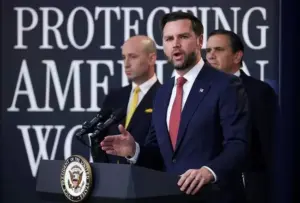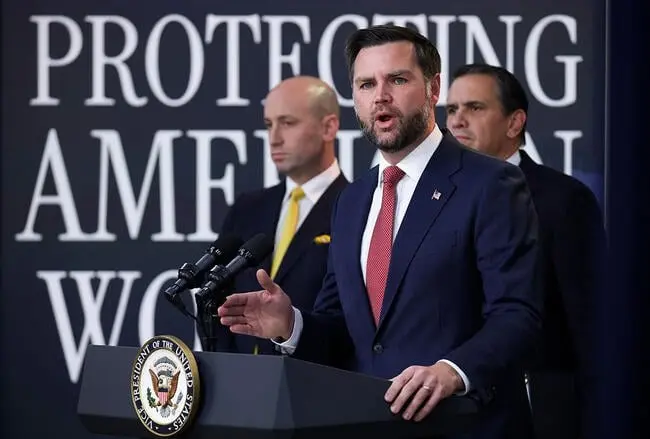
Speaking at a press conference in Washington, D.C., Vance, who serves as the chair of the administration’s task force to eliminate fraud, was joined by high-ranking officials including Stephen Miller and Todd Blanche. Standing before a banner that read "Protecting American Workers," the Vice President detailed what he described as "weird" and "alarming" patterns in the way top-tier institutions utilize foreign labor. The investigation, led by the Labor Department’s Office of Inspector General, has already resulted in the serving of subpoenas to several of the institutions involved.
The J-1 visa program is traditionally designed as an exchange visitor program, intended to promote cultural and educational exchange by allowing noncitizens to temporarily enter the United States to teach, lecture, conduct research, or receive graduate medical education. However, Vance argued that for the universities under investigation, the program has drifted far from its original intent, becoming instead a mechanism for securing "cheap labor" at the expense of American citizens.
The universities specifically named by the Vice President include a list of the country’s most influential research hubs: Harvard University, Yale University, Stanford University, Brown University, the Massachusetts Institute of Technology (MIT), the California Institute of Technology (Caltech), Arizona State University (ASU), the University of Pittsburgh, and the University of California, Davis.
"Something weird is going on at these universities," Vance said, citing internal data on J-1 visa usage. He pointed to a stark statistical discrepancy between the national average and the practices at these specific institutions. According to the Vice President, the targeted universities are employing J-1 visa holders for federally funded grants at a rate of approximately 61 percent. In contrast, the national average for similar research roles sits at 38 percent.
"They’re using these visas way too much," Vance continued. "They’re using them to undercut the wages of American grad students and American researchers." The Vice President further alleged that the financial disparity is quantifiable, claiming that an American graduate student or researcher typically earns roughly $20,000 more than a colleague performing similar work while on a J-1 visa. This wage gap, the administration argues, creates a perverse incentive for universities to favor foreign applicants for research positions funded by American taxpayers.
The investigation is being spearheaded by Anthony D’Esposito, the Labor Department’s Inspector General. D’Esposito, a former New York City Police Department detective, struck a defiant and aggressive tone during the press conference, characterizing the inquiry as a "historic investigation into J-1 visa fraud." He emphasized that the primary objective is to protect the integrity of federal funding and ensure that the "American people" are not being defrauded by institutions they help subsidize through tax dollars.
"We are going to follow the money and uncover the schemes," D’Esposito told reporters. He noted that the investigation would go beyond mere labor violations to explore whether "foreign influence, improper financial relationships, or visa abuse" are compromising the security and integrity of federally funded research. He specifically highlighted concerns regarding foreign adversaries, including China, suggesting that the misuse of visa programs could serve as a conduit for intellectual property theft or the erosion of American technological superiority.
D’Esposito’s rhetoric was notably sharp, reflecting the administration’s broader confrontational stance toward the "Ivory Tower." Drawing on his background in law enforcement, the Inspector General warned university administrators that their prestige would not shield them from legal consequences.
"I don’t care how prestigious a university thinks it is," D’Esposito said. "Break the law and screw the American people, and I will personally cuff you in the university square. I don’t care how large your endowment is, how powerful your alumni are, or how many politicians you have on speed dial."

In the wake of the announcement, the named universities began issuing responses, many of which defended their use of international scholars while acknowledging the government’s inquiry. The consensus among the institutions was one of compliance with current laws and a firm belief in the value that international talent brings to the American economy and scientific progress.
A spokesperson for Brown University confirmed that the institution had received a subpoena for records pertaining to foreign labor programs. "Brown’s international scholars, students, and employees make essential contributions on our campus, including to teaching and research that advances American innovation, competitiveness, and economic vitality," the spokesperson said in an email. The university added that it intends to respond "promptly and directly" to the government’s request for documentation.
At Arizona State University, officials defended their hiring practices by highlighting the sheer scale of their scientific output. A spokesperson noted that ASU educates more STEM (Science, Technology, Engineering, and Mathematics) majors than any other university in the country and manages one of the largest technical workforces in the United States. "This benefits both the Arizona and the United States economies," the spokesperson stated, asserting that the university has hired the talent necessary to maintain its research functions in "complete compliance with existing United States policy and law."
Stanford University also issued a brief statement, noting that it complies with all applicable visa laws and intends to cooperate fully with the Labor Department’s investigation.
The Massachusetts Institute of Technology (MIT) took a more cautious tone, with Kimberly Allen, the executive director of media relations, describing the Labor Department’s subpoena as "very broad." Allen noted that the university is currently reviewing the request but took the opportunity to remind the public that the U.S. government itself is responsible for vetting every individual who is granted a J-1 visa.
"We value international students and scholars on our campus," Allen said. "America’s ability to attract top talent from around the world while protecting U.S. economic and security interests is a national strength, and that competitive advantage should be supported."
The tension between the administration and the universities highlights a growing debate over the globalization of higher education and the protection of the domestic workforce. While universities argue that the pursuit of the "best and brightest" requires a global reach, the administration views the current system as a loophole that allows wealthy institutions to suppress wages and reduce opportunities for American-born scientists.
The Labor Department’s investigation is expected to be lengthy and complex, involving the audit of thousands of grant records, payroll data, and visa applications. Officials indicated that they will be looking for evidence of "displacement," where American applicants were passed over in favor of J-1 holders, as well as discrepancies in how federal grant money is allocated between domestic and foreign staff.
The mention of foreign influence by D’Esposito also suggests that the investigation may overlap with national security concerns. For years, federal agencies have expressed apprehension regarding the "thousand talents" programs and other foreign initiatives designed to recruit Western-trained scientists. By framing the J-1 visa investigation as a matter of "following the money," the Labor Department is signaling that it will scrutinize the financial ties between these elite universities and foreign entities.
As the subpoenas are processed and the Labor Department begins its deep dive into university records, the higher education sector is bracing for a period of intense oversight. The outcome of this investigation could have far-reaching implications for how universities staff their research departments and how the J-1 visa program is regulated in the future. For now, the administration remains firm in its position: that the pursuit of academic excellence cannot come at the cost of the American worker’s paycheck.