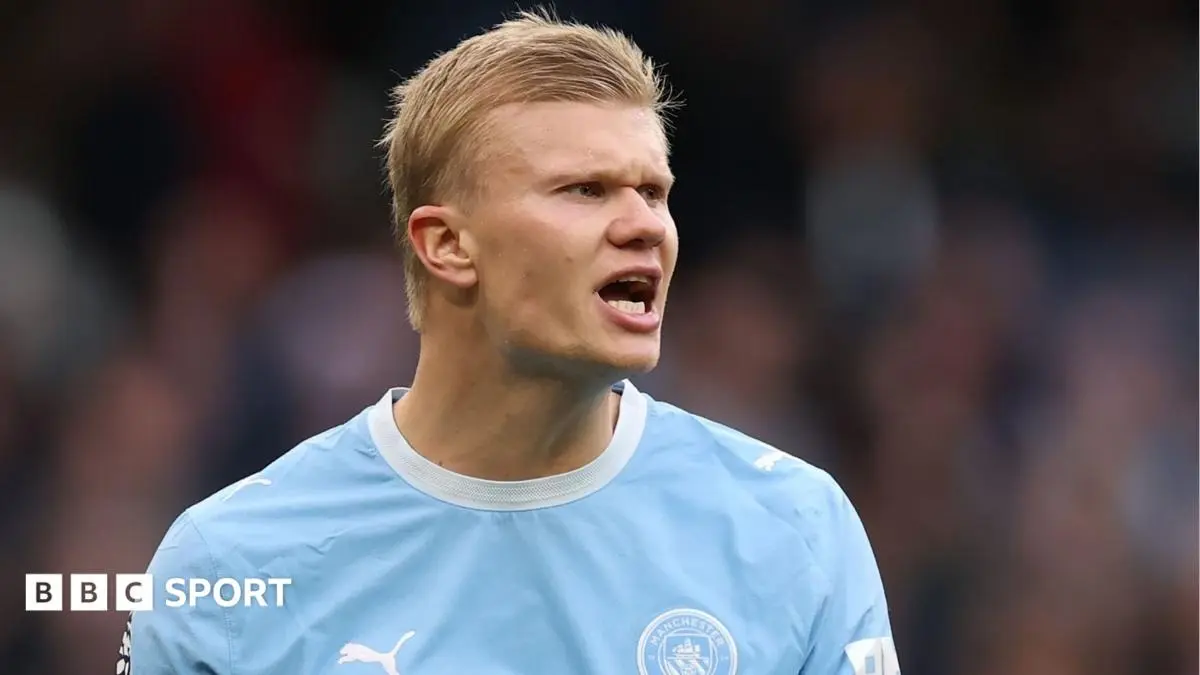
Manchester City’s flawless start to the season faces its most significant hurdle yet as the club grapples with a potential injury crisis at the spearhead of their attack. Despite a commanding position at the summit of the Premier League table, the availability of Erling Haaland for the upcoming fixture against AEK remains shrouded in uncertainty. The Norwegian international, whose prolific form has been the engine behind City’s seven-match winning streak, was a notable absentee from Monday’s training session, leaving manager Enzo Maresca to weigh a series of tactical alternatives in a squad suddenly depleted of natural striking options.
The stakes could hardly be higher for a City side that has looked untouchable in the opening weeks of the campaign. Haaland has been the protagonist of this early-season dominance, finding the net in six consecutive top-flight matches. This remarkable consistency has not only propelled the team to the top of the standings but has also seen the forward rewrite the record books once again. During the recent victory over Ipswich Town, Haaland reached the milestone of 100 non-penalty goals in the Premier League. Achieving this feat in fewer appearances than any other player in the history of the competition, he has further cemented his status as a generational talent whose presence dictates the tactical approach of both his teammates and his opponents.
However, the aura of invincibility surrounding Haaland has been flickered by concerns over his physical condition. Speaking ahead of the midweek European encounter, Maresca offered a cautious update, suggesting that while Haaland "can be available" for the match against AEK, a final decision would only be reached following a medical assessment. The tension escalated when the media, gathered for the open portion of Monday’s training session, noted the striker’s absence from the grass. While City’s medical staff often manage the workloads of high-intensity players with individual recovery programs, the timing of his absence—coupled with the looming fixture—has sparked intense speculation regarding the depth of City’s offensive reserves.
The current predicament highlights a broader structural challenge within the Manchester City squad. For several seasons, the club has navigated the difficulty of recruiting and retaining high-caliber forwards willing to serve as understudies to a player of Haaland’s stature. The sheer volume of minutes Haaland demands, combined with his near-constant goal-scoring output, makes it a daunting task for any secondary striker to find regular rhythm. This was a reality faced by Julian Alvarez and Omar Marmoush, both of whom eventually sought opportunities elsewhere to secure the starting roles their talents merited.
The sense of vulnerability was compounded during the summer transfer window when the club sanctioned the departure of Divin Mubama. The decision to allow the promising young forward to join Championship side Southampton on a loan deal was viewed as a surprise by many observers, as it effectively left the senior squad without a natural, recognized replacement for Haaland. While the move was intended to facilitate Mubama’s development through regular first-team football, it has left Maresca with a tactical puzzle to solve in the event of a long-term or even short-term absence for his primary number nine.