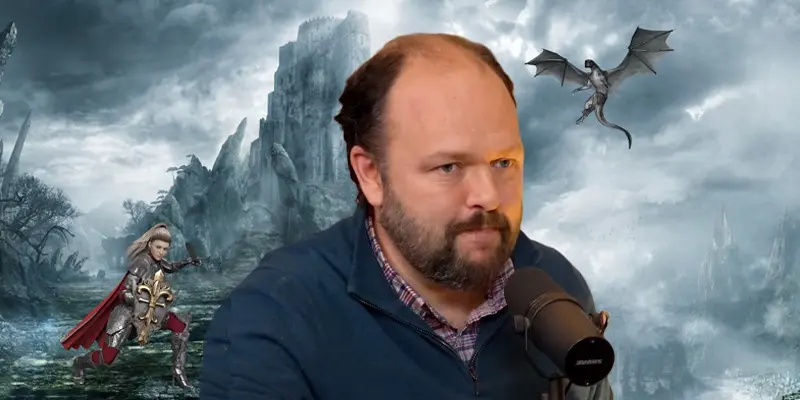
Ross Douthat, the long-standing conservative columnist for the New York Times and a prominent voice in American Catholic intellectual circles, is set to bring his foray into the world of young adult fantasy to a wider audience. His debut trilogy, The Falcon’s Children, which initially gained traction as a serialized project on Substack, has officially secured a print publication deal. The series will be released next year through Luminor, the literary imprint of Word on Fire, the Catholic media apostolate founded by Bishop Robert Barron.
The move marks a significant transition for Douthat, who is better known for his analytical prose on spiritual malaise, the decline of institutional religion, and the shifting tides of American populism. By stepping into the realm of speculative fiction, Douthat joins a storied tradition of Catholic writers who have used the medium of fantasy to explore theological and moral themes, though his specific approach to the genre has already sparked considerable debate among critics and readers alike.
The Falcon’s Children introduces readers to a meticulously constructed universe defined by the Emperors of Narsil, the Mandoran Invasion of Brethony, and the treacherous Skalbard Coast. The narrative framework is dense, drawing on fictional histories such as Pharazel Maheris’s Lives of the Great Viceroys and featuring a complex hierarchy of Nine Archangels. Douthat has described the project as "speculative historical fiction," a label that reflects the heavy emphasis on world-building and supplemental documentation that accompanies the primary narrative.
The transition from digital serial to physical print is a milestone for the project, which Douthat has been nurturing alongside his more traditional journalistic duties. While the author continues to contribute to the New York Times, he has also expanded his media presence in recent years, collaborating with independent outlets such as Bari Weiss’s The Free Press and appearing in various broadcast formats. This creative pivot into fiction appears to be the culmination of a long-held interest in the "secondary worlds" popularized by authors like J.R.R. Tolkien and C.S. Lewis.
Interestingly, the connection between Douthat’s political worldview and his penchant for fantastical structures was noted long before the announcement of The Falcon’s Children. A 2010 profile in Mother Jones suggested that Douthat’s conservative vision often bordered on the "utopian," characterizing his intellectual framework as a form of "magical, Tolkien-like thinking." For Douthat, the creation of a fantasy world may not be a departure from his political commentary but rather an extension of it—an attempt to build a coherent moral and social order within the safety of fiction.
The publication by Luminor is a strategic fit for both the author and the publisher. Word on Fire’s Luminor imprint seeks to champion literature that engages with the Catholic imagination, often looking to revive the "Catholic literary giant" model of the mid-20th century. By bringing a writer of Douthat’s stature into their fold, Luminor signals its intent to be a serious player in the contemporary fiction market, particularly for readers looking for alternatives to secular young adult offerings.
However, the road to print has not been without its critics. When the first chapter of The Falcon’s Children was made available online in 2023, it drew the attention of seasoned book reviewers. Laura Miller, the prominent book critic for Slate, was notably unimpressed by the opening pages. In a sharp critique, Miller suggested that the prose struggled under the weight of its own world-building, stating that if the remainder of the novel followed the template of the first chapter, it would require a "top to bottom" rewrite.
Miller’s critique highlights a common pitfall for debut novelists coming from the world of opinion journalism: the tendency to prioritize "data-dumping" and structural lore over character-driven narrative. Douthat’s world is undeniably vast, supported by hand-drawn maps and exhaustive documents detailing the geopolitical history of Narsil. While these elements are catnip for a certain subset of high-fantasy enthusiasts, they can occasionally alienate readers looking for a more fluid storytelling experience.
Despite the critical pushback, the project maintains a dedicated following, particularly among those who share Douthat’s interest in traditionalist themes. The world of Narsil is not merely a backdrop for adventure but a canvas for exploring the dynamics of empire, faith, and historical memory. The inclusion of the "Nine Archangels" and other quasi-religious motifs suggests a narrative deeply rooted in a supernaturalist worldview, one that mirrors Douthat’s own critiques of modern secularism.
The anticipated audience for The Falcon’s Children remains a subject of curiosity. Some observers suggest the books will find a natural home among "young apparatchiks" and conservative families who are seeking fiction that aligns with their values without retreating into purely didactic or "preachy" territory. There is a clear market for "virtue-oriented" fantasy, as evidenced by the enduring popularity of the Chronicles of Narnia and The Lord of the Rings. Douthat seems to be positioning himself as a modern successor to this lineage, though the comparison to Tolkien and Lewis is a high bar for any contemporary writer to clear.
Critics of the project often point to other contemporary Christian writers as examples of a different, perhaps more nuanced, approach to faith and fiction. The original reporting on Douthat’s book suggests that readers looking for "open-hearted" and "non-regressive" Christian writing might instead turn to the work of Christian Wiman. A poet and essayist whose work has appeared in the New Yorker, Wiman is often cited for his ability to explore the human condition and the complexities of faith in a way that feels more grounded in the modern experience than the high-fantasy tropes of archangels and empires. Wiman’s books, such as My Bright Abyss and Zero at the Bone, offer a reflection on belief that is often described as more intimate and less concerned with the "magical thinking" of world-building.
Nevertheless, the appeal of a fully realized fantasy world remains potent. For many, the "hand-drawn map" is the true entry point into a story, a signal that the author has constructed a reality with its own internal logic and history. Douthat’s commitment to this level of detail suggests that The Falcon’s Children is intended to be an immersive experience, a "speculative history" that invites readers to lose themselves in the intricacies of the Narsil Empire.
As the publishing industry prepares for the print release next year, the literary world will be watching to see if Douthat can successfully bridge the gap between being a respected commentator and a successful novelist. The transition requires a shift in tone—from the authoritative, often polemical voice of an op-ed columnist to the more vulnerable and imaginative voice required for fiction.
The success of The Falcon’s Children may ultimately depend on whether Douthat can balance his penchant for dense historical world-building with the emotional resonance required of the young adult genre. While his supplemental documents on the "Emperors of Narsil" provide a sturdy foundation, the heart of any trilogy lies in its characters and their journey through the world the author has created.
For the "weary traveler" of the modern media landscape, Douthat’s foray into fiction offers a curious detour. It is a project that sits at the intersection of political identity, religious tradition, and the universal human desire for myth-making. Whether The Falcon’s Children becomes a staple of the Catholic literary canon or remains a niche interest for the author’s existing fanbase is a question that will only be answered when the print editions finally hit the shelves.
In the meantime, Douthat continues his work in the "Square of Times," casting his gaze over the cultural and political horizon. But for those who have followed the ravens’ messages to the shores of Substack, the true interest lies in the fate of Brethony and the legacy of the Emperors of Narsil. As the publication date approaches, the literary community awaits the full unveiling of a world that has, until now, existed primarily in the mind of one of America’s most prominent conservative intellectuals.