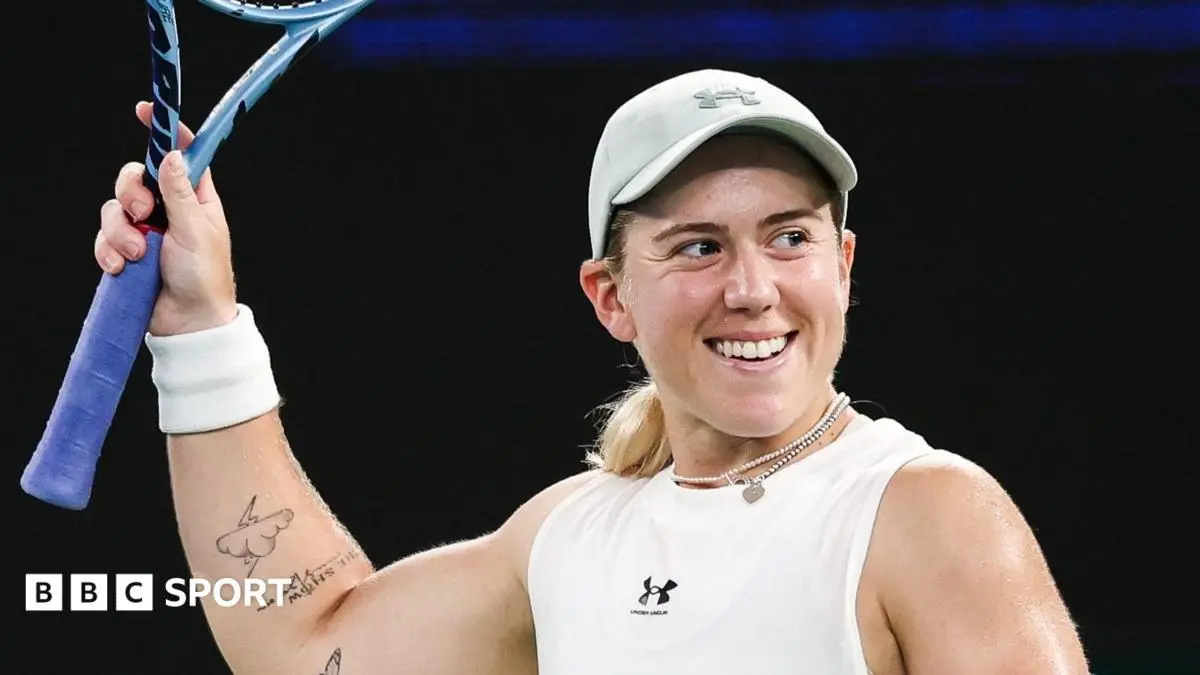
Sonay Kartal’s extraordinary "dream week" at the Wuhan Open reached new heights on Saturday as the British player secured a place in the biggest final of her professional career. In a match defined by resilience, tactical discipline, and nerves of steel, Kartal overcame former Grand Slam champion Jelena Ostapenko in straight sets to move within one victory of a WTA 1,000 title. The victory is not only a personal milestone for the 24-year-old but also a historic moment for the sport, as she becomes the lowest-ranked player to reach a final at this level since the WTA 1,000 format was established in 1990.
Currently the British number five, Kartal entered the tournament as the world number 170, a ranking that belies her talent but reflects a difficult season marred by health struggles. The Wuhan Open marks only her third competitive event since returning from a grueling six-month absence caused by a persistent back injury. Despite the lack of recent match play, Kartal’s composure was the deciding factor in her 7-6 (11-9) 7-6 (7-5) semi-final triumph over Latvia’s Ostapenko, a player known for her explosive power and unpredictable nature.
The match was a pulsating affair that tested Kartal’s mental fortitude from the opening serve. Ostapenko, the world number 34 and former world number five, started the contest with the kind of aggressive intent that won her the French Open in 2017. The Latvian stepped into the court immediately, hammering away a pair of blistering backhand winners off Kartal’s second serves in the very first two points. This early pressure paid dividends for Ostapenko, who secured an immediate break of serve and quickly established a commanding lead.
With the early advantage, Ostapenko began to play with the freedom and ferocity that often makes her "unplayable." She served with immense power and struck her groundstrokes with such velocity that Kartal was initially unable to impose any rhythm on the match. When Kartal found herself trailing by a double break at 4-1 in the opening set, it appeared as though the occasion and the opponent’s firepower might prove too much for the Briton.
However, the match underwent a dramatic shift as Ostapenko’s high-risk style began to falter. The Latvian is often described as a player who can "self-combust" when her aggressive shots stop finding the lines, and Kartal was ready to capitalize on the ensuing errors. Remaining level-headed despite the deficit, Kartal began to claw her way back into the set. She reclaimed one of the breaks of serve as Ostapenko grew increasingly wayward from the baseline, missing targets that she had been hitting with ease just moments prior.
The set became a battle of wills. Ostapenko briefly steadied herself, utilizing her formidable serve to pummel aces and winners, eventually moving to within a single hold of the opening set. Yet, the pressure of closing out the set seemed to weigh heavily on the Latvian. She became visibly agitated, failing twice to serve out the set at 5-4 and 6-5. Kartal’s persistence forced a tie-break, which proved to be one of the most intense segments of play in the tournament thus far. In a see-saw battle that stretched to 11-9, Kartal survived three set points, showing remarkable defensive skills and opportunistic shot-making to eventually take the lead.
The second set followed a nearly identical and equally dramatic pattern. Once again, Kartal found herself in a deep hole, trailing 4-1 as Ostapenko rediscovered her range. The Latvian’s statistical output was staggering; by the end of the match, she had tallied 50 winners and nine aces. On many occasions, Kartal could do little more than watch as the ball whistled past her. Nevertheless, the British player’s ability to keep her emotions on an even keel proved to be her greatest asset.
While Ostapenko struggled with the high-pressure moments, Kartal remained steadfast. She again survived three set points in the second set, refusing to let the match slip into a decider. Her ability to "ride the wave" of Ostapenko’s brilliance allowed her to stay in contention until the Latvian’s consistency dipped. The second tie-break was another narrow affair, but Kartal’s composure guided her to a 7-5 win, sealing a victory that will undoubtedly live long in her memory and the annals of British tennis.
Reflecting on the match, Kartal was quick to acknowledge the difficulty of facing such a powerful opponent. "That was probably one of the toughest matches I’ve ever played," she admitted. "At times she is unplayable and you have to ride that wave. Mentally, this is one of the best performances of my career."
The significance of this victory extends far beyond the scoreline. By reaching the final in Wuhan, Kartal has secured a massive jump in the world rankings. Before her six-month lay-off, she had climbed as high as 54th in the world, with a career-high of 44th. Her injury-induced absence saw her slide down the ladder, but her performance this week ensures a triumphant return to the elite. When the next rankings are released on Monday, Kartal is projected to return to the world’s top 50. Perhaps even more significantly for her domestic standing, she is set to become the new British number one.
Kartal’s journey to the Wuhan final is a testament to her perseverance. Returning from a back injury is a notoriously difficult task for any tennis player, given the physical demands of the modern game. To reach a WTA 1,000 final—one of the most prestigious prizes in tennis outside of the four Grand Slams—in only her third tournament back is a feat that has stunned observers. Her status as the lowest-ranked finalist in the history of this tournament tier highlights the magnitude of her achievement.
Standing between Kartal and the title is a formidable challenge. She will face either the six-time Grand Slam champion Iga Swiatek or the rising Polish star and French Open finalist Maja Chwalinska in Sunday’s showpiece final. Regardless of the opponent, Kartal will enter the match as the underdog, a role she has embraced throughout her run in China.
The final represents more than just a trophy; it is a validation of Kartal’s talent and her successful recovery from injury. Her run has captivated British tennis fans, providing a significant boost to the women’s game in the UK. As she prepares for the biggest match of her life, Kartal carries with her the confidence of a player who has already overcome the odds, both on the scoreboard and in her physical rehabilitation.
As the Wuhan Open draws to a close, the story of the tournament remains Kartal’s resilience. From the brink of defeat in both sets against a former major champion to the cusp of a WTA 1,000 title, her week in Wuhan has been nothing short of transformative. Whether she lifts the trophy on Sunday or not, her ascent to the top of the British rankings and her historic run as the world number 170 have already made this one of the most remarkable stories of the tennis season.