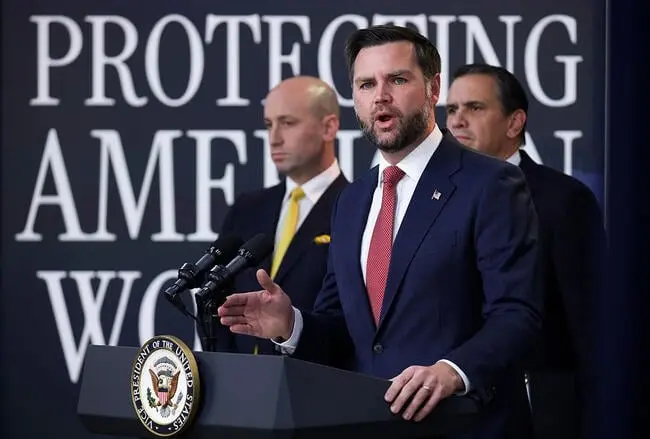
In a significant escalation of the administration’s crackdown on perceived labor and immigration fraud, Vice President JD Vance announced on Thursday that the Department of Labor has launched a sweeping investigation into nine of the nation’s most prestigious universities. The inquiry focuses on allegations that these institutions have systematically abused the J-1 visa program to recruit foreign researchers and educators at lower costs, thereby undercutting the wages and opportunities of American graduate students and academic professionals. Speaking from a podium flanked by senior advisors Stephen Miller and Todd Blanche, and set against a dark banner emblazoned with the words "Protecting American Workers," Vance described the findings of a preliminary data review as a troubling anomaly within the American higher education system.
The J-1 visa program, officially known as the Exchange Visitor Program, is designed to foster global cultural and educational exchange by allowing noncitizens to temporarily reside in the United States to teach, study, conduct research, or receive graduate medical training. However, Vance and officials from the Labor Department’s Task Force to Eliminate Fraud contend that several top-tier institutions have transformed this cultural exchange tool into a mechanism for securing cheap labor. The Vice President, who chairs the administration’s fraud task force, specifically identified a group of schools that he suggested were outliers in their reliance on foreign labor for federally funded projects.
The list of institutions currently under the federal microscope includes some of the most influential names in global academia: Harvard University, Yale University, Brown University, Stanford University, the Massachusetts Institute of Technology (MIT), the California Institute of Technology (Caltech), Arizona State University, the University of California, Davis, and the University of Pittsburgh. According to Vance, these nine universities demonstrate a statistical pattern of visa usage that deviates sharply from the national norm. He noted that while the national average for employing J-1 visa holders on federally funded grants stands at approximately 38 percent, the nine institutions in question utilize these visas at a rate of roughly 61 percent.
“Something weird is going on at these universities,” Vance told reporters during the press conference. He argued that the discrepancy suggests a deliberate effort to bypass the domestic labor market in favor of foreign nationals who are often paid significantly less than their American counterparts. Vance provided specific figures to illustrate the economic impact of this practice, asserting that an American graduate student or researcher typically earns about $20,000 more annually than an individual performing similar work on a J-1 visa. By opting for the lower-cost J-1 holders, Vance claimed, these universities are effectively suppressing the wages of American citizens and permanent residents who are seeking to build careers in research and academia.
The Labor Department’s Inspector General, Anthony D’Esposito, joined the Vice President at the briefing to provide details on the enforcement actions already underway. D’Esposito, a former New York Police Department detective, characterized the inquiry as a “historic investigation into J-1 visa fraud” and confirmed that subpoenas for records and communications have already been served to the targeted higher education institutions. He emphasized that the investigation is not merely about labor costs but also concerns the integrity of federal spending. D’Esposito pledged that his office would "follow the money and uncover the schemes," ensuring that American taxpayers are aware of how their funds are being allocated in the name of innovation and research.
The rhetoric from the Inspector General was notably pointed, reflecting a confrontational stance toward the ivory tower. D’Esposito stated that his background in law enforcement informed his approach to the case, and he issued a blunt warning to university administrators. "I don’t care how prestigious a university thinks it is," D’Esposito said. "Break the law and screw the American people, and I will personally cuff you in the university square. I don’t care how large your endowment is, how powerful your alumni are or how many politicians you have on speed dial." This aggressive tone underscores the administration’s broader commitment to holding large institutions accountable for what it views as a betrayal of the American workforce.
Beyond the immediate concerns regarding wages and labor competition, the investigation is also poised to examine broader issues of national security and foreign interference. D’Esposito noted that the inquiry would explore whether improper financial relationships, foreign influence, or visa abuses are compromising the security and independence of research funded by the federal government. He specifically pointed to concerns regarding China, suggesting that the misuse of visa programs could provide a gateway for foreign interests to exert undue influence over American intellectual property and scientific advancement.

The universities named in the investigation were quick to respond, with several issuing statements on Thursday afternoon defending their practices and the value of their international communities. The consensus among the schools was that they operate in full compliance with federal immigration and labor laws, and they argued that the presence of international scholars is a vital component of American scientific and economic leadership.
A spokesperson for Brown University confirmed that the institution has received a subpoena and intended to cooperate fully with the government’s request for records. However, the spokesperson also defended the university’s recruitment strategies, noting that international students and employees make "essential contributions" to the campus environment. The statement emphasized that the work performed by these individuals advances American innovation, competitiveness, and economic vitality, suggesting that a crackdown on these visas could inadvertently harm the very national interests the administration seeks to protect.
Arizona State University (ASU) also pushed back against the implications of the investigation. A university spokesperson highlighted ASU’s role as a leading producer of graduates in science, technology, engineering, and mathematics (STEM) fields. The university noted that it employs one of the largest technical and scientific workforces in the country, a feat that requires hiring the best available talent from a global pool. ASU maintained that its hiring practices have always been in complete compliance with United States policy and law, and that its efforts directly benefit both the state and national economies.
At MIT, Kimberly Allen, the executive director of media relations, described the Labor Department’s subpoena as “very broad” and noted that the university is currently in the process of reviewing the document. Allen pointed out that the U.S. government itself is responsible for vetting every individual who receives a J-1 visa, implying that any systemic issues with the program should be addressed at the regulatory level rather than through punitive measures against universities. She reiterated the importance of attracting top global talent, describing it as a "national strength" and a "competitive advantage" that should be supported by the government rather than curtailed.
Stanford University echoed these sentiments, with a spokesperson stating that the university complies with all applicable visa laws and intends to cooperate with the federal investigation. The University of California, Davis, the University of Pittsburgh, Harvard, Yale, and Caltech did not immediately provide detailed rebuttals, though the general sentiment from the academic community suggests a mounting concern that the investigation is politically motivated or based on a misunderstanding of how high-level research is conducted in the 21st century.
The tension between the administration and the academic elite highlights a fundamental debate over the future of the American labor market. For Vance and the Labor Department, the issue is one of fairness and the protection of domestic workers from being priced out of their own country’s institutions. They argue that if universities are receiving billions of dollars in federal grants, they have a moral and legal obligation to prioritize the American workforce.
Conversely, the universities argue that the pursuit of scientific breakthroughs requires a borderless approach to talent. They contend that the $20,000 wage gap cited by Vance may not account for the different levels of experience, specific roles, or the temporary nature of the J-1 visitor status compared to long-term faculty or staff positions. Furthermore, they warn that aggressive enforcement actions could create a "chilling effect," discouraging the world’s brightest minds from bringing their expertise to American shores, which could ultimately allow rival nations to overtake the United States in critical fields like artificial intelligence, biotechnology, and renewable energy.
As the Labor Department begins the arduous process of reviewing the subpoenaed records, the investigation is expected to be a long-term endeavor. The Task Force to Eliminate Fraud has signaled that these nine universities may only be the beginning, as they continue to analyze visa data across other sectors of the economy. For now, the focus remains on the halls of some of the world’s most famous educational institutions, where the intersection of immigration policy, federal funding, and labor rights has become a high-stakes battlefield. The outcome of the investigation could have profound implications for how American universities operate and how they balance their global aspirations with their domestic responsibilities.