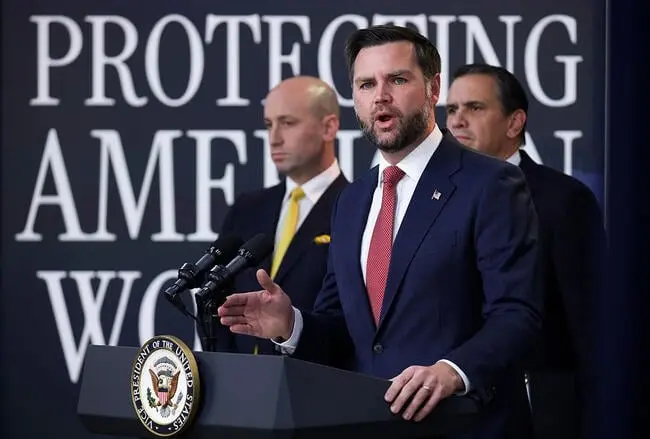
In a significant escalation of the administration’s crackdown on perceived labor and immigration fraud, Vice President JD Vance announced on Thursday that the Department of Labor has launched a sweeping investigation into nine of the nation’s most prestigious universities. The inquiry focuses on allegations that these institutions have systematically abused the J-1 visa program to recruit foreign researchers and educators at lower costs, thereby undercutting the wages and opportunities of American graduate students and academic professionals. Speaking from a podium flanked by senior advisors Stephen Miller and Todd Blanche, and set against a dark banner emblazoned with the words "Protecting American Workers," Vance described the findings of a preliminary data review as a troubling anomaly within the American higher education system.
The J-1 visa program, officially known as the Exchange Visitor Program, is designed to foster global cultural and educational exchange by allowing noncitizens to temporarily reside in the United States to teach, study, conduct research, or receive graduate medical training. However, Vance and officials from the Labor Department’s Task Force to Eliminate Fraud contend that several top-tier institutions have transformed this cultural exchange tool into a mechanism for securing cheap labor. The Vice President, who chairs the administration’s fraud task force, specifically identified a group of schools that he suggested were outliers in their reliance on foreign labor for federally funded projects.
The list of institutions currently under the federal microscope includes some of the most influential names in global academia: Harvard University, Yale University, Brown University, Stanford University, the Massachusetts Institute of Technology (MIT), the California Institute of Technology (Caltech), Arizona State University, the University of California, Davis, and the University of Pittsburgh. According to Vance, these nine universities demonstrate a statistical pattern of visa usage that deviates sharply from the national norm. He noted that while the national average for employing J-1 visa holders on federally funded grants stands at approximately 38 percent, the nine institutions in question utilize these visas at a rate of roughly 61 percent.
“Something weird is going on at these universities,” Vance told reporters during the press conference. He argued that the discrepancy suggests a deliberate effort to bypass the domestic labor market in favor of foreign nationals who are often paid significantly less than their American counterparts. Vance provided specific figures to illustrate the economic impact of this practice, asserting that an American graduate student or researcher typically earns about $20,000 more annually than an individual performing similar work on a J-1 visa. By opting for the lower-cost J-1 holders, Vance claimed, these universities are effectively suppressing the wages of American citizens and permanent residents who are seeking to build careers in research and academia.
The Labor Department’s Inspector General, Anthony D’Esposito, joined the Vice President at the briefing to provide details on the enforcement actions already underway. D’Esposito, a former New York Police Department detective, characterized the inquiry as a “historic investigation into J-1 visa fraud” and confirmed that subpoenas for records and communications have already been served to the targeted higher education institutions. He emphasized that the investigation is not merely about labor costs but also concerns the integrity of federal spending. D’Esposito pledged that his office would "follow the money and uncover the schemes," ensuring that American taxpayers are aware of how their funds are being allocated in the name of innovation and research.