The Labor Department has initiated a sweeping investigation into nine of the nation’s most prominent higher education institutions, accusing them of systematically abusing the J-1 visa program to suppress wages and displace American researchers. Vice President JD Vance announced the probe during a high-profile press conference on Thursday, signaling a significant escalation in the administration’s efforts to crack down on what it characterizes as the exploitation of foreign labor programs by elite academic institutions.
The investigation, led by the Department of Labor’s Office of Inspector General, focuses on allegations that these universities have used the J-1 visa—a program intended for temporary educational and cultural exchange—to recruit foreign nationals for roles that would otherwise be filled by American graduate students and researchers at higher pay scales. According to administration officials, the practice has not only disadvantaged domestic workers but has also raised concerns regarding the integrity of federally funded research.
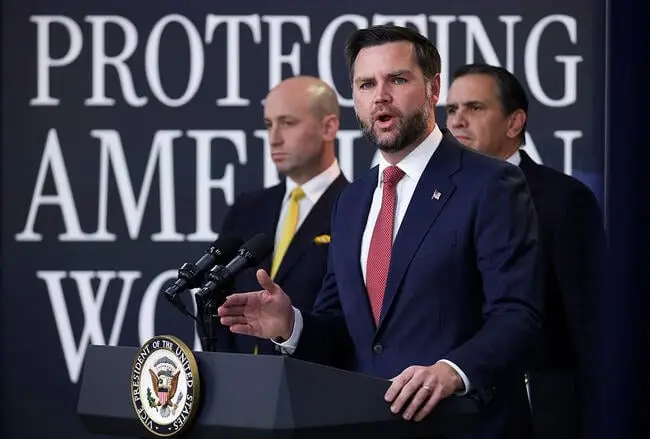
Speaking from a podium flanked by Stephen Miller and Todd Blanche, Vice President Vance, who chairs the administration’s Task Force to Eliminate Fraud, presented data suggesting a stark disparity in how certain elite institutions utilize the visa program compared to the rest of the country.
“Something weird is going on at these universities,” Vance said, citing internal data on J-1 visa usage. “They’re using these visas way too much. They’re using them to undercut the wages of American grad students and American researchers.”
The Scope of the Investigation
The universities named in the investigation include some of the most prestigious names in global academia: Harvard University, Yale University, Stanford University, Brown University, the Massachusetts Institute of Technology (MIT), and the California Institute of Technology (Caltech). Also under scrutiny are Arizona State University, the University of Pittsburgh, and the University of California, Davis.
At the heart of the government’s case is a statistical outlier in the employment of J-1 visa holders for projects funded by federal grants. Vance noted that while the national average for using J-1 visas on federally funded research grants stands at approximately 38 percent, the nine institutions currently under investigation are employing them at a rate of about 61 percent.
The administration contends that this reliance on foreign labor is a cost-saving measure that directly harms the American workforce. According to Vance, the wage gap is substantial; he stated that an American graduate student or researcher typically earns roughly $20,000 more than a counterpart working under a J-1 visa in a similar capacity. By opting for the lower-cost foreign labor, the Vice President argued, these universities are effectively siphoning opportunities away from domestic talent while benefiting from taxpayer-funded research budgets.
The J-1 visa program was designed to allow noncitizens to temporarily enter the United States to teach, lecture, conduct research, or receive graduate medical education. However, the Labor Department’s inspector general, Anthony D’Esposito, characterized the current situation as a departure from the program’s original intent, describing the inquiry as a “historic investigation into J-1 visa fraud.”
Aggressive Oversight and Legal Action