The Labor Department has initiated a sweeping investigation into nine of the nation’s most prominent higher education institutions, accusing them of systematically abusing the J-1 visa program to suppress wages and displace American researchers. Vice President JD Vance announced the probe during a high-profile press conference on Thursday, signaling a significant escalation in the administration’s efforts to crack down on what it characterizes as the exploitation of foreign labor programs by elite academic institutions.
The investigation, led by the Department of Labor’s Office of Inspector General, focuses on allegations that these universities have used the J-1 visa—a program intended for temporary educational and cultural exchange—to recruit foreign nationals for roles that would otherwise be filled by American graduate students and researchers at higher pay scales. According to administration officials, the practice has not only disadvantaged domestic workers but has also raised concerns regarding the integrity of federally funded research.
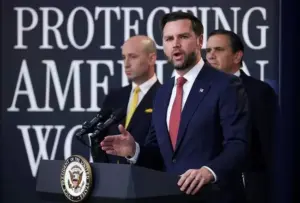
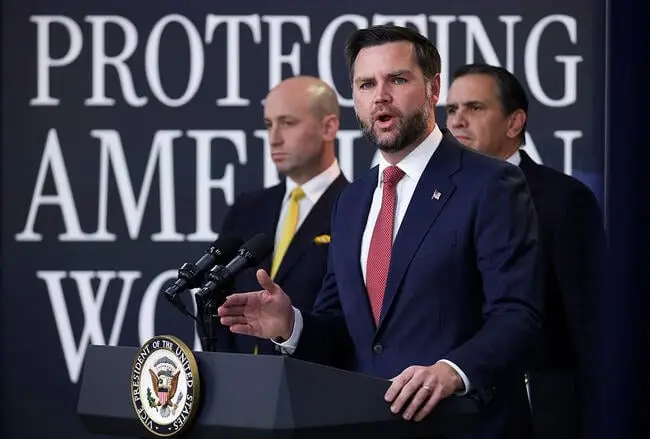
Speaking from a podium flanked by Stephen Miller and Todd Blanche, Vice President Vance, who chairs the administration’s Task Force to Eliminate Fraud, presented data suggesting a stark disparity in how certain elite institutions utilize the visa program compared to the rest of the country.
“Something weird is going on at these universities,” Vance said, citing internal data on J-1 visa usage. “They’re using these visas way too much. They’re using them to undercut the wages of American grad students and American researchers.”
The Scope of the Investigation
The universities named in the investigation include some of the most prestigious names in global academia: Harvard University, Yale University, Stanford University, Brown University, the Massachusetts Institute of Technology (MIT), and the California Institute of Technology (Caltech). Also under scrutiny are Arizona State University, the University of Pittsburgh, and the University of California, Davis.
At the heart of the government’s case is a statistical outlier in the employment of J-1 visa holders for projects funded by federal grants. Vance noted that while the national average for using J-1 visas on federally funded research grants stands at approximately 38 percent, the nine institutions currently under investigation are employing them at a rate of about 61 percent.
The administration contends that this reliance on foreign labor is a cost-saving measure that directly harms the American workforce. According to Vance, the wage gap is substantial; he stated that an American graduate student or researcher typically earns roughly $20,000 more than a counterpart working under a J-1 visa in a similar capacity. By opting for the lower-cost foreign labor, the Vice President argued, these universities are effectively siphoning opportunities away from domestic talent while benefiting from taxpayer-funded research budgets.
The J-1 visa program was designed to allow noncitizens to temporarily enter the United States to teach, lecture, conduct research, or receive graduate medical education. However, the Labor Department’s inspector general, Anthony D’Esposito, characterized the current situation as a departure from the program’s original intent, describing the inquiry as a “historic investigation into J-1 visa fraud.”
Aggressive Oversight and Legal Action
The investigation has already moved into a formal legal phase. During the press conference, officials confirmed that subpoenas have been served to the involved higher education institutions, demanding a comprehensive review of their records pertaining to foreign labor programs.
Inspector General D’Esposito, a former New York Police Department detective, struck a defiant and aggressive tone during the announcement. He emphasized that the investigation would “follow the money” to uncover what he described as schemes designed to circumvent labor protections.
“I don’t care how prestigious a university thinks it is,” D’Esposito said. “Break the law and screw the American people, and I will personally cuff you in the university square. I don’t care how large your endowment is, how powerful your alumni are, or how many politicians you have on speed dial.”
D’Esposito’s remarks underscored a broader concern within the administration: the potential for foreign influence to compromise American innovation. He noted that the investigation would explore whether “foreign influence, improper financial relationships, or visa abuse” are impacting research funded by U.S. taxpayers. While the probe covers a range of administrative issues, D’Esposito specifically pointed to concerns regarding China, suggesting that the misuse of visa programs could provide an avenue for foreign entities to gain undue access to sensitive American research and development.
Universities Defend International Collaboration

In the wake of the announcement, several of the named universities issued statements defending their practices and the value of their international scholarly communities. While most confirmed they would cooperate with the Labor Department’s inquiries, they pushed back against the narrative that their use of J-1 visas is predatory or illegal.
A spokesperson for Brown University confirmed that the institution had received a subpoena for records related to foreign labor programs and stated that the university intends to respond promptly. However, the spokesperson also defended the presence of international staff on campus.
“Brown’s international scholars, students and employees make essential contributions on our campus, including to teaching and research that advances American innovation, competitiveness and economic vitality,” the spokesperson said in an email.
Similarly, MIT expressed support for the role of global talent in maintaining the United States’ edge in science and technology. Kimberly Allen, the university’s executive director of media relations, noted that the Labor Department’s subpoena was “very broad” and is currently under review by the institution.
“We value international students and scholars on our campus,” Allen said. “America’s ability to attract top talent from around the world while protecting U.S. economic and security interests is a national strength, and that competitive advantage should be supported.” She also pointed out that the federal government itself vets every J-1 visa holder before they are permitted to enter the country and begin their work.
Arizona State University (ASU), which was singled out alongside the Ivy League institutions, highlighted its role as a major producer of STEM (science, technology, engineering, and mathematics) graduates. An ASU spokesperson noted that the university employs one of the largest technical and scientific workforces in the nation, which they argued is a boon to both the state and national economies.
“ASU has hired the talent needed to perform these functions and done so in complete compliance with existing United States policy and law,” the spokesperson said, emphasizing that their hiring practices are designed to meet the high demand for specialized research talent.
Stanford University also issued a brief statement, asserting that it complies with all applicable visa laws and will cooperate fully with the federal investigation.
The Economic and National Security Context
The investigation arrives at a time of heightened scrutiny regarding the intersection of higher education, federal funding, and immigration policy. The administration’s focus on the $20,000 wage disparity suggests a shift toward viewing university research environments through the lens of domestic labor protection.
For years, the American academic model has relied heavily on the influx of international talent, particularly in high-level STEM fields where domestic supply often struggles to meet the demands of massive, federally funded research projects. Universities argue that the J-1 program is a vital tool for maintaining the United States’ position as the world’s premier destination for scientific inquiry.
However, the Task Force to Eliminate Fraud appears to be challenging the status quo, suggesting that the "competitive advantage" described by universities may actually be a mechanism for labor exploitation that suppresses the earning potential of American citizens. By highlighting the 61 percent usage rate at these nine institutions, the administration is attempting to paint a picture of an academic elite that has become disconnected from the economic interests of the American public.
Furthermore, the mention of "foreign influence" and China adds a national security dimension to what might otherwise be a budgetary or labor dispute. The administration has frequently raised alarms about the theft of intellectual property and the potential for foreign governments to use academic exchanges as a means of industrial espionage. By linking J-1 visa "abuse" to these broader security concerns, the Labor Department is positioning the investigation as a matter of national defense as much as a matter of labor law.
As the Labor Department begins the process of reviewing the documents obtained through its subpoenas, the higher education sector is bracing for a protracted legal and political battle. The outcome of the investigation could have far-reaching implications for how universities staff their research departments and how the federal government oversees the billions of dollars in grants it distributes annually to the nation’s top colleges.
For now, the administration remains firm in its stance. As Inspector General D’Esposito noted, the focus remains on ensuring that federal money is used to support American workers and that prestigious institutions are held to the same legal standards as any other employer. The investigation continues as the Labor Department seeks to determine if the "something weird" identified by Vice President Vance constitutes a systemic violation of federal law.