As the battle for control of the United States Congress intensifies ahead of the midterm elections, President Donald Trump has introduced a distinctive and highly personal metric for evaluating the Republican candidates he supports: their physical appearance. In a series of high-energy rallies across the country, the President has increasingly moved beyond traditional political resumes and policy platforms, instead offering the American electorate a series of "handsomeness appraisals" that frame his preferred candidates as individuals who look the part of leadership.
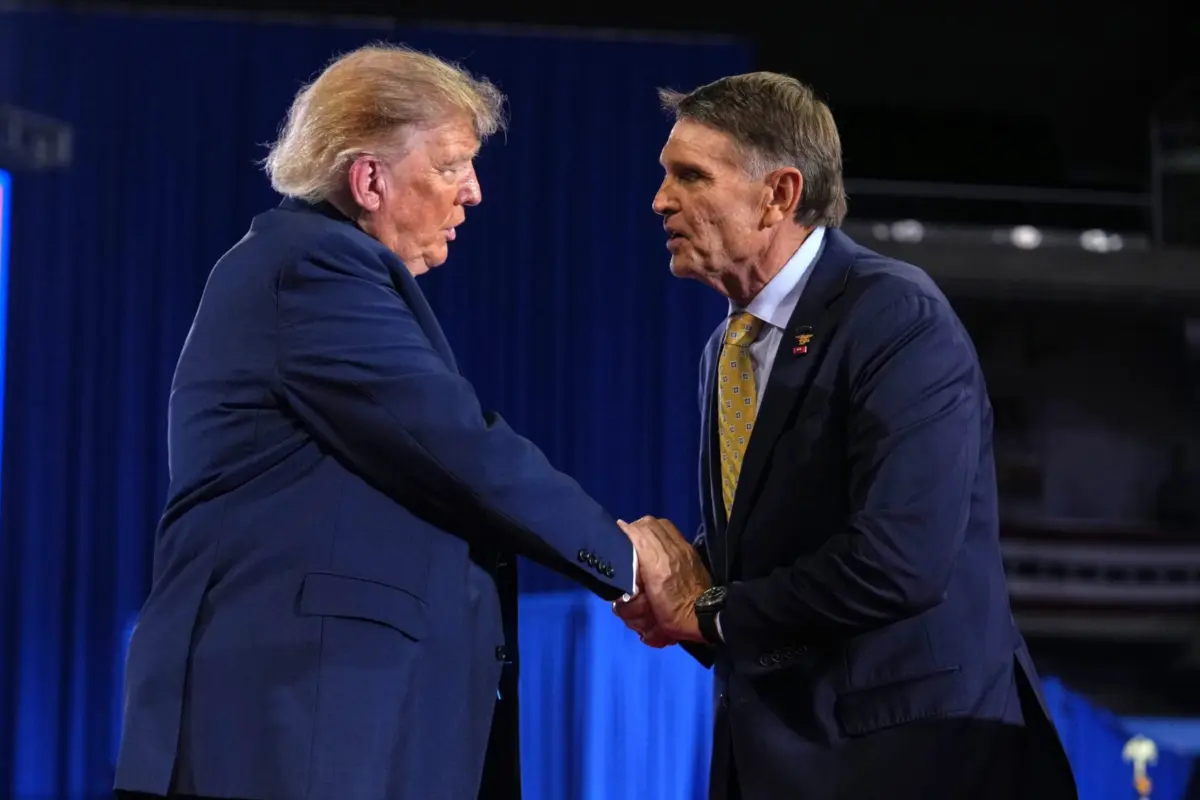
This unconventional approach was on full display during a Saturday rally in Kentucky, where the President took a moment to admire U.S. House candidate Ed Gallrein. A former U.S. Navy SEAL known for his disciplined bearing and an angular, rugged face, Gallrein stood near the stage as Trump paused his prepared remarks to draw the crowd’s attention to the candidate’s physical presence.
“Look at this beautiful guy,” Trump told the gathered supporters, gesturing toward Gallrein. In a phrase that has become a staple of his political lexicon, the President added, “Central casting.”
The “central casting” refrain is one that Trump has deployed frequently since his transition from the private sector to the Oval Office. It serves as a window into a worldview shaped by decades in the entertainment industry and high-stakes branding. Before entering the political arena, Trump owned the Miss Universe beauty pageant and cemented his national celebrity as the star of the reality television series “The Apprentice.” In those environments, aesthetics were not merely a surface-level concern; they were a primary measuring stick for success, marketability, and authority. Now, that same lens is being applied to the selection and promotion of the men and women who seek to represent the Republican Party in Washington.
The President’s focus on visual appeal comes at a time when the midterm elections are already being shaped by a broader national conversation regarding gender and political identity. Recent debates within the GOP and across the aisle have frequently touched upon which candidates project a more traditional sense of masculinity, a theme that Trump’s endorsements often reinforce. For the President, the outcome of these races is existential; the results will determine whether Republicans maintain their grip on Congress or if Trump will spend the remainder of his term facing a newly emboldened and aggressive Democratic opposition.
The Kentucky rally was not an isolated incident. Shortly after touting Gallrein’s "beauty," the President shifted his attention to Senator Jon Husted, the Ohio Republican currently campaigning for reelection. Trump’s description of Husted was even more granular, characterizing the Senator as a “perfect person” and a “good-looking guy.”
In a moment that elicited a wave of laughter from the audience, Trump launched into a droll, highly detailed assessment of Husted’s physique. “I examined his ass,” Trump said, leaning into the comedic timing of the remark. “I never did that with a man before. I examined his ass. And then I looked at his shoulders. I looked at his feet. I looked at his hand. I looked at his jawline.”
The commentary served as a reprise of similar remarks Trump had made during an earlier appearance in Ohio. On that occasion, the President had also praised Husted’s physical stature, specifically referencing the Senator’s history as a college football player. For Trump, the "football player" archetype—broad-shouldered, athletic, and physically imposing—represents the ideal image of a Republican leader, fitting neatly into the "central casting" mold he prizes.
However, the President’s aesthetic evaluations are not always complimentary. While he uses physical praise as a tool for endorsement, he also utilizes visual critique as a method of "tough love" or even public ridicule, even when dealing with members of his own party. Ken Paxton, a Republican Senate candidate in Texas, recently found himself on the receiving end of such a critique.
During the party’s midterm convention in Texas, as Paxton stood nearby with a grin, Trump offered a blunt assessment of the candidate’s appearance. “I don’t really like the way he looks,” Trump remarked. He had previously noted that while such a comment might be considered "insulting," he felt compelled to say it anyway.
The President’s criticism of Paxton appeared to be focused on style and presentation rather than inherent physical traits. Trump suggested that Paxton’s record as a conservative attorney general was his strongest asset, one that “speaks a lot louder than the suit he’s wearing that doesn’t look so great.” This distinction highlights a core element of the Trumpian political philosophy: while a candidate’s record and loyalty are paramount, their failure to meet the President’s standards for "the look" remains a point of public contention.
Democratic candidates are also frequently subjected to the President’s visual judgments, though in their case, the remarks are often designed to diminish or emasculate. When discussing Paxton’s opponent, Democratic candidate James Talarico, Trump has frequently relied on a specific pop-culture comparison. He told supporters that Talarico reminds him of Alfred E. Neuman, the iconic, freckled, gap-toothed mascot of MAD magazine. By equating a political opponent with a cartoon character known for his "What, me worry?" catchphrase and goofy appearance, Trump attempts to frame the Democrat as a non-serious figure.
A similar tactic was employed against Senator Jon Ossoff, a Democrat who has often been characterized by the media as a "heartthrob" with a chiseled jawline that some observers have compared to Husted’s. During a Friday rally in Georgia held for Ossoff’s opponent, Representative Mike Collins, Trump took the opportunity to challenge Ossoff’s reputation for good looks.
The President compared Ossoff to Pee-wee Herman, the comedic character known for a waxy complexion, a tight suit, and a distinctive widow’s peak. “Somebody said, ‘He’s a good-looking man.’ I don’t think he’s a good-looking man,” Trump declared to the Georgia crowd.
In contrast, Trump offered a glowing review of Mike Collins, framing him as the visual and masculine opposite of his opponent. “I actually think Mike Collins is a good-looking man, and he’s all man,” Trump said, emphasizing the candidate’s perceived strength and traditional masculine appeal.
The President then extended his visual endorsement to the Republican nominee for Georgia governor. “And I actually think that Rick Jackson is a very handsome, distinguished, beautiful-looking guy,” Trump added, before moving on with the dismissive transition, “But anyway.”
The consistent use of these appraisals suggests that for President Trump, the "image" of the Republican Party is a vital component of its political survival. By framing candidates like Gallrein, Husted, Collins, and Jackson as "beautiful," "distinguished," or "all man," he is attempting to build a brand for the GOP that is synonymous with physical vigor and cinematic leadership. Conversely, by mocking the appearance of Paxton’s suit or comparing Democrats to comedic characters, he seeks to undermine the perceived authority of his opponents.
This focus on aesthetics is more than just a quirk of the President’s personality; it is a calculated part of his communication strategy. In an era where political messaging is consumed through short video clips and social media images, the "look" of a candidate can often resonate with voters as much as their policy positions. Trump’s reliance on his background in pageantry and television allows him to speak to his base in a language they recognize—the language of branding and celebrity.
As the midterm cycle enters its final, most critical phase, the President’s "central casting" approach will continue to be a hallmark of his campaign stops. Whether these visual endorsements will translate into the votes necessary to hold the House and Senate remains to be seen. However, in the theater of American politics, Donald Trump has made it clear that he believes the first step toward winning the office is looking like you already belong there.