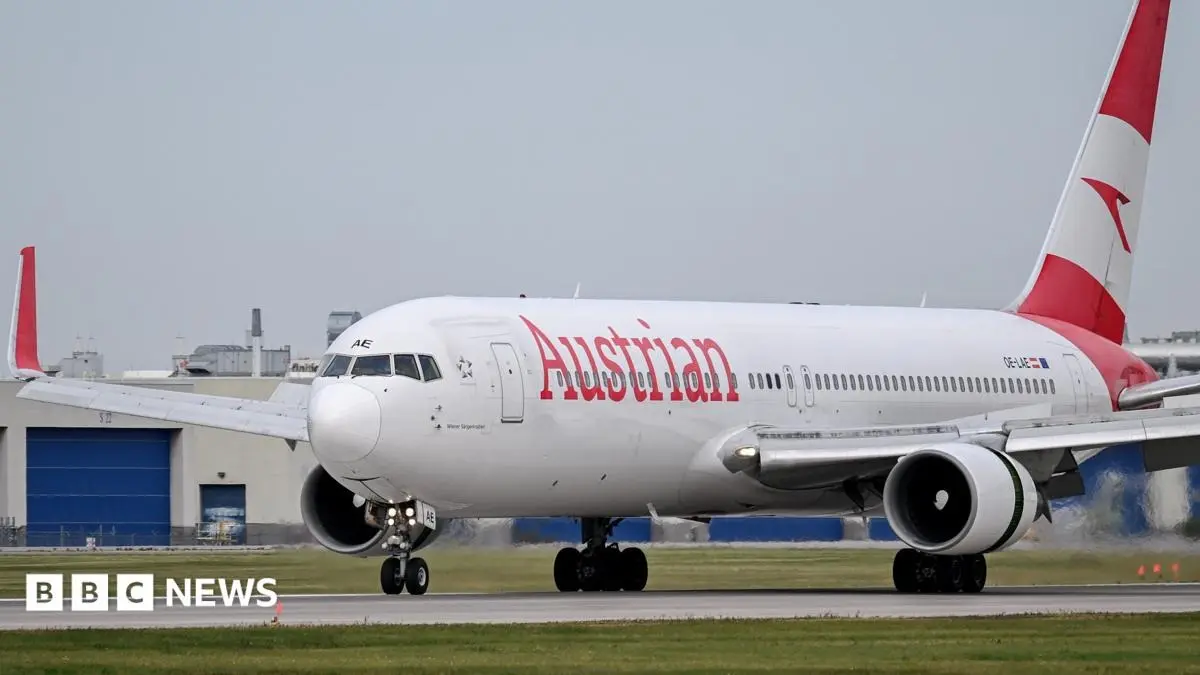
An Austrian Airlines passenger flight traveling from Israel to Austria was forced to make an emergency diversion and landing in Bulgaria late Sunday night following a reported bomb threat made while the aircraft was airborne over Southeastern Europe. Flight OS 82, operated by an Airbus A320 carrying 51 passengers and six crew members, was en route from Tel Aviv’s Ben Gurion Airport to Vienna when the security alert was raised, prompting immediate emergency response protocols across regional air traffic control networks and national defense agencies.
According to an official statement issued by the Bulgarian Transport Ministry, the flight was cruising over Romanian airspace when the threat was communicated, triggering an urgent operational decision to divert the twin-engine jet away from its original flight path toward the nearest suitable airport equipped to manage high-level aviation security contingencies. Air traffic controllers and defense authorities designated Vasil Levski Airport in the Bulgarian capital of Sofia as the emergency destination, leading to a swift operational response both in the air and on the ground.
In response to the potential emergency, the Bulgarian Air Force immediately scrambled a MiG-29 fighter jet from its air defense system to intercept and escort the commercial airliner as it entered Bulgarian airspace. The military jet accompanied the Airbus A320 continuously during its descent toward Sofia, providing air security and visual monitoring until the passenger plane touched down safely on the runway.
Upon landing at Vasil Levski Airport, approximately 30 minutes after the initial emergency alert was raised over Romania, the aircraft was brought to a stop in a designated secure area of the airfield. Specialized security teams, law enforcement personnel, and ground emergency services met the plane on the tarmac, where officials immediately initiated a complete emergency evacuation of all 51 passengers and six crew members on board.
Bulgarian authorities, working in coordination with airport security personnel, conducted a thorough and comprehensive search of the entire airliner. The security protocol included meticulous sweeps of the passenger cabin, flight deck, cargo holds, and all checked and carry-on luggage. Following the extensive search of the vessel and its contents, security forces confirmed that no explosive devices, dangerous materials, or active threats were found anywhere on board.
Austrian Airlines confirmed that a threat had been made against the flight, though the carrier refrained from releasing additional operational details regarding the specific nature or transmission channel of the warning. A spokesperson for Austrian Airlines told the BBC that a total of 51 passengers and six crew members were on board the jet at the time of the event. The spokesperson emphasized that no injuries were reported among those on board throughout the emergency diversion, evacuation, or subsequent security procedures on the ground.
Following the completion of the security search and formal clearance from Bulgarian authorities, the Airbus A320 was cleared to resume its commercial operation. Austrian Airlines confirmed that the aircraft subsequently took off from Sofia with all 51 passengers and six crew members back on board, successfully completing the final leg of the journey to its original destination at Vienna International Airport. Flight tracking data recorded that Austrian Airlines Flight 82 originally departed Ben Gurion Airport in Tel Aviv on Sunday evening before making its unscheduled landing at Vasil Levski Airport in Sofia approximately three hours later, prior to its ultimate departure for Austria.
An official investigation into the origin and circumstances surrounding the bomb threat has been formally launched by authorities. Security officials are analyzing communication logs and threat reports to identify the source responsible for issuing the warning that caused the international military scramble and airborne disruption.
The emergency diversion in Sofia comes amid a period of heightened sensitivity and security vigilance regarding commercial aviation routes connecting Israel, the Middle East, and European air corridors. Recent weeks have seen multiple high-profile security incidents and false alarms that have placed commercial flight crews, air traffic controllers, and national military forces on elevated alert across the region.
Just last month, a severe security crisis occurred aboard a Flydubai passenger flight bound for Tel Aviv when a pilot attempted to hijack the aircraft mid-flight. During that incident, the pilot launched an physical attack against the flight’s captain inside the cockpit while the aircraft was en route to its destination in Israel. The crisis was successfully resolved mid-air when the flight’s crew members and passengers intervened together, overpowering the attacker and securing the cockpit.
Following the containment of the airborne attack aboard the Flydubai flight, the remaining crew members managed to navigate the aircraft to a safe emergency landing in Saudi Arabia. That incident highlighted the operational challenges facing commercial flights operating in regional airspace, demonstrating the critical role of onboard crew training and rapid intervention during airborne emergencies.
In another recent incident demonstrating the high state of readiness across European air defense networks, quick-reaction fighter jets were deployed in Central Europe last week after a commercial passenger airliner accidentally sent out a emergency alert. That event involved a commercial flight traveling from the Greek holiday island of Corfu to the German city of Nuremberg.
During that flight, an emergency hijacking code was accidentally transmitted from the aircraft’s transponder. The automated transmission immediately activated national air defense protocols, prompting both Croatia and Germany to scramble supersonic fighter jets to intercept the airliner mid-flight. The military pilots conducted visual checks and established contact with the flight crew to confirm that the aircraft was safe before the alert was confirmed as an accidental code entry and standing air defense measures were stood down.
The rapid execution of emergency procedures during the Austrian Airlines diversion to Sofia underscores the established frameworks governing civil-military coordination during airborne threats. When Flight OS 82 received the security alert over Romania, multi-national air traffic protocols allowed flight commanders to make an immediate decision to land at Sofia within a 30-minute timeframe, ensuring the safety of everyone on board.
The tactical deployment of the Bulgarian Air Force MiG-29 fighter jet served to maintain direct visual oversight of the commercial jet from the moment it entered Bulgarian airspace until its wheels touched down in Sofia. Military escorts in these scenarios provide continuous communication support to air traffic management, monitoring the target aircraft for any external signs of distress or abnormal maneuvers while ensuring that civil airspace remains clear and secure around the affected plane.
Once on the ground at Vasil Levski Airport, the prompt evacuation of all 57 individuals allowed law enforcement officers and bomb disposal units to perform their security duties without risk to human life. The thorough sweep of the airframe, passenger seats, overhead bins, and cargo holds ensured that the plane was entirely safe before any consideration was given to resuming the flight schedule.
The confirmation by Austrian Airlines that no threat was located provided immediate relief to the passengers and crew who experienced the mid-air disruption. The fact that the same flight crew and passenger contingent were able to re-board the Airbus A320 in Sofia and complete their flight to Vienna demonstrated the thoroughness of the clear verdict delivered by the Bulgarian authorities.
As the formal investigation into the false threat continues, international authorities continue to emphasize the significant operational burdens and legal consequences associated with security hoaxes targeted at commercial flights. Incidents of this nature divert critical defense assets, require emergency responses at civilian airports, and create substantial logistical disruptions for international air transport networks.
The series of events surrounding Austrian Airlines Flight 82—from its evening takeoff in Tel Aviv, through its military-escorted landing in Bulgaria, to its final clear inspection and safe arrival in Vienna—demonstrates the operational focus of international aviation security systems. Though the bomb threat was determined to be unfounded, the response by Austrian Airlines, air traffic control, and the Bulgarian Air Force ensured that passenger and crew safety remained fully protected throughout the emergency.