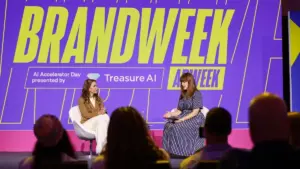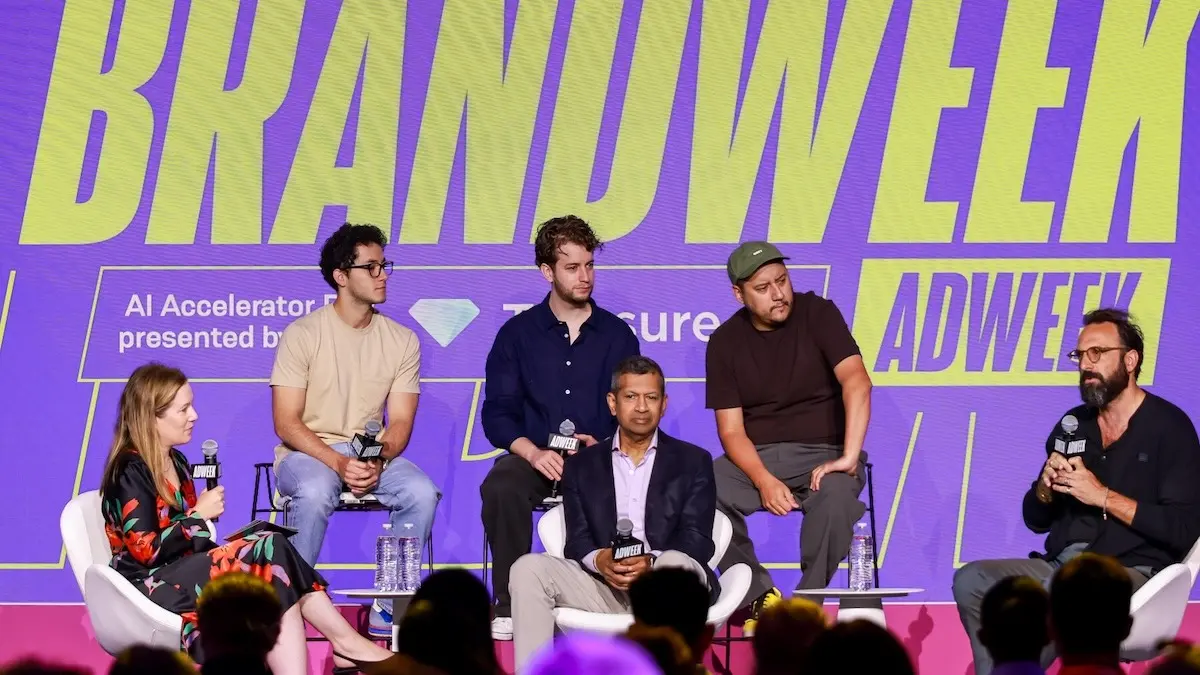
In the bustling atmosphere of Midtown, where the intersections of commerce and creativity often collide, the conversation surrounding artificial intelligence has shifted. What was once a discourse dominated by existential dread and technical jargon has evolved into a more nuanced exploration of craft, expression, and the enduring necessity of the human touch. This evolution was on full display during a recent fireside chat at Brandweek 2026, an event hosted by ADWEEK House, where industry leaders gathered to dissect the current state of AI-driven storytelling.
The session, co-hosted by Higgsfield AI, brought together some of the most influential voices in the modern media landscape. Zoë Ruderman, Chief Content Officer of ADWEEK, led a deep-dive conversation with Mahi de Silva, the co-founder and Chief Strategy Officer of Higgsfield AI. Their discussion aimed to move past the speculative debates that have characterized the last several years of the "AI revolution" and instead focus on the tangible ways in which AI-native creative suites are being integrated into the professional workflow.
The timing of the discussion is significant. As the advertising industry moves deeper into the late 2020s, the novelty of generative AI has largely worn off, replaced by a demand for utility, reliability, and creative control. For Higgsfield AI, a platform that has spent the last year and a half positioning itself at the center of this transition, the goal is no longer just to prove that the technology works, but to prove that it belongs in the hands of the world’s most sophisticated storytellers.
A new language for creators
Higgsfield AI entered the market approximately 17 months ago, a period during which the public perception of AI shifted almost monthly. In those early days, as de Silva recalled, the platform was often dismissed by the creative community as little more than a "toy." This skepticism was not unique to Higgsfield; it mirrored a broader industry-wide doubt regarding whether machines could ever produce anything of professional-grade quality or if they were merely capable of producing uncanny, unpolished simulations.
However, as the technology matured and creators began to experiment with its capabilities, that perception began to change. According to de Silva, the realization that Higgsfield was a serious tool came when users stopped looking at it as an automated replacement and started viewing it as an extension of their own creative intent.
"It’s not here to replace you," de Silva emphasized during the talk. "It is a new language for creators, and it’s a new form of expression—the ability for them to fully realize what’s in their brain without the physical limits of cameras, lighting, location, and budget."
This concept of AI as a "language" suggests a fundamental shift in how creative work is produced. In traditional advertising, the gap between a creative idea and its execution is often filled with logistical hurdles. A director might envision a specific sunset in a specific desert, but the realities of travel, weather, and production costs frequently force compromises. De Silva argues that AI-native tools remove these barriers, allowing the creator to communicate their vision directly to the screen.
In the daily workflows of modern agencies, Higgsfield is being used not just for the final product, but as an integral part of the entire lifecycle of a campaign. From the initial ideation and storyboarding phases to the final production, the platform allows for a level of agility that was previously impossible. This allows for work to be produced, as de Silva noted, at a fraction of the budget and a fraction of the time, without necessarily sacrificing the creative integrity of the piece.
One of the more compelling metaphors de Silva used to describe the platform was that of a "booster seat." This framing is intended to demystify the technology for those who may feel overwhelmed by the technical requirements of early AI tools.
"It’s really like a booster seat for you—it helps you get in the game of AI without becoming a prompt engineer," he explained. "It’s a tool for expression, right? It’s a platform that helps creators become more productive."
By lowering the barrier to entry, Higgsfield aims to ensure that the creative process remains focused on the "expression" rather than the "engineering." To address those who remain skeptical of AI’s place in the arts, de Silva looked back at the history of the industry. He pointed out that thirty years ago, the introduction of Adobe Photoshop sparked similar debates about the "death of photography" and the loss of authenticity in visual media. Today, Photoshop is an invisible, indispensable part of the creative process. In de Silva’s view, AI is currently undergoing that same journey from a controversial disruptor to a standard industry tool.
What AI can and can’t do
The conversation shifted from the theoretical to the practical when Ruderman introduced Michael Ventura to the stage. Ventura, a renowned strategist and the author of Applied Empathy and Constellation Thinking, joined the panel to help announce the winners of the Adathon.
The Adathon, a high-stakes competition hosted by Higgsfield in partnership with ADWEEK, served as a real-world stress test for these new tools. Agencies and brand creatives were given a four-week window to conceptualize and produce a fully realized advertisement using AI tools. The goal was to see if the technology could move beyond short clips and "flexing" and actually sustain a narrative that resonated with a professional audience.
The winning entry came from AI-R Studio, the dedicated AI division of PicoLove, a creative technology agency based in Mexico City. Their submission was noted for its wit and its self-aware approach to the very technology it utilized. The ad featured a commercial director who is instructed to replace his AI-generated cast with "something more human." The narrative ends with a poignant and clever tagline: "Don’t kill the AI stars. They’re just trying to improve your video."
Ventura, who served as one of the judges for the competition, explained that his criteria went far beyond technical proficiency. For Ventura, the "how" of the technology is only interesting if it serves the "why" of the creative idea.
"I think you’ve got to look at it first from how they’re using the tool," Ventura said, describing his judging process. "Once you get past that, what I’m interested in is: What’s the creative idea? Where’s the discernment? Can you see that someone made a good choice going this direction vs. that direction? And is there a story here?"
This focus on "discernment" is perhaps the most critical takeaway for the future of AI in advertising. As the tools become more accessible, the value of a creator will no longer be defined by their ability to operate the technology, but by their ability to make choices—to decide what looks right, what feels authentic, and what tells the best story. Ventura noted that the submissions that truly excelled were those that didn’t just use AI to show off what the software could do, but used it to serve a larger narrative purpose.
In the case of AI-R Studio, Ventura was particularly impressed by the "meta narrative" at play. By making a joke about the industry’s own fears of AI, the agency demonstrated a level of human insight and irony that the AI could not have generated on its own. "The thing I loved about their submission was that we were in on the joke," he recalled.
Despite the impressive strides made by Higgsfield and the winners of the Adathon, the panel concluded with a grounding reminder of the technology’s limitations. While AI can simulate imagery, generate voices, and accelerate production, it lacks the fundamental spark of human experience that drives great storytelling.
De Silva was clear on this point, noting that while the "language" of creation is changing, the "art" remains a human domain. "There is no replacement for the human art of storytelling," he concluded. "How you tell that story, the imagery of it, the voice behind the story—AI is never going to get there."
As the industry continues to congregate in Midtown and beyond, the message from Higgsfield and ADWEEK is clear: AI is not the storyteller; it is the most powerful pen the storyteller has ever held. The future of advertising lies in the hands of those who can master this new language while holding onto the empathy and discernment that only a human creator can provide.