
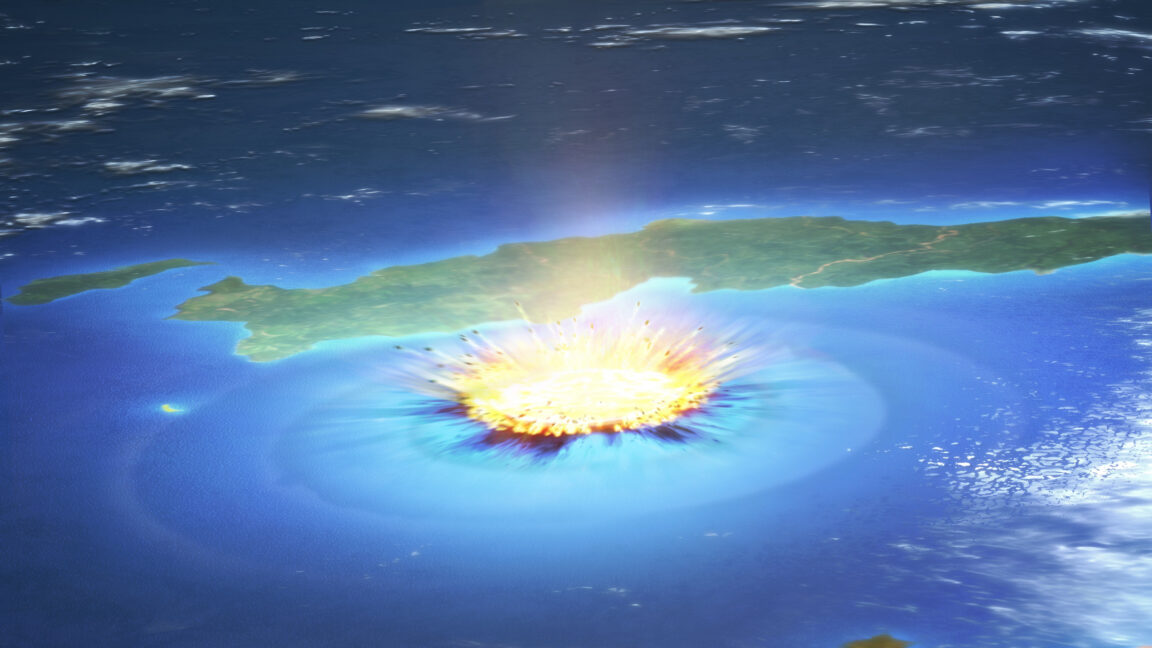
Hydrothermal systems triggered by extraterrestrial impacts are recognized as potentially habitable zones, but verifying their biological history presents immense challenges for geologists. Across Earth, signs of ancient microbial life remain difficult to preserve in the rock record, and establishing a direct link between the exact timing of an impact and the biological colonization of its hydrothermal systems is even harder. Out of approximately 70 underwater impact craters known to possess hydrothermal activity, evidence of microbial colonization has been identified in only eight.
To investigate whether the Chicxulub impact sustained environmental conditions capable of supporting life, Pickersgill and her colleagues examined rock samples recovered from deep within the crater. The biological question was not whether microbes definitely lived there—a fact that remains difficult to prove conclusively—but rather how long the thermal engine remained active enough to offer a viable home.
The primary physical evidence came from an international scientific drilling project conducted in 2016. Researchers drilled a borehole roughly 1 kilometer (0.6 miles) deep into the peak ring of the Chicxulub crater, located off the coast of the Yucatán Peninsula. The resulting core samples contained altered shock-melted rocks and impact breccias, providing a physical archive of the crater’s dynamic post-collision history.
To establish a precise timeline for the duration of the hydrothermal system, Pickersgill recovered mineral samples from these core depths and focused on analyzing potassium-bearing minerals, specifically feldspar. The team performed radioisotopic dating by measuring the natural radioactive decay of potassium-40 into argon-40.
Because argon is a noble gas, it escapes easily from rock when the mineral is in a molten or elevated thermal state. Once the rock cools and solidifies below a specific threshold temperature, the newly produced argon-40 becomes trapped within the crystal lattice of the feldspar. By measuring the ratio of potassium-40 to trapped argon-40 isotopes inside the rock, scientists can calculate precisely how much time has passed since the rock cooled enough to lock the gas in place. This radioisotopic technique is widely utilized in planetary science and has previously been used to date volcanic formations on Earth as well as rock samples returned from the Moon.
Life finds a way … and a heat source
The radioisotopic analysis of the Chicxulub feldspar revealed that argon gas remained mobile within the system for far longer than earlier models had predicted. The isotopic ratios indicated that the crater’s rock structures remained thermally active and sustained fluid circulation from the initial asteroid strike 66 million years ago down to approximately 58 million years ago—spanning an uninterrupted period of 8 million years.
To double-check these isotopic age determinations, Pickersgill’s research team constructed high-resolution computer simulations to model the thermal dynamics and fluid transport within the Chicxulub crater over millions of years.
The thermal transport simulations closely matched the isotopic clock derived from the feldspar samples. According to the modeling, at depths of 1 kilometer below the crater floor, it took between 1.5 and 2.3 million years for the hydrothermal fluids to cool down to 90°C (194°F). Temperatures continued to drop slowly over the subsequent millennia, taking up to 5 million years to fall below 50°C (122°F).