
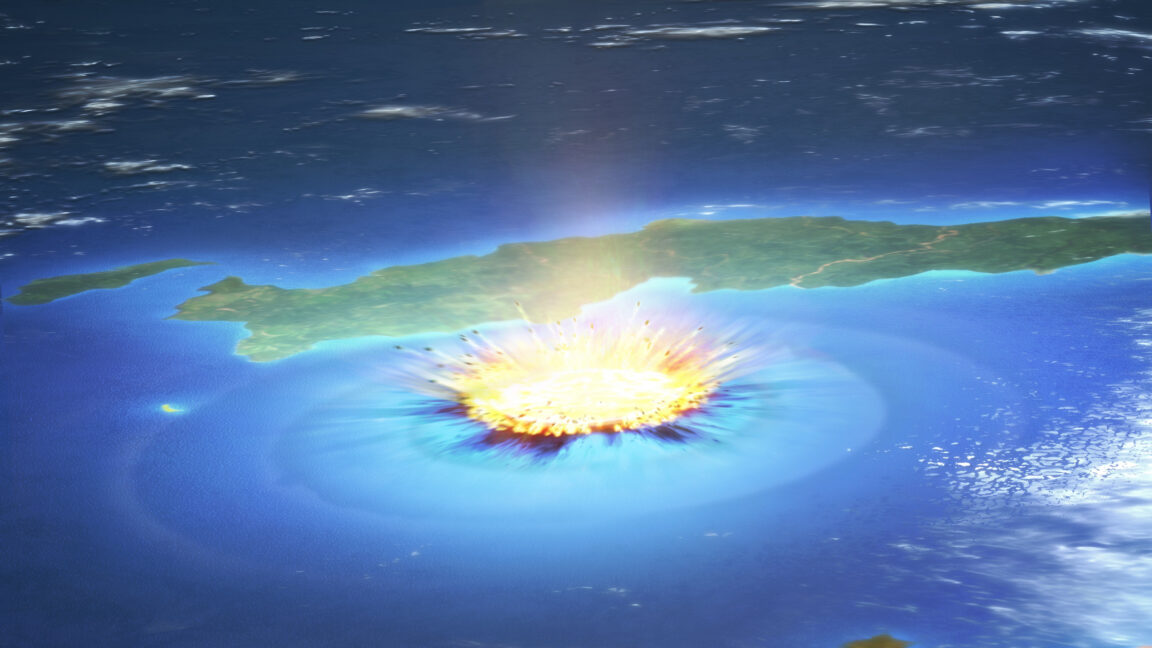
Roughly 66 million years ago, a massive asteroid collided with Earth at the edge of what is now the partially submerged Yucatán Peninsula in Mexico. The Chicxulub impact delivered a devastating blow to the global biosphere, triggering colossal tsunamis, worldwide wildfires, and a dense blanket of atmospheric debris that blocked out sunlight. The resulting climate catastrophe wiped out non-avian dinosaurs alongside an estimated 75 percent of all plant and animal species on the planet.
Yet, amidst this landscape of continental destruction, the catastrophic energy of the space rock laid the groundwork for a startlingly different environment deep beneath the ocean floor. At the bottom of the sea, the kinetic force of the impact generated an extraordinary amount of subsurface heat, creating a subterranean hydrothermal network that circulated hot, nutrient-dense fluids through shattered crustal rock.
New scientific research reveals that this underwater thermal sanctuary survived far longer than geologists had ever anticipated. A team led by planetary scientist and geologist Annemarie Pickersgill of the Scottish Universities Environmental Research Centre (SUERC) at the University of Glasgow has discovered that the hydrothermal system within the Chicxulub crater persisted for approximately 8 million years after the collision. This timeframe is four times longer than previous estimates, which suggested the hydrothermal system cooled down within 2 million years.
The discovery implies that while the surface of the Earth was undergoing a violent biological reboot, deep underwater fractures provided a stable, thermal oasis that remained warm and nutrient-rich for eons. Such an extended lifespan significantly broadens the temporal window during which primitive microorganisms could have taken hold, adapted, and flourished in the wake of global devastation.
The findings, published in the journal Communications Earth & Environment, offer fresh insight into how catastrophic impacts—long viewed strictly as drivers of mass extinction—can simultaneously forge long-term habitats capable of supporting and nurturing microscopic life.
Fathoms below and eons ago
The creation of the Chicxulub impact structure was a high-energy event that altered the Earth’s crust at a fundamental level. When the asteroid struck, the shockwave shattered and deformed subterranean rock layers to depths reaching 35 kilometers (nearly 22 miles) beneath the surface. The extreme kinetic energy melted vast quantities of target rock at the center of the impact site.
As seawater rushed back to submerge the newly formed crater, it came into direct contact with the superheated, molten, and fractured rock layers. The intense heat differential and shock-induced fracturing made the subterranean rock extraordinarily porous. Seawater percolated deep into these porous crustal networks, where it was rapidly heated by the cooling magma beneath. The hot, buoyant water dissolved essential minerals and trace elements from the deep rocks before venting back upward into the ocean floor, establishing a massive hydrothermal convection system.
In the freezing, sunless depths of the post-impact ocean, these venting fluids delivered localized heat and concentrated chemical nutrients. In modern marine environments, similar hydrothermal vents serve as biological hotbeds where complex communities of microbes and specialized animals thrive entirely independent of sunlight.
Hydrothermal systems triggered by extraterrestrial impacts are recognized as potentially habitable zones, but verifying their biological history presents immense challenges for geologists. Across Earth, signs of ancient microbial life remain difficult to preserve in the rock record, and establishing a direct link between the exact timing of an impact and the biological colonization of its hydrothermal systems is even harder. Out of approximately 70 underwater impact craters known to possess hydrothermal activity, evidence of microbial colonization has been identified in only eight.
To investigate whether the Chicxulub impact sustained environmental conditions capable of supporting life, Pickersgill and her colleagues examined rock samples recovered from deep within the crater. The biological question was not whether microbes definitely lived there—a fact that remains difficult to prove conclusively—but rather how long the thermal engine remained active enough to offer a viable home.
The primary physical evidence came from an international scientific drilling project conducted in 2016. Researchers drilled a borehole roughly 1 kilometer (0.6 miles) deep into the peak ring of the Chicxulub crater, located off the coast of the Yucatán Peninsula. The resulting core samples contained altered shock-melted rocks and impact breccias, providing a physical archive of the crater’s dynamic post-collision history.
To establish a precise timeline for the duration of the hydrothermal system, Pickersgill recovered mineral samples from these core depths and focused on analyzing potassium-bearing minerals, specifically feldspar. The team performed radioisotopic dating by measuring the natural radioactive decay of potassium-40 into argon-40.
Because argon is a noble gas, it escapes easily from rock when the mineral is in a molten or elevated thermal state. Once the rock cools and solidifies below a specific threshold temperature, the newly produced argon-40 becomes trapped within the crystal lattice of the feldspar. By measuring the ratio of potassium-40 to trapped argon-40 isotopes inside the rock, scientists can calculate precisely how much time has passed since the rock cooled enough to lock the gas in place. This radioisotopic technique is widely utilized in planetary science and has previously been used to date volcanic formations on Earth as well as rock samples returned from the Moon.
Life finds a way … and a heat source
The radioisotopic analysis of the Chicxulub feldspar revealed that argon gas remained mobile within the system for far longer than earlier models had predicted. The isotopic ratios indicated that the crater’s rock structures remained thermally active and sustained fluid circulation from the initial asteroid strike 66 million years ago down to approximately 58 million years ago—spanning an uninterrupted period of 8 million years.
To double-check these isotopic age determinations, Pickersgill’s research team constructed high-resolution computer simulations to model the thermal dynamics and fluid transport within the Chicxulub crater over millions of years.
The thermal transport simulations closely matched the isotopic clock derived from the feldspar samples. According to the modeling, at depths of 1 kilometer below the crater floor, it took between 1.5 and 2.3 million years for the hydrothermal fluids to cool down to 90°C (194°F). Temperatures continued to drop slowly over the subsequent millennia, taking up to 5 million years to fall below 50°C (122°F).

These temperature thresholds are ecologically critical. Modern hyperthermophilic and thermophilic microorganisms thrive in thermal environments ranging from 50°C to well over 90°C, utilizing dissolved minerals like iron, sulfur, and manganese for metabolic energy.
The computer models further demonstrated that while fluid circulation began to slow significantly after 6 million years, a diminished flow of warm fluid continued until the hydrothermal system fully ceased operation around 8 million years post-impact.
The extended duration of this thermal network fundamentally changes how geologists view post-impact habitability. Long-lasting hydrothermal activity provides extended temporal windows for prebiotic organic chemistry to occur, allowing microscopic organisms time to drift into the crater, establish stable colonies around hydrothermal vents, and propagate throughout the subterranean plumbing of the crater.
“Longer periods of hydrothermal activity will generate extended windows of opportunity for prebiotic chemical reactions to occur, life to develop, and micro-organisms to thrive and propagate beyond their point of origin,” Pickersgill said.
Beyond shedding light on Earth’s history, the discovery has far-reaching implications for astrobiology and the search for life on other planets. During the early history of the Solar System—particularly during the Late Heavy Bombardment roughly 4 billion years ago—Earth, Mars, the Moon, and other terrestrial bodies were subjected to impacts far larger than the one that formed Chicxulub.
If the relatively modest Chicxulub impact was capable of powering a hydrothermal sanctuary for 8 million years, much larger impact basins on early Earth or ancient Mars could have sustained thermal systems for tens or even hundreds of millions of years.
“Chicxulub is still relatively small compared to the impact basins expected on early Earth and observed on other planetary bodies,” Pickersgill noted. “It is therefore possible that these larger impacts could have created even longer-lived hydrothermal systems and, hence, could have been able to maintain the temperatures and fluid flux required for habitable environments for a minimum of several million years.”
By showing that one of Earth’s most destructive events also produced a remarkably durable, nutrient-rich habitat, the study highlights a profound planetary paradox: the very space rocks that bring mass extinction to a planet’s surface may simultaneously kindle long-term cradles for life in the dark depths below.