The American media landscape underwent a series of seismic shifts this week, characterized by a direct confrontation between the executive branch and major news organizations, significant leadership transitions at legacy networks, and a strategic realignment of international operations. From the briefing rooms of the White House to the editorial offices of NBC and the global hubs of CNBC, the industry is grappling with internal friction and external pressures that threaten to redefine the standards of modern journalism.
A Constitutional Standoff at the White House
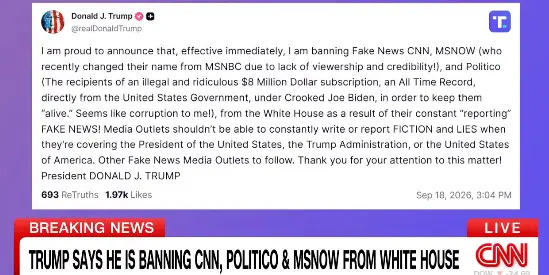
The most visible conflict emerged on Friday as President Donald Trump intensified his long-standing grievances with the press, taking to social media to announce an "effective immediately" ban on reporters from CNN, MS NOW, and Politico. The directive sought to bar these organizations from reporting within the White House grounds, a move that critics and legal experts immediately flagged as a potential violation of the First Amendment.
Despite the President’s public declaration, reporters from the targeted networks remained on-site through Friday afternoon. During a question-and-answer session held within the Oval Office, the President was pressed for a specific justification for the ban. When asked why he had singled out these three outlets, he replied that he had "no reason," before clarifying that the decision was the result of "cumulative stories" produced by the organizations over the last two years. The admission that the ban was not tied to a specific security concern or breach of protocol, but rather to the nature of the coverage itself, has heightened concerns regarding the weaponization of access.
The response from the media was swift and grounded in constitutional law. CNN issued a formal statement affirming its commitment to its White House correspondents and the necessity of an independent press. "The network has a right under the U.S. Constitution to report without hindrance from the government," the statement read. The network further cautioned that if the President’s threatened ban were to be enforced, it would constitute "an illegal assault on that fundamental and constitutionally-protected right."
The sentiment was echoed by Weijia Jiang, the former president of the White House Correspondents’ Association (WHCA), who utilized social media to remind the administration of the legal framework governing press freedom. Jiang posted the text of the First Amendment, highlighting the clause that "Congress shall make no law… abridging the freedom of speech, or of the press." This public exchange underscores a deepening divide between the current administration and the news organizations tasked with holding it accountable, setting the stage for a potential legal battle over the limits of executive authority in restricting media access to public grounds.
Leadership Transitions and Anchor Rotations at ABC and NBC
While the White House faced off against reporters, internal restructuring dominated the headlines at ABC News and NBC News. Over the weekend, ABC’s flagship morning program, Good Morning America (GMA), unveiled a revamped lineup for its Saturday and Sunday editions, signaling a strategic effort to bolster its weekend viewership and integrate its linear and streaming talent.
Rachel Scott, the network’s senior political correspondent, has been elevated to a co-anchor role on the Saturday broadcast, joining veteran Whit Johnson. Scott’s promotion is a significant move for the network, as she will continue her duties hosting the streaming program What You Need to Know on Disney+, effectively bridging the gap between traditional broadcast and digital platforms. The Sunday editions also saw a change, with correspondent Rhiannon Ally pairing with Gio Benitez.
The changes extended to the weather desk, where Leslie Lopez was named the new weekend meteorologist for GMA. Lopez, who arrives from the ABC Los Angeles affiliate KABC, fills the vacancy left by Somara Theodore. Theodore has transitioned to a full-time weekday role on ABC News Live, the network’s 24/7 streaming service. In a further push toward cross-platform synergy, the weekend anchor quartet—Johnson, Scott, Benitez, and Ally—will now take turns anchoring ABC News Live Weekend at 10 a.m. ET.
Simultaneously, NBC News is preparing for the departure of a key architect of its recent programming strategy. Janelle Rodriguez, the Executive Vice President of NBC News Programming, announced she is leaving the organization after a 12-year tenure. In a memo to staff, Rodriguez described the move as "the right moment" to pursue a new chapter. Her departure has prompted a rapid reorganization of the leadership hierarchy under NBC News President of Editorial Rebecca Blumenstein.
The new structure sees Catherine Kim promoted to Executive Vice President of Editorial and Content, a role that grants her oversight of specials and the streaming network NBC News Now. Matt Carluccio will see his responsibilities expand to manage the network’s specialized editorial units, including health, business, investigations, and climate reporting. Additionally, Matt Frucci, the Executive Producer of NBC Nightly News, will now report directly to Blumenstein. These moves suggest a desire to streamline editorial decision-making as the network navigates an increasingly fragmented media environment.
Global Realignment: CNBC Exits Hong Kong
The shifting priorities of the media industry are also being felt on an international scale. CNBC recently confirmed the closure of its Hong Kong bureau, a decision that marks a significant retreat from what was once a central hub for financial journalism in Asia. The shutdown has resulted in the cancellation of several business-day programs, including Inside India, The China Connection, and Europe Early Edition. Furthermore, feature series like CNBC Meets and Built for Billions are slated to end once their current runs conclude.
According to the network, the decision followed a months-long evaluation of international programming, commercial viability, and the strategic deployment of resources. While a "small number of employees" were impacted by the layoffs, CNBC is not exiting the region entirely. Instead, it is shifting its operational focus to its bureaus in Singapore and Beijing. These locations, along with existing hubs in London and Abu Dhabi, will remain the primary centers for the network’s editorial and technical facilities. The pivot reflects a broader trend of multinational corporations reassessing their presence in Hong Kong amidst changing geopolitical and economic dynamics in the Pacific.
60 Minutes and the Battle for Editorial Integrity
Back in the United States, the return of 60 Minutes for a new season on CBS has been overshadowed by internal dissent and allegations of editorial interference. The legendary newsmagazine is entering a new era under the guidance of Bari Weiss and Nick Bilton. In a joint note with CBS News President Tom Cibrowski, Weiss and Bilton praised the season premiere as a "powerful start," featuring "three original, revelatory stories" that they claimed represented the program at its best.
To support this new direction, the show has recruited new production talent, including Jordan Kronick, formerly of HBO’s Real Sports with Bryant Gumbel, and Wally Griffith, who joins from CNBC’s documentary unit. However, the transition has been anything but smooth.
Guy Campanile, the former managing editor of 60 Minutes, has become the latest high-profile departure to speak out against the current leadership. In a private social media post obtained by The Guardian, Campanile alleged that the editorial process has been compromised by outside pressures. He asserted that he and his colleagues refused to "jam unverifiable notions or White House talking points" into their reporting.
Campanile’s critique was pointed, suggesting that the staff who were let go or resigned did so because they "refused to be accomplices in the destruction of the most prestigious news program on American television." These allegations of "editorial interference" under Weiss’s watch have sparked a debate within the industry regarding the balance between modernizing legacy programs and maintaining the rigorous standards of investigative journalism that have defined 60 Minutes for decades.
The Rise of Direct-to-Consumer Engagement
As networks grapple with internal politics and global shifts, they are also experimenting with new revenue models to combat the decline of traditional cable television. MS NOW launched its direct-to-consumer offering, "MS NOW Membership," on Wednesday, September 9. The service seeks to monetize audience loyalty by providing exclusive access to the network’s journalists.
The centerpiece of the membership is a seven-day interactive lineup featuring twice-daily live Q&A sessions. Available via the MS NOW app and website, these sessions allow members to participate in live discussions and, in some instances, engage directly with hosts via live video. This move toward a subscription-based, interactive model reflects a broader industry-wide push to cultivate a more direct and profitable relationship with viewers, moving beyond the passive consumption of news.
Looking Ahead: The California Governor Debate
Finally, as the political season intensifies, CNN has announced it will host the upcoming California Governor Debate on Wednesday, September 30. The event, which will be moderated by anchors Jake Tapper and Dana Bash, will feature candidates Xavier Becerra and Steve Hilton.
The one-hour debate will be broadcast live from CNN’s Los Angeles studios at 9 p.m. ET. Given California’s role as a national political trendsetter, the debate is expected to draw a significant audience. It will be available across CNN’s various platforms, including CNN International and CNN en Español, and will be streamed for subscribers, further highlighting the network’s multi-platform distribution strategy.
As these stories continue to develop, they paint a picture of an industry in the midst of profound transformation. Whether through the defense of constitutional rights, the restructuring of executive suites, or the pivot to digital memberships, the media world is navigating a period of uncertainty and evolution that will likely have lasting implications for how news is produced and consumed in the years to come.