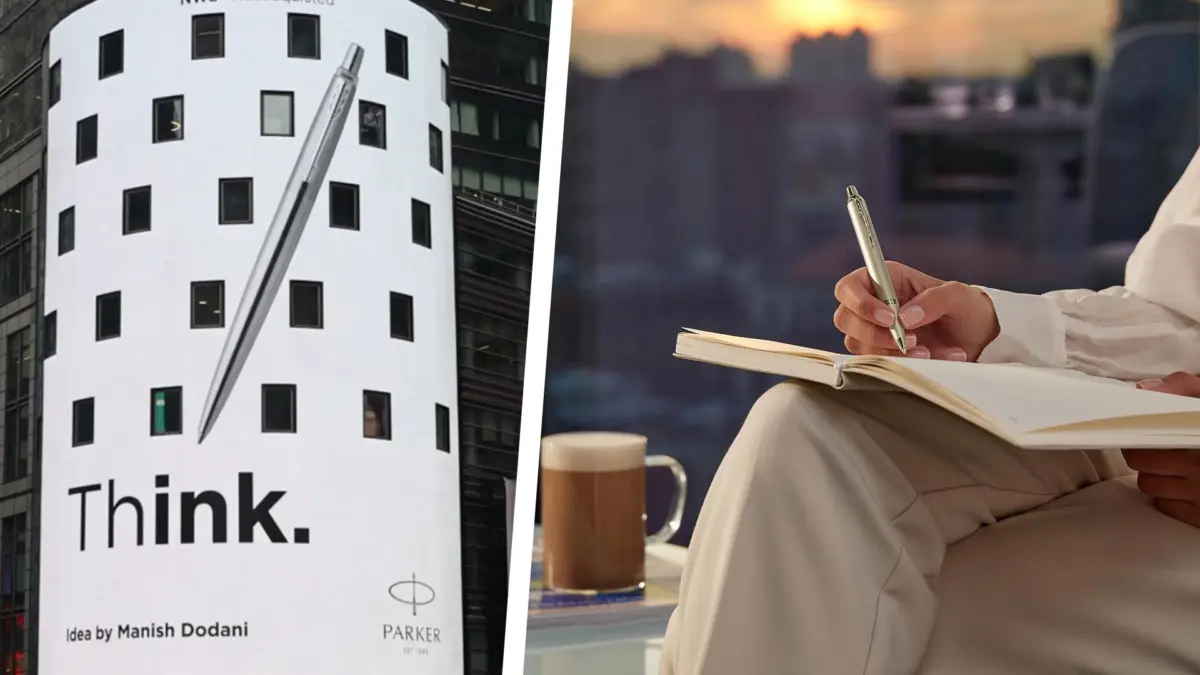
The iconic pen manufacturer Parker has recently found itself at the center of a burgeoning cultural movement, successfully parlaying a viral social media challenge into a high-profile marketing triumph. In an era increasingly dominated by generative artificial intelligence and synthetic media, the brand has leaned into a grassroots rebranding effort that positions the humble ballpoint pen as a tool of creative rebellion. What began as a series of unsolicited "spec ads" created by independent designers has now culminated in a massive digital presence in New York City’s Times Square, signaling a significant shift in how legacy brands interact with digital communities and the evolving AI landscape.
The momentum began when creatives across social media platforms started proposing conceptual rebranding ideas for Parker, specifically designed to resonate in the age of AI. These designers sought to highlight the visceral, human connection of handwriting in contrast to the algorithmic output of large language models. Recognizing the authenticity and timing of the viral challenge, Parker acted with surprising agility for a century-old institution. Rather than merely acknowledging the fan-made designs, the company moved to make these concepts a reality, launching a digital billboard in the heart of Manhattan that echoes the sentiments of the creative community: that the most personal thoughts are best expressed by hand.
This marketing pivot comes at a time when the initial novelty of artificial intelligence is beginning to meet significant public friction. While many tech analysts previously predicted that the rise of sophisticated AI would signal the final death knell for handwriting, a robust counter-movement has emerged. This "analog revival" is driven by a growing segment of the population that is rediscovering the profound cognitive and psychological benefits of putting pen to paper. Recent studies and creative discourse have highlighted how handwriting fosters greater focus, deeper reflection, and a more intimate form of creativity that digital typing or AI prompting cannot replicate.
The backlash against what critics call "AI slop"—the flood of low-quality, often nonsensical AI-generated imagery and text—has also played a role in this resurgence. On platforms like Instagram, where AI-generated flyers and promotional materials have become ubiquitous, a new trend has taken hold. Graphic designers and small business owners are increasingly turning back to hand-drawn elements and handwritten notes as a way to signal authenticity and human effort. In a digital environment where users are becoming increasingly skeptical of "perfect" but hollow synthetic content, the minor imperfections of handwriting have become a hallmark of genuine human presence.
Amidst this cultural shift, the practical and economic arguments for the return to analog tools are also gaining traction. As many consumers find themselves burdened by the "subscription economy," where access to advanced AI tools like ChatGPT or Gemini requires a recurring monthly fee, the one-time investment in a high-quality writing instrument is being viewed in a new light. Currently, the cost of a professional-grade Parker pen has dipped below the price of a single month’s subscription to premium AI services, making the "rebellion" against digital automation both a philosophical and a financial choice for many.
Retailers like Amazon have responded to this renewed interest by offering significant discounts on some of Parker’s most historically significant models. Among the most notable is the Parker Jotter, a pen that has maintained its status as a design icon since its introduction in the mid-1950s. The Jotter’s place in popular culture was cemented by its appearance in the 1995 James Bond film Goldeneye, where it served as a sophisticated gadget for the world’s most famous secret agent. Today, the classic black and steel model, featuring the brand’s signature arrowhead clip and its famous "click" mechanism, is being offered at a 30% discount, bringing the price down to a highly accessible $8.34.
For those who prefer a more substantial writing experience, the Jotter XL—a larger version of the classic silhouette designed for those who find the original model too slender for long writing sessions—has also seen price reductions. The monochrome stainless steel Jotter XL is currently available with an 18% discount, priced at $32.79. This model retains the timeless aesthetics of the 1954 original while providing a more ergonomic grip for modern users who are returning to long-form journaling or manual note-taking.

The trend toward analog tools extends beyond ballpoints into the more ritualistic world of fountain pens. The Parker 51, a pen frequently cited as one of the most successful and aesthetically pleasing writing instruments ever made, is also part of the current wave of interest. Known for its "hooded" nib and sleek, aerodynamic profile, the Parker 51 was famously favored by the late Queen Elizabeth II throughout her reign. It also holds a place in literary history, being the specific pen used by James Bond in Ian Fleming’s Moonraker novel. For enthusiasts looking to capture a piece of this heritage, the Parker 51 fountain pen has seen a price reduction of nearly $25, bringing the current cost to $101.25.
The success of Parker’s Times Square campaign and the subsequent interest in their product line suggests that the "anti-AI" sentiment is more than a fleeting internet trend. It represents a broader desire for tactile experiences in an increasingly intangible world. Designers who participated in the original viral challenge argued that handwriting is "the ultimate act of rebellion" because it requires time, physical presence, and a direct link between the mind and the hand—elements that are often bypassed in the world of automated content generation.
This movement is also being reflected in the professional world of graphic design. As AI-generated layouts become more common, veteran designers are reporting a "race to the bottom" in terms of visual quality and brand identity. In response, many are advocating for a return to "human-first" design principles, where the initial stages of branding and typography are executed by hand. This approach, they argue, prevents the homogenization of design that often occurs when algorithms are used to generate creative assets.
Parker’s ability to capitalize on this sentiment has been lauded by branding experts as a masterclass in modern marketing. By validating the work of independent creators and bringing their "anti-AI" message to one of the world’s most visible advertising stages, Parker has transformed itself from a legacy stationery brand into a symbol of human-centric creativity. The message is clear: while AI can process information at an unprecedented scale, it cannot replicate the soul, history, and personal touch inherent in a handwritten note.
As the digital landscape continues to evolve, the tension between automated efficiency and human craftsmanship is likely to persist. However, for those looking to disconnect from the digital noise, the path forward appears to involve a return to the basics. Whether it is through a $8 ballpoint or a $100 fountain pen, the act of writing by hand is being reaffirmed as a vital component of the creative process.
For consumers interested in joining this analog resurgence, the current market offers a rare opportunity to acquire high-quality tools at a fraction of their usual cost. The availability of these deals across various models—from the entry-level Jotter to the premium Parker 51—ensures that the "handwriting rebellion" remains accessible to everyone, regardless of their budget. As the viral campaign in Times Square reminds us, the most powerful tool for expression might not be a complex algorithm, but the pen that has been sitting in our pockets for decades.
The ongoing deals on these iconic writing instruments reflect a broader market realization that there is a permanent place for analog tools in a digital world. As long as there is a need for focus, a desire for authenticity, and a passion for human-led creativity, the pen will remain a formidable competitor to even the most advanced artificial intelligence. Parker’s recent success is a testament to the enduring power of a simple, well-designed tool and the community that continues to find meaning in its use.