Former England defender Anita Asante began her coaching journey immediately after retiring from her playing career, securing prominent roles including a coaching stint with Bristol City in the WSL 2 and working with the England Under-23 national team. Yet, speaking on the BBC’s Women’s Football Fallout, Asante explained how she was quickly forced to choose between her career and her family.
"For myself, the doors did open—I was fortunate to go into Bristol City and work with them, then with England Under-23s," Asante said. "But it became a choice for me; we have a young child at home, and for players so much of our playing career has been missing out on events and family—you want that time back."

Asante notes that the systemic lack of resources in coaching often exacerbates these personal pressures. "There are many young women who want to go into coaching but don’t have the support. Then when coaches get there, they are often under-resourced, so the job becomes less about coaching, and it takes a toll on people."
Some local clubs are beginning to recognise this issue and are actively trying to accommodate mothers. Handyside highlighted an initiative by Kent-based non-league club Faversham Town, which launched a targeted campaign designed specifically to bring mothers into coaching roles. However, such initiatives remain rare exceptions rather than the industry standard.
"What can be unique about a woman’s experience is the life stages—such as becoming a parent, as women carry the child," Handyside said. "It disproportionately affects women. We need job shares, more part-time coaching roles. If you need to step away for a while, you should not have to step away forever."
At the grassroots level, the lack of formal employment protection often leaves women vulnerable to being sidelined permanently once they start a family—a stark contrast to the elite level, where coaches are better protected by employment legislation.
"What has struck me at grassroots level is women being written off as soon as they have a family, which does not happen at elite level as much as they are protected by employment law," Handyside noted. "All coaches need to have agreements and contracts in place—if you need to step away, you should have guarantees where you can come back. People deserve a level of respect and protection at grassroots level."
‘This isn’t about blaming men’
The cultural perception of sport as a male-dominated environment remains a powerful deterrent, even in an era of unprecedented success for women’s national teams.
Conning recalled her own isolation while moving through the qualification system. "I have done a few coaching courses, and there has been one female coaching mentor," she said. "And on my B licence, it was 28 men taking the course, and three women. It is an intimidating environment to go into."

This imbalance persists on matchdays at the local level. "In our [Manchester Laces’] division, there are maybe a handful of female coaches. On a matchday there will be a male referee, male coaches; it can be intimidating."
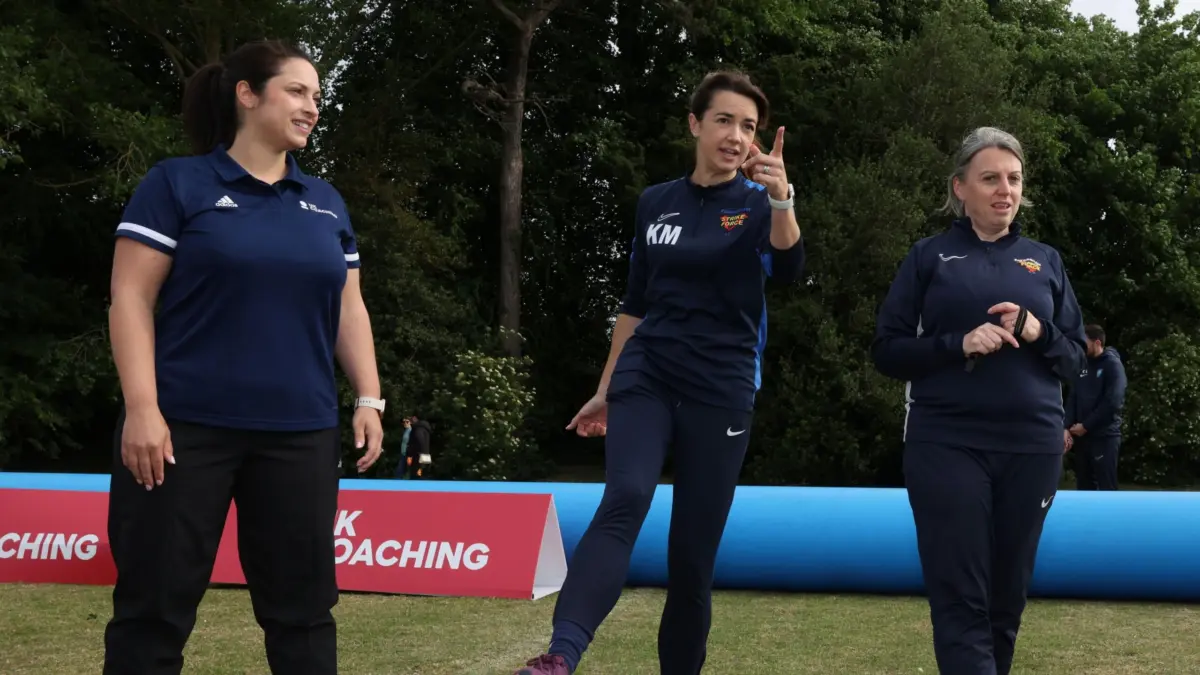
Through the implementation of the Women in Coaching plan, Handyside and her colleagues at UK Coaching want to move beyond superficial representation and empty slogans.
"This is not ‘see it to be it’, that does not sit well with me," Handyside said. "We want to show that the sports sector really values women and wants them around."
For Handyside, resolving the coaching crisis is not about creating division, but about fundamentally restructuring the demanding, uncompromising nature of sporting environments. "This isn’t about blaming men; it is about the nature of high-performance sport—all or nothing. It is the culture, the stereotypes that exist."