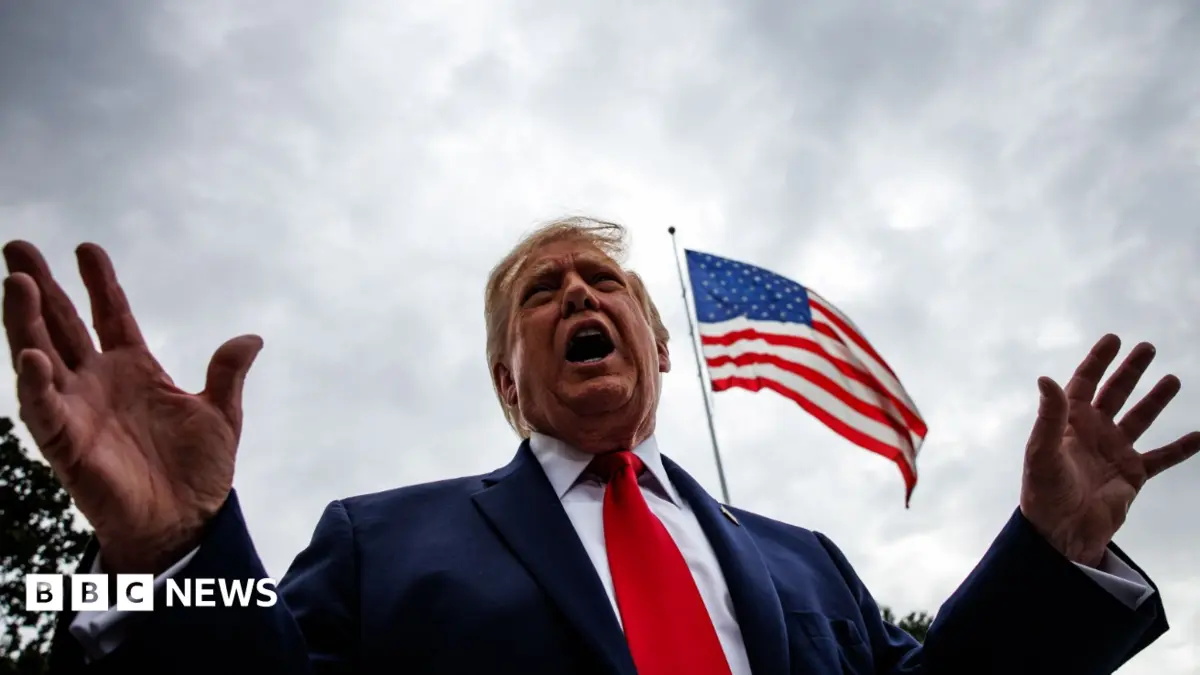
US President Donald Trump has formally rejected a diplomatic proposal put forward by Iran that aimed to reopen the strategically vital Strait of Hormuz to commercial shipping within a week. Speaking to reporters at the White House on Saturday, the American president dismissed the overture from Tehran, characterizing the move as a sign of weakness and desperation from an adversary buckling under intense economic and military pressure. Trump asserted that the Iranian government was eager to secure a quick resolution because of the severe toll the ongoing conflict and subsequent naval blockade have taken on the country’s domestic stability.
The president told reporters that Tehran is eager to make a deal to open the strait immediately because they are losing so badly. While Trump acknowledged his general willingness to engage in negotiations, he made it clear that the specific terms of the current proposal do not align with American interests or demands. He emphasized that the United States is currently operating from a position of significant strength in the region, claiming that Washington already maintains total control over the strategic waterway and that massive amounts of oil continue to pass through it under American oversight. While Trump reiterated his fondness for negotiating deals, he firmly stated that the proposal presented by Iran is simply not acceptable to his administration.
In Tehran, the response to the US president’s public dismissal was measured but critical. Iranian Foreign Minister Abbas Araghchi acknowledged the comments in a post published on the messaging platform Telegram. However, Araghchi indicated that Iran would not treat public remarks made to the press as the final word on the matter. Instead, the foreign minister stated that Tehran would wait for an official, formal response to be delivered through the established international mediators who have been working to facilitate communication between the two hostile nations. Araghchi noted that Trump has frequently made a wide range of statements, describing them as a mix of good and highly contradictory remarks. He concluded that Iran would remain patient, awaiting the definitive views of the mediators before making any further decisions on how to proceed.
The diplomatic push had gained momentum just a day prior, when Araghchi spoke to reporters at the United Nations in New York on Friday. During his press briefing, the Iranian foreign minister had expressed optimism that a diplomatic breakthrough was within reach, suggesting that an agreement to resolve the maritime crisis could be secured if the necessary conditions were met. According to Araghchi, the framework for such an agreement already exists within the parameters of a memorandum of understanding (MOU) that was signed by both the United States and Iran in June.
The June memorandum of understanding was a highly detailed 14-point agreement designed to establish a comprehensive ceasefire and pave the way for at least a partial reopening of the Strait of Hormuz to international commercial traffic. At its core, the MOU addressed the primary security concerns of both Washington and Tehran. The agreement explicitly stated that Iran would never pursue or possess a nuclear weapon, addressing a long-standing demand of the United States and its international allies. In return, the document outlined a mutual commitment to end all military operations on all fronts, involving the United States, Iran, and their respective regional allies. Furthermore, the MOU contained specific provisions aimed at lifting the highly damaging US naval blockade on Iranian ports, alongside the easing of other sweeping economic sanctions that have crippled the Iranian economy.
However, the promising diplomatic framework established by the June agreement quickly fell apart. The fragile peace collapsed after both sides resumed military strikes, plunging the region back into active conflict. In the wake of the breakdown, Iran began targeting and attacking commercial vessels attempting to navigate the Strait of Hormuz, claiming that these ships were attempting to cross the vital waterway without proper authorization. The United States responded with a series of military actions, launching targeted airstrikes against Iranian military installations located within the strait, as well as striking Iranian oil tankers operating off the country’s coast. Alongside these direct military engagements, the US military maintained its strict naval blockade of Iranian ports, a move that has caused immense disruption to the Iranian economy by halting its vital oil exports.
The current maritime standoff is the latest and most severe escalation of a broader conflict that erupted in late February. The hostilities began when the United States and Israel launched a series of coordinated airstrikes against Iranian targets. Iran retaliated swiftly, launching attacks against Israel, US military installations situated in the Persian Gulf, and several of Washington’s key Arab Gulf allies. As part of its retaliatory campaign, Tehran also effectively closed the Strait of Hormuz to international shipping. The closure of this critical maritime chokepoint—through which approximately one-fifth of the world’s global gas and oil supply typically flows—has had a profound impact on international markets, causing wild fluctuations in global energy prices and triggering widespread economic anxiety.
While President Trump has repeatedly claimed that the United States has successfully managed to keep oil flowing through the Strait of Hormuz, independent maritime data presents a far more volatile and constrained picture of the situation. According to shipping data provided by the commodities analytics firm Kpler and cited by Reuters, the recent 10-day average for vessel transits through the strait stood at approximately 18 transits per day. However, this average masks significant daily fluctuations, with transit numbers dropping as low as nine vessels on certain days. The low transit numbers highlight the ongoing danger and instability surrounding the waterway, which remains a highly contested military zone despite Washington’s assertions of control.
The security situation in the region has been further complicated by military developments on the opposite side of the Arabian Peninsula, where the conflict has spilled over into the Red Sea. Yemen’s Houthi movement, which is closely allied with Iran, has intensified its military campaign in recent weeks, launching targeted attacks on Saudi Arabian oil installations. These attacks are aimed at disrupting Saudi oil exports through the Red Sea, effectively creating a secondary front in the maritime economic war.
The threat to global shipping routes became even more acute this month when Houthi forces seized control of strategic stretches of Yemen’s Red Sea coast. Among the areas captured by the group is the port of Mokha, a highly strategic location that directly overlooks the Bab al-Mandab Strait. The Bab al-Mandab Strait serves as another critical chokepoint for global maritime trade, connecting the Red Sea to the Gulf of Aden and the Suez Canal. By establishing a military presence at this key bottleneck, the Iran-aligned Houthi forces have significantly increased their leverage over international shipping lanes, exacerbating the pressure on the global energy supply chain.
The compounding economic fallout from the dual maritime crises has intensified the domestic political pressure on President Trump. The wild fluctuations in energy prices and the broader economic disruptions caused by the blockades have become central issues as the United States moves closer to the critical Congressional elections in November. The administration is facing growing demands to find a viable resolution to the conflict and restore stability to global energy markets before voters head to the polls.
Despite these domestic political considerations, the Trump administration appears highly skeptical of Iran’s diplomatic intentions and is reportedly preparing for a potential escalation of hostilities. According to a report published by the Wall Street Journal, which cited unnamed officials, President Trump remains deeply doubtful that Iran has any genuine intention of meeting his administration’s core demands. The report indicated that the president has already told his staff that he views a renewed and intensified bombing campaign against Iranian targets as a highly probable outcome. According to these officials, Trump expects that any such military escalation would likely take place after the November midterm elections have concluded, suggesting that the current diplomatic stalemate is likely to persist through the coming weeks as both sides brace for a potential return to wider military conflict.