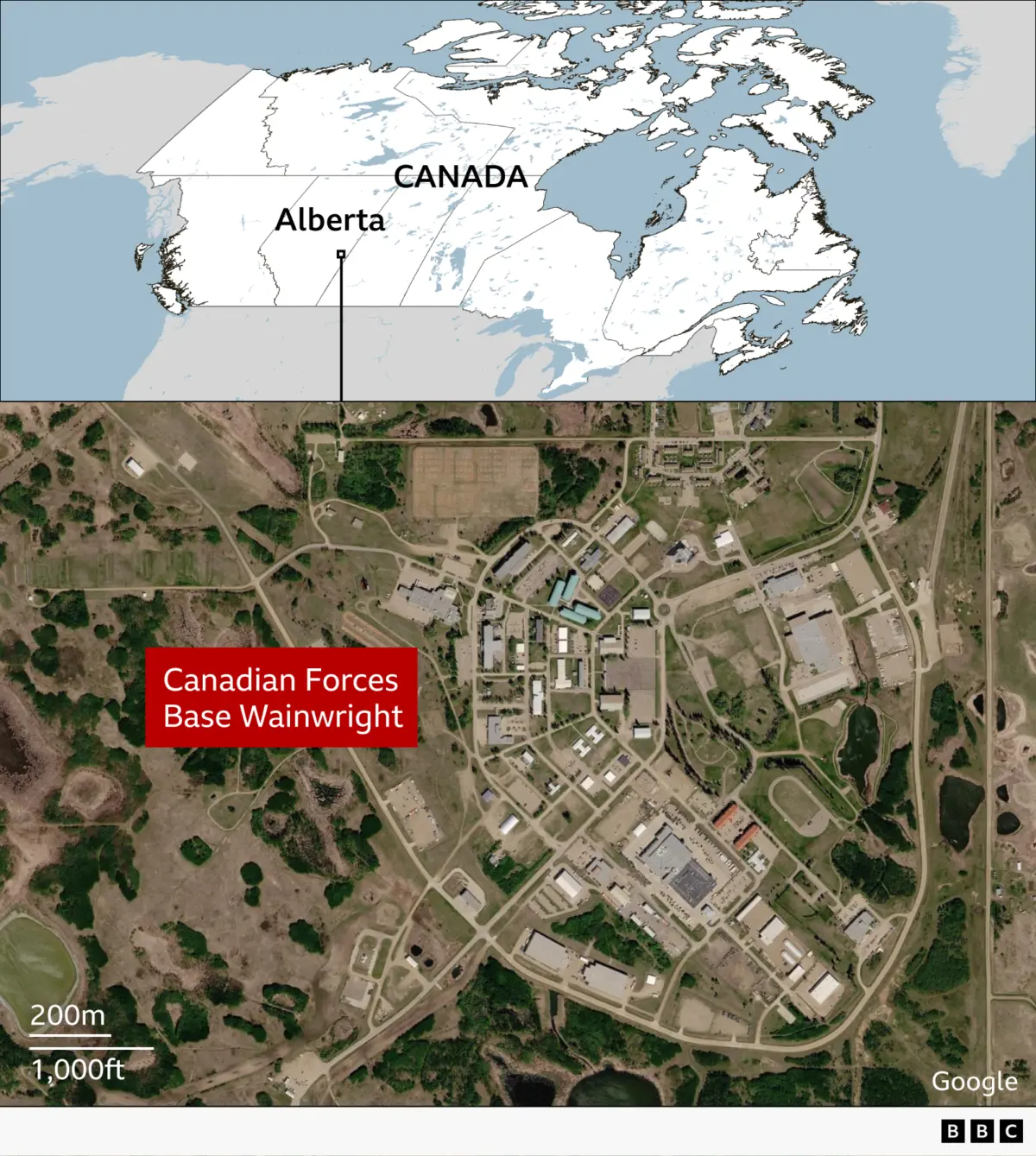
A fast-moving and violent blaze swept through Canadian Forces Base Wainwright in Alberta on Saturday, resulting in at least four fatalities and leaving dozens of service members injured, with 19 reported to be in critical condition. The disaster, which erupted during active military exercises, has sent shockwaves across the nation and mobilized an extensive emergency medical response to care for victims suffering from life-threatening burns.
Prime Minister Mark Carney addressed the nation in the aftermath of the disaster, describing the incident as one of the worst peacetime tragedies on Canadian soil in the history of the country’s armed forces. Offering solemn condolences to the families affected, Carney emphasized the bravery of those who battled the flames and stated that the nation must now rally behind the military members who put their lives on the line.
As military investigators and provincial authorities piece together the sequence of events that led to the devastating outbreak, here is a detailed breakdown of what is known so far about the deadly fire, the ongoing investigation, the medical response, and the base where the tragedy unfolded.
How did the fire start?
The outbreak began at approximately 16:00 local time (22:00 GMT) on Saturday within the extensive perimeter of Canadian Forces Base Wainwright. According to military officials, the incident originated on a live-fire training range where personnel were actively engaged in military exercises.
Major-General Wade Rutland, Commander of the 1st Canadian Division, provided initial details regarding the environmental conditions that rapidly escalated the hazard. He explained that what started as a localized grass fire on the range was suddenly driven out of control by adverse weather conditions. "Uncommonly strong winds caused it to spread rapidly and shift direction," Major-General Rutland confirmed, noting that the sudden change in wind direction swept the fast-moving wall of fire directly toward soldiers stationed in the area for training exercises.
In the immediate wake of the ignition, military personnel alongside civilian firefighter units rushed to contain the flames. Prime Minister Carney commended the emergency crews who responded to the scene, noting that military and civilian fire crews worked tirelessly under extreme duress. Carney described how responders "fought this fire throughout the night in some of the worst conditions imaginable, risking their lives to protect their fellow Canadians" as the fire tore across the rugged terrain.

In the early hours following the catastrophe, local media reports speculated that the blaze may have been triggered when a gas main was inadvertently struck during a live-firing exercise. However, military officials later clarified the situation, stating that investigators do not believe any explosions were caused by oil or gas infrastructure operating within or near the base grounds.
While the exact mechanical or operational trigger of the initial grass fire remains under active investigation by military authorities, the Canadian Department of National Defence has sought to address security concerns. The ministry explicitly stated that "at this time, there are no indications that it was the result of any terrorist activity," focusing the ongoing probe strictly on training operations, environmental factors, and exercise safety protocols.
How many people have been killed?
The human toll of the blaze has been severe. Officials have confirmed that four Canadian service members lost their lives in the fire. In addition to the fatalities, 39 individuals were transported to regional medical facilities for emergency care, with 19 of those patients listed in critical condition due to severe and extensive burn injuries.
Due to the severity of the burns sustained by many of the surviving personnel, health officials have highlighted the critical nature of the coming days. While authorities have not officially indicated whether the death toll is expected to rise further, the high number of critically injured personnel underscores the extreme intensity of the fire.
The influx of casualties prompted a massive, multi-jurisdictional emergency medical operation across the province of Alberta. Alberta’s health service revealed that the initial emergency response spanned over 10 consecutive hours, requiring a coordinated fleet of 22 ground ambulances and eight medical aircraft to evacuate the wounded from the remote training area to specialized care centers.
On Saturday evening, the Royal Alexandra Hospital in Edmonton declared a "Code Orange"—a critical disaster response protocol specifically reserved for high-casualty, mass-injury incidents that require immediate reallocation of hospital resources and emergency personnel. The facility experienced an immediate influx of patients as a steady stream of ambulances arrived from the base.

One physician treating victims at the facility spoke to the public broadcaster CBC, describing the hospital as being "completely overwhelmed" by the sudden arrival and sheer severity of the injured patients during the height of the triage effort. The Code Orange status remained active overnight and through the morning as medical teams worked to stabilize the most critically injured, before officially being stood down on Sunday afternoon.
Healthcare authorities have emphasized that while the acute evacuation phase has concluded, the ongoing medical care required for the burn victims will be long-term and intensive, requiring specialized surgical and intensive care support.
Where is the base?
Canadian Forces Base (CFB) Wainwright is located in a rural sector of east-central Alberta. Situated approximately 120 miles (193 kilometers) east of Edmonton and roughly 180 miles (290 kilometers) northeast of Calgary—the province’s two primary urban centers—the base occupies a vast footprint of open prairie and brush-covered terrain ideal for complex tactical maneuvers.
CFB Wainwright stands as one of the Canadian Army’s premier and busiest training installations. Its expansive range facilities are regularly utilized for large-scale combined arms exercises, live-fire weapons practice, and pre-deployment training for Canadian troops preparing for overseas missions. In addition to its ground training facilities, the base features an airfield that is frequently utilized by the Royal Canadian Air Force for tactical transport and air-ground coordination exercises.
Because of its status as a primary training hub, the base experiences significant fluctuations in its overall population. While a substantial permanent staff is permanently assigned to maintain operations, the number of personnel on site swells significantly during major training operations, frequently placing more than 1,000 military members on the base at any given time.
As the military community mourns the loss of the four service members, support services have been activated for families and personnel at CFB Wainwright, while federal and military investigators continue their work on the training grounds to determine the precise sequence of events that led to the tragedy.