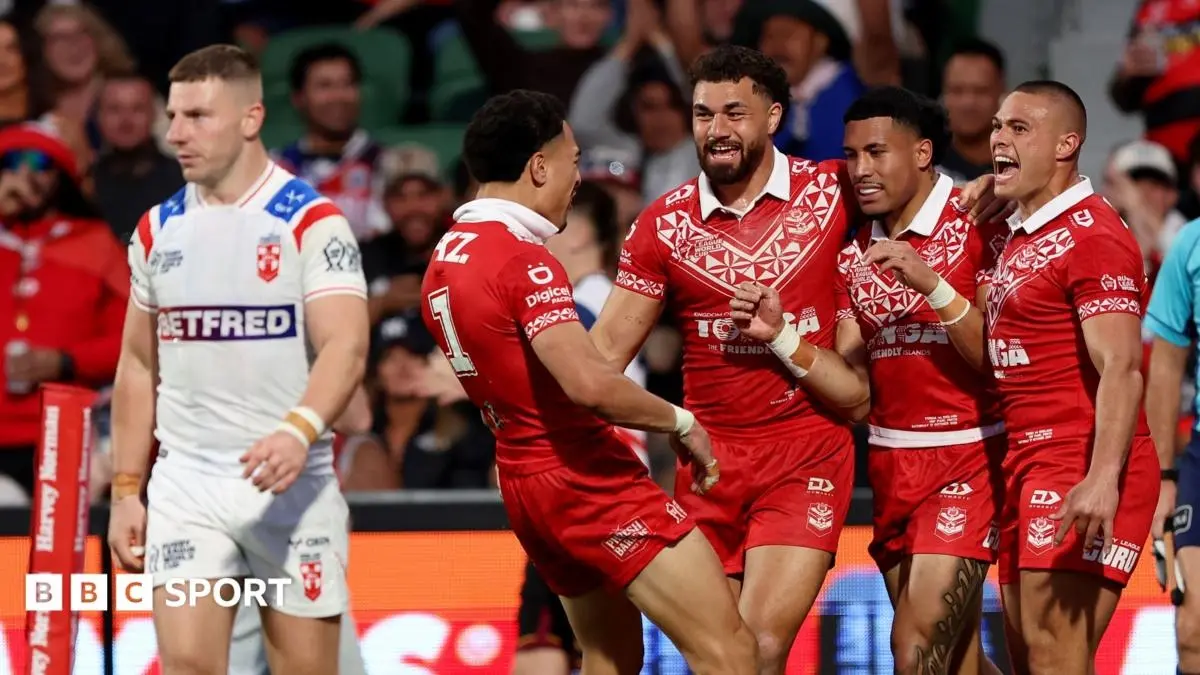
As thousands of deliriously happy Tongan supporters transformed Perth into a sea of red and white, singing and celebrating long after the final whistle, the England rugby league team was left to absorb a heavy dose of harsh reality. Their opening fixture of the 2026 Rugby League World Cup was supposed to set a positive tone for a new era under head coach Brian McDermott. Instead, a 30-12 defeat at the hands of a disciplined and clinical Tonga side served as a sobering reminder of the margins for error at the highest level of international sport.
For large stretches of the match, England were far from non-competitive. Indeed, they had arguably been the superior side during the opening 20 minutes of both the first and second halves. They engineered several promising attacking opportunities and succeeded in establishing early territory. Yet, a relentless series of self-inflicted mistakes ultimately proved fatal to their chances. Handling errors at critical moments, ill-advised offloads in heavy traffic, and sloppy penalties repeatedly surrendered hard-earned momentum, handing Tonga total control over the flow and tempo of the contest.
By the time Tongan back-rower Haumole Olakau’atu crashed through the defensive line to score his side’s fourth try, any realistic hope of an England comeback had completely evaporated. The 30-12 scoreline reflected a comprehensive defeat on paper, instantly raising urgent questions over whether England’s World Cup campaign and semi-final ambitions have been severely compromised before the tournament has even properly hit its stride.
Despite the damaging nature of the loss, head coach Brian McDermott remained defiant during his post-match media conference, dismissing suggestions that his side’s World Cup dream was already over.
"It was a really good contest, when it wasn’t it was down to us and the errors we made," McDermott told reporters as he reflected on his first official game in charge. "We stood toe to toe for nearly all the game, but we made errors chasing the scoreboard. I’m not going to say it’s an easy fix, but it’s something I can change."
McDermott maintained that England were not outmanoeuvred from a tactical perspective, pointing instead to fundamental execution issues that can be rectified on the training paddock before their next fixture.
"We know what is in front of us now. We have to win the next two games," McDermott emphasized. "I have seen enough to say we are heading in the direction. We were not strategically outdone. There are tonnes of positives to take out of tonight, but one or two things we must get rid of, like losing possession."
The defeat carries additional weight given the administrative context surrounding England’s preparation. Due to the notorious irregularities of the international rugby league calendar, this World Cup opener marked McDermott’s very first match at the helm since his appointment in April as the successor to Shaun Wane.
Wane had parted ways with the national side in January following a heavy series defeat in last year’s Ashes. While Wane faced his fair share of criticism during his tenure, much of it justified, he had nevertheless built a structurally organized and defensively solid England side that famously recorded a 3-0 whitewash over Tonga during their tour of Britain in 2023.
Following Wane’s departure after the Ashes series ended with a loss to Australia at Headingley in November 2025, McDermott was tasked with assembling a competitive international squad under exceptionally tight time constraints. England entered this World Cup without playing a single warm-up match beforehand. The clash in Perth was their first competitive outing since that defeat to Australia ten months earlier, and remarkably, England have not tasted victory in an international fixture since defeating Samoa back in November 2024.
In stark contrast, a much more composed and cohesive Tonga side arrived in Perth brimming with confidence. They set the tone for the evening prior to kick-off with a spine-tingling performance of the Sipi Tau battle dance, captivating the crowd and laying down a physical challenge that they fully backed up on the field. The victory was a historic milestone for Tongan rugby league, marking their first-ever win against England in seven attempts.
While the lack of warm-up fixtures and limited preparation time were circumstances entirely beyond McDermott’s control, tactical setups and squad selection fall squarely within his domain. It is in these areas that the former Leeds Rhinos head coach now faces intense scrutiny from pundits and supporters alike.
Addressing his side’s erratic play in possession, McDermott conceded that his players had failed to grasp the strict requirements of international tournament football.
"You cannot play with freedom at international level, you have to keep hold of the ball," McDermott remarked during his post-match press conference. Throughout the evening, his side looked visibly anxious with the ball in hand, appearing far too eager to pass up straightforward opportunities to run directly at the formidable Tongan defensive line, opting instead to pass the responsibility along the chain.
Selection decisions have also drawn significant debate. McDermott opted for a central playmaking partnership of Harry Smith and team captain George Williams. The duo struggled to assert control over the match, with Williams enduring one of his most frustrating and ineffective games in an England jersey.
Defensive and positional choices elsewhere in the backline also came under fire. McDermott chose AJ Brimson at full-back ahead of Jack Welsby. While Brimson produced a moment of individual quality by scoring England’s opening try, his evening was overshadowed when he was caught completely out of position during the defensive breakdown that allowed Olakau’atu to score Tonga’s decisive fourth try.
McDermott acknowledged that he would carefully evaluate his options ahead of naming the matchday squad to face France on Tuesday, hinting heavily that team changes could be on the horizon.
Captain George Williams was brutally honest in his assessment of the performance, offering no excuses for the team’s inability to capitalize on their early dominance.
"You have to give Tonga credit for the scramble, but I reckon we left three or four [opportunities] out there early doors," Williams admitted. "We lost our way, we were erratic, we must find that balance to improve the team. We can’t be kicking stones. We have a great group of lads, and one loss does not change how we think."
However, whether one loss will ultimately cost England a spot in the semi-finals remains an urgent concern due to the structure of the tournament’s group phase. The World Cup features a combined Group B-C format comprising six nations. Under this system—resembling a scaled-down version of the league phase utilized in European football’s Champions League—each nation plays only three opponents rather than facing every team in the pool. Only the top two teams in the overall combined standings will secure passage to the semi-finals.
Under the tournament rules, if teams finish tied on points at the conclusion of the group stage, head-to-head records serve as the primary tiebreaker over overall points difference. However, because not every team in the combined group plays one another, points difference could ultimately prove to be the deciding factor in determining which two sides advance.
To maintain any realistic hope of progressing to the knockout stages, England must now treat their remaining two fixtures as non-negotiable must-win encounters. They face France next Saturday before taking on Papua New Guinea on October 30.
Even if England manage to win both matches convincingly, their ultimate fate may not remain entirely in their own hands. Secondary results across the group will inevitably come into play, potentially creating a complex web of mathematical permutations. Adding to the tension, England face a very real prospect of playing a waiting game; they may not know whether they have done enough to qualify until two days after their final group match against Papua New Guinea, when Tonga take on 2022 World Cup finalists Samoa in the ultimate fixture of the pool stage.
Under these high-stakes circumstances, England’s clearest path forward is simple in theory yet demanding in execution: secure maximum points, rack up substantial winning margins in their next two outings, and hope the wider pool results fall in their favor.
England winger Dom Young struck an optimistic tone regarding the team’s offensive potential, insisting that the squad possesses more than enough quality to post heavy scores if they play to their capability.
"We want to rack up some points," Young declared. "You know, we’re good enough to do it."
Whether England truly possess the composure to turn their campaign around remains to be seen. The talent within the squad is unquestioned, but as their painful opening night in Perth clearly demonstrated, talent alone will not suffice if the team continues to repeat the same fundamental errors under pressure.