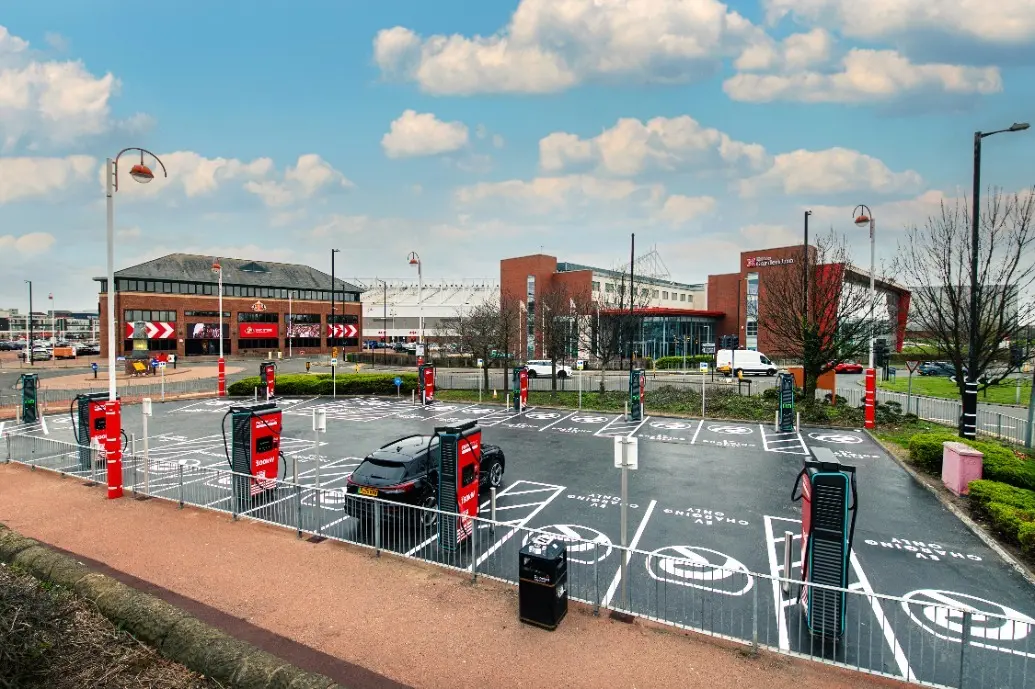
The new facility is designed to meet the growing demand for high-speed charging options as the United Kingdom continues its shift away from internal combustion engines. According to the project specifications, the hub will consist of a sophisticated mix of charging units tailored to different user needs. Specifically, the site will host 16 chargers with a capacity of 150kW and four ultra-rapid 300kW chargers. These power levels are significantly higher than standard public charging points, allowing drivers to add substantial range to their vehicles in a matter of minutes rather than hours. This speed is particularly crucial for a high-traffic location like the Stadium of Light, where visitors, residents, and match-day fans require efficient and reliable power solutions.
Central to the project is its alignment with Sunderland AFC’s broader environmental objectives. The charging hub will be powered by 100% renewable energy, ensuring that the transition to electric mobility is supported by truly green power sources. This move is a cornerstone of the club’s "Ready Eco" strategy, an ambitious roadmap designed to position the organization as a leader in sports-sector sustainability. Under this framework, Sunderland AFC aims to become entirely energy-sufficient through renewable sources by the year 2028. Looking further ahead, the club has set a target to achieve net-zero status by 2040, a goal that requires a comprehensive overhaul of its energy consumption, waste management, and transport logistics.
Paul Kingsmore, the Chief Operations Officer at Sunderland AFC, emphasized the dual benefits of the project, noting that it serves both the club’s supporters and the wider community. He stated that by installing a state-of-the-art EV charging hub at the Stadium of Light, the club is not only improving the experience for fans and visitors but also supporting the wider transition to cleaner, greener transport across the North East. His comments reflect a growing trend among professional sports organizations to leverage their physical assets—such as stadiums and training grounds—to provide essential services that benefit the public while advancing ecological goals.
The financial backing for this project comes from RAW, a company specializing in electric vehicle charging solutions. The firm has invested approximately £750,000 into the city of Sunderland to bring this hub to fruition. This investment is part of a larger national trend where private capital is increasingly flowing into EV infrastructure to keep pace with the rising adoption of electric cars. Recent industry reports suggest that infrastructure is finally beginning to catch up with consumer demand, following significant capital injections across the sector totaling hundreds of millions of pounds. By choosing the Stadium of Light as a primary location, RAW is capitalizing on the stadium’s status as a regional landmark and a focal point for community activity.
To celebrate the launch of the new hub and to encourage fans to engage with the new technology, the club and RAW have announced a special promotional event. On the 8th and 9th of October, coinciding with Sunderland’s home fixture against Brighton, fans will be able to utilize the charging bays free of charge. This initiative is part of RAW’s wider scheme to promote the benefits of electric vehicle ownership and to demonstrate the ease of use associated with ultra-rapid charging. By timing the offer with a major home game, the club ensures maximum visibility for the project, introducing thousands of match-goers to the reality of accessible, high-speed green energy.
The introduction of such a high-capacity hub at a football stadium underscores the evolving role of sports venues in the 21st century. No longer just sites for weekend entertainment, stadiums are increasingly being viewed as "anchor institutions" that can drive regional development and technological adoption. For the city of Sunderland and the broader North East region, the addition of 20 ultra-rapid bays provides a much-needed boost to the local charging network. As the government moves toward phasing out the sale of new petrol and diesel cars, the availability of high-speed charging in accessible, well-known locations is vital for reducing "range anxiety" and making EV ownership a practical choice for a larger segment of the population.
The "Ready Eco" strategy itself represents a paradigm shift for Sunderland AFC. The commitment to becoming energy-sufficient by 2028 is a particularly bold target for a stadium of its size, which has significant power requirements for lighting, hospitality, and day-to-day operations. Achieving this will likely involve a combination of on-site generation, advanced energy storage solutions, and continued partnerships with renewable energy providers. The EV charging hub serves as a visible, tangible symbol of this strategy in action. It demonstrates that the club is not merely setting long-term goals but is actively implementing the infrastructure necessary to meet them.
Furthermore, the choice of 150kW and 300kW chargers indicates a future-proofed approach to infrastructure. As battery technology in electric vehicles improves, cars are becoming capable of accepting higher rates of charge. The 300kW units, in particular, represent the cutting edge of currently available public charging technology. These units can provide a significant charge in the time it takes for a visitor to grab a coffee or visit the club shop, making the Stadium of Light a convenient "pit stop" for those traveling through the region, regardless of whether a match is taking place.
The collaboration between Sunderland AFC and RAW also highlights the importance of private-sector partnerships in achieving climate goals. With the £750,000 investment, RAW is providing the technical expertise and financial resources, while the club provides the prime location and the platform to reach a massive audience. This synergy is essential for the rapid rollout of green technology, as it allows for the deployment of expensive infrastructure without placing the entire financial burden on the public purse or the club’s primary operating budget.
As the sports sector globally begins to take its environmental responsibilities more seriously, initiatives like the Stadium of Light charging hub are becoming the new standard. From solar-panel-covered roofs to zero-waste match days, the industry is recognizing that its influence extends far beyond the pitch. Sunderland AFC’s move into the EV space is a clear indication that the club views sustainability as an integral part of its identity and its relationship with its fanbase.
The free charging offer during the Brighton match is expected to be a major draw, providing a practical demonstration of how green technology can be integrated into the traditional match-day routine. It bridges the gap between abstract environmental goals and the daily lives of the fans. By making the experience seamless and, for a limited time, cost-free, the club and RAW are lowering the barriers to entry and fostering a positive association with electric mobility.
In the wider context of the North East’s economic landscape, this development complements other green energy projects in the region, which is increasingly becoming a hub for the UK’s battery manufacturing and renewable energy sectors. The presence of high-end charging facilities at a landmark like the Stadium of Light reinforces the region’s reputation as a forward-thinking area prepared for the energy transition.
As October 8th approaches, the focus will not only be on the performance of the team on the pitch but also on the performance of the new infrastructure in the car park. The launch of the hub marks a milestone in the "Ready Eco" journey, proving that the road to net zero is paved with practical, high-tech solutions that serve the community. With 20 ultra-rapid bays ready to serve the public, the Stadium of Light is firmly positioned as a leader in the greening of the sports world, ensuring that the club remains a vital and sustainable part of the city for decades to come.