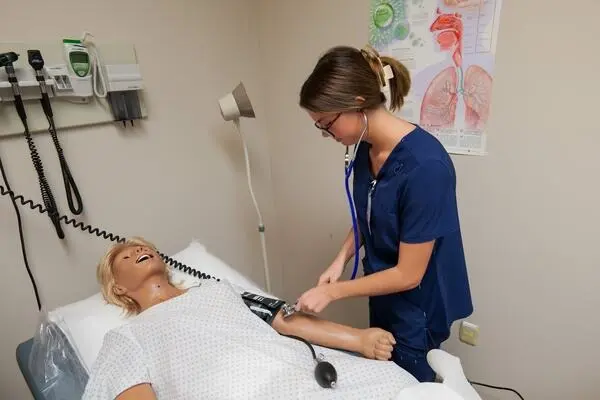
At Ivy Tech, the road to implementation has been a study in persistence. Colby Shank, the college’s vice president of financial aid and student accounts, detailed a timeline that illustrates the bureaucratic hurdles involved. The college submitted its application for the certified medical assistant program on July 7, shortly after the new policy went live. Approval from the federal government did not arrive until August 19.
"We were very excited, but then we also recognized that that’s just kind of the beginning," Shank said. He noted that once the legal authority was granted, the institution was immediately met with "a lot of questions on how we take approval to implementation."
When the program officially begins accepting Pell Grants in late October, the initial scale will be modest. The grants are expected to fund up to a dozen students at just one of the 19 campuses within the Ivy Tech system. However, this small-scale pilot is intended to serve as a proof-of-concept. Shank indicated that he expects two additional campuses to begin accepting Workforce Pell for the certified medical assistant program in the near future as the system refines its processes.
The move is a welcome relief for students who have historically been forced to pay out-of-pocket or take out private loans for short-term vocational training. "It’s rewarding to be able to offer a new avenue for financial aid when, on the short-term-program side, the options have historically been fairly limited," Shank said. However, he was candid about the current administrative reality: "Right now, we expect it will be a lot of manual work."
Shank explained that because Ivy Tech’s current software is not configured to process financial aid for these non-traditional timelines, financial aid officers must manually intervene. This involves identifying eligible students, calculating their specific Workforce Pell award based on individual financial need and the exact length of the program, and then personally overseeing the disbursement of funds. While this is sustainable for a dozen students, the college is already looking toward a future where such aid can be scaled to thousands. "We’re starting to explore what it will take with our software systems to scale this, which is what we want to see happen," Shank said. "But in the meantime, to get us off the ground, we plan on doing quite a bit of this work manually just so that we can serve students as quickly as possible."
The experience has been slightly different at Iowa Central Community College, which holds the distinction of having the first program in the country—a 14-week emergency medical technician (EMT) course—approved for Workforce Pell. Stacy Mentzer, the college’s vice president of instruction, noted that Iowa Central was better positioned for the transition than some of its peers. The college already offered a Pell-eligible commercial driver’s license (CDL) program, which meant its financial aid systems were already capable of calculating aid based on clock hours rather than traditional credit hours.