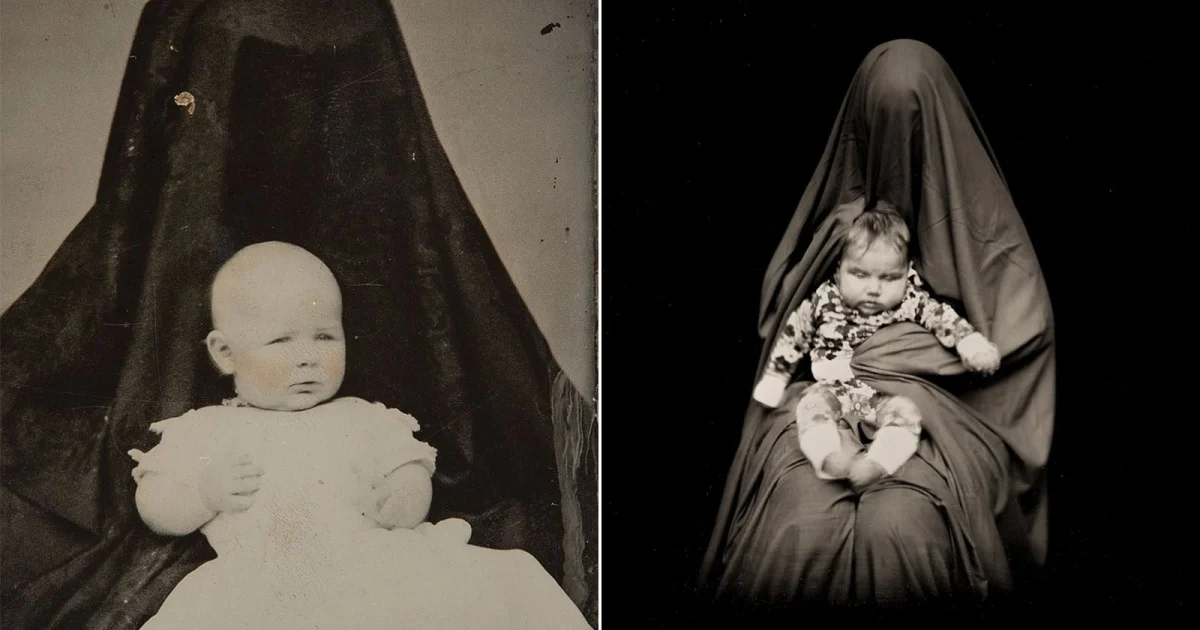
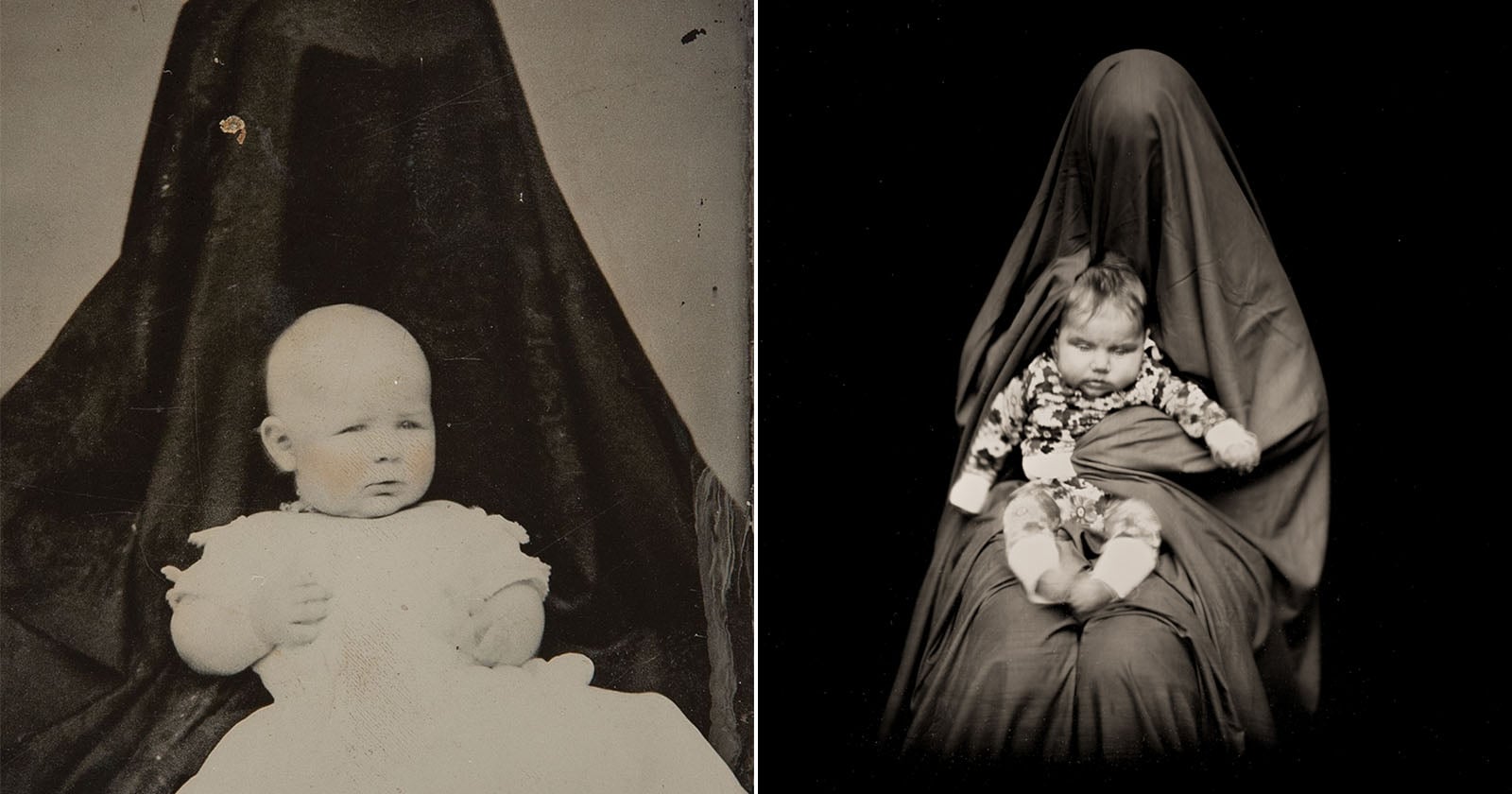
In the archives of 19th-century photography, few genres evoke as much immediate curiosity—and, for the modern viewer, a sense of mild unease—as the "Hidden Mother" portrait. These vintage images, captured during the mid-to-late Victorian era, typically feature a young child sitting stoically for a portrait, flanked or supported by a figure entirely obscured under a heavy, dark shroud. To the contemporary eye, accustomed to the instant, crystal-clear snapshots of the smartphone era, these photographs appear like scenes from a gothic horror novel. The faceless, draped figures lurking behind infants suggest something spectral or macabre, yet the reality behind this practice was rooted not in the supernatural, but in the grueling technical demands of early photographic chemistry.
The genre of Hidden Mother photography emerged during the very infancy of the medium, with examples dating back as far as 1839, the year the daguerreotype was introduced to the public. During this period, and continuing through the reign of the wet plate collodion process in the 1850s and 60s, photography was a slow, arduous endeavor. Unlike the millisecond shutter speeds of today, early photographers required exposures that lasted anywhere from several seconds to several minutes. For an adult, remaining perfectly still for such a duration was a challenge; for a restless infant or a curious toddler, it was an impossibility. The "Hidden Mother" was the era’s ingenious, if visually startling, solution to the problem of motion blur.
To achieve a sharp image of a child, a parent—usually the mother—would serve as a human stabilizer. She would sit in the frame, her body providing a familiar and firm foundation for the baby, but to ensure the child remained the sole focus of the commemorative portrait, she would be camouflaged. Methods varied based on the photographer’s preference and the tools at hand. In some instances, a heavy shroud or velvet sheet was thrown over the adult. In others, the mother might crouch behind a high-backed, cloaked chair, her arms reaching through the fabric to hold the child’s waist. Some photographers were more meticulous, attempting to blend the mother into the background drapery, while others were content with a more haphazard approach, knowing that the edges of the plate could be cropped or hidden behind a decorative brass matte once the photograph was framed.
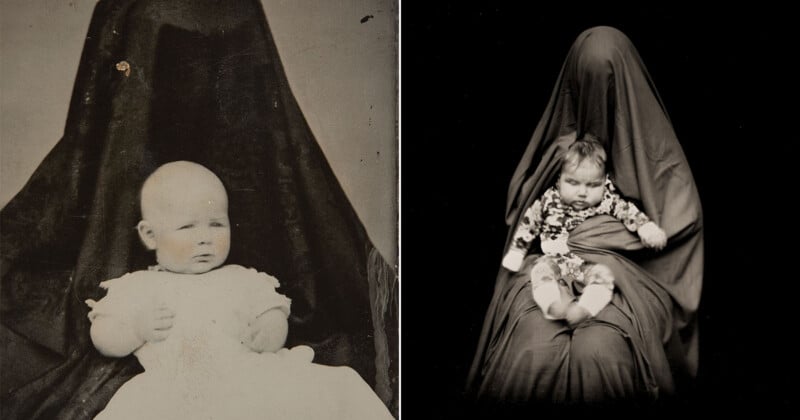
While these images were intended to be cherished family keepsakes, our modern sensibilities often struggle to see past the "spooky" aesthetic. We are conditioned to look for the human face, and when that face is replaced by a void of dark fabric, the result is often described as unnerving. However, for the Victorian parent, these photographs were a triumph of technology over nature. In an age where infant mortality was high, a clear photograph of a child was a precious, sometimes once-in-a-lifetime luxury. The viewer of the time was implicitly asked to perform a feat of mental editing: to overlook the shrouded figure in the background and see only the life and clarity of the child in the foreground.
Shane Balkowitsch, a modern-day practitioner of the wet plate collodion process, understands the necessity of this "game of hide-and-seek" better than most. Operating out of his Nostalgic Glass Wet Plate Studio, Balkowitsch eschews digital technology entirely, dedicating his craft to the historic method invented by Frederick Scott Archer in 1851. In his studio, the ghost of the 19th century is very much alive, and the technical hurdles faced by his predecessors remain his daily reality.
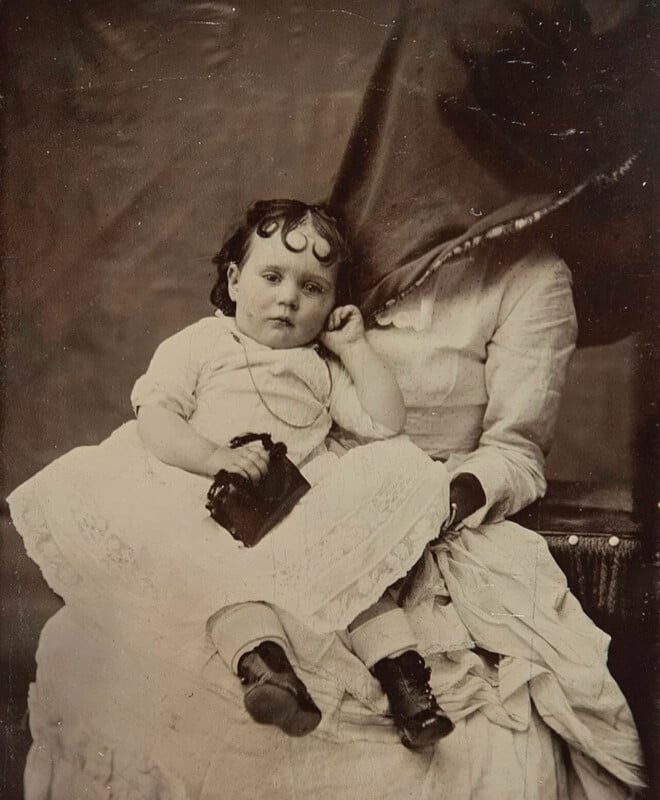
"The daguerreotype and the wet plate process are very slow and require the lens to be open for exorbitant amounts of time," Balkowitsch explains. "Sometimes as little as a few seconds, but sometimes subjects needed to hold perfectly still for minutes on end. These longer exposure times pushed the boundaries of what a human can endure."