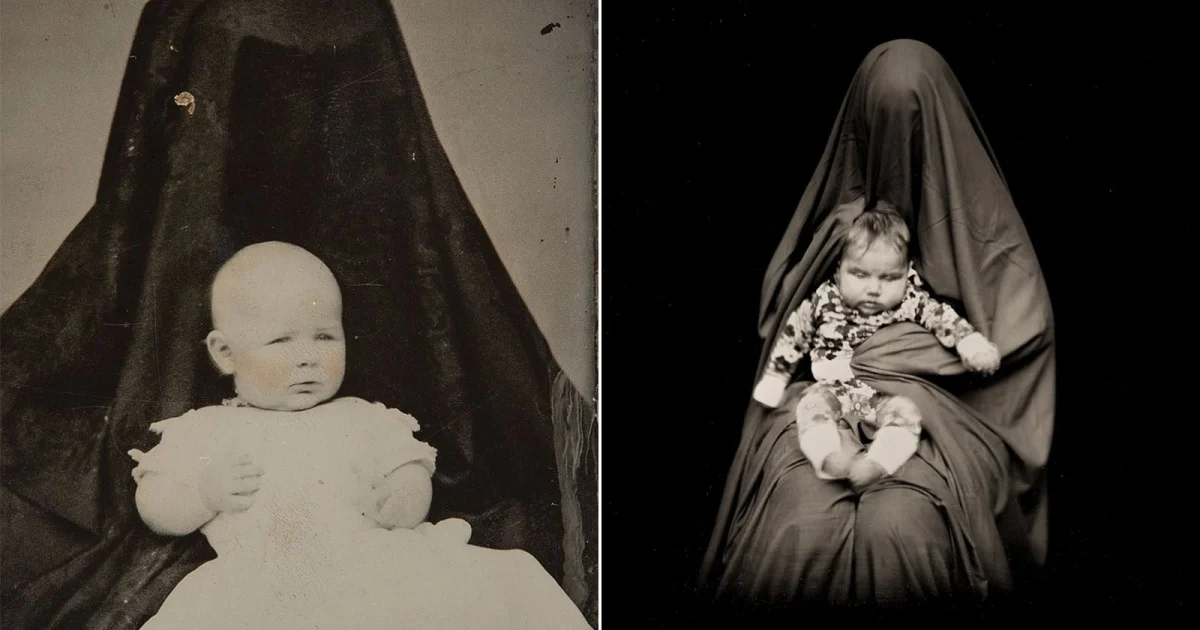
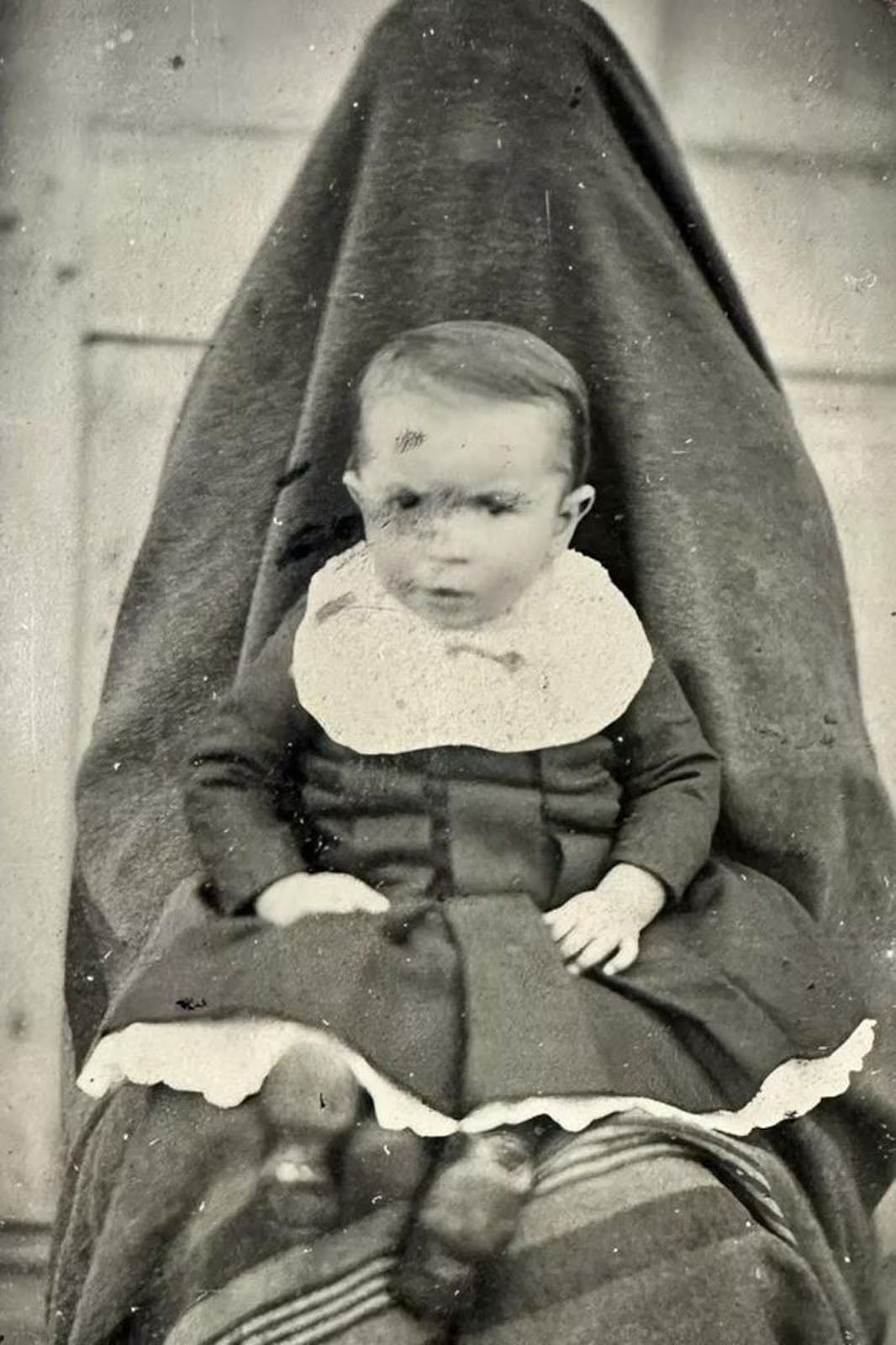
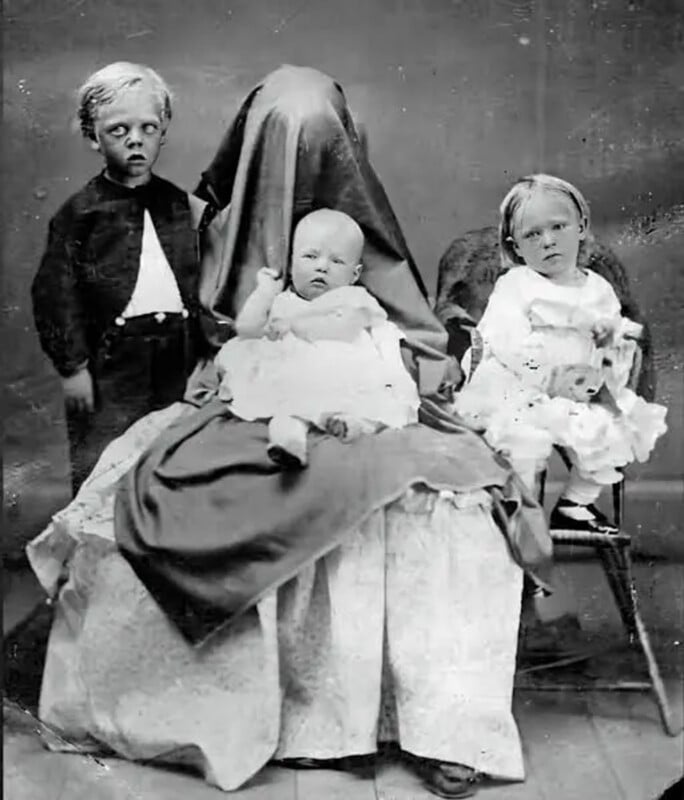
In the archives of 19th-century photography, few genres evoke as much immediate curiosity—and, for the modern viewer, a sense of mild unease—as the "Hidden Mother" portrait. These vintage images, captured during the mid-to-late Victorian era, typically feature a young child sitting stoically for a portrait, flanked or supported by a figure entirely obscured under a heavy, dark shroud. To the contemporary eye, accustomed to the instant, crystal-clear snapshots of the smartphone era, these photographs appear like scenes from a gothic horror novel. The faceless, draped figures lurking behind infants suggest something spectral or macabre, yet the reality behind this practice was rooted not in the supernatural, but in the grueling technical demands of early photographic chemistry.
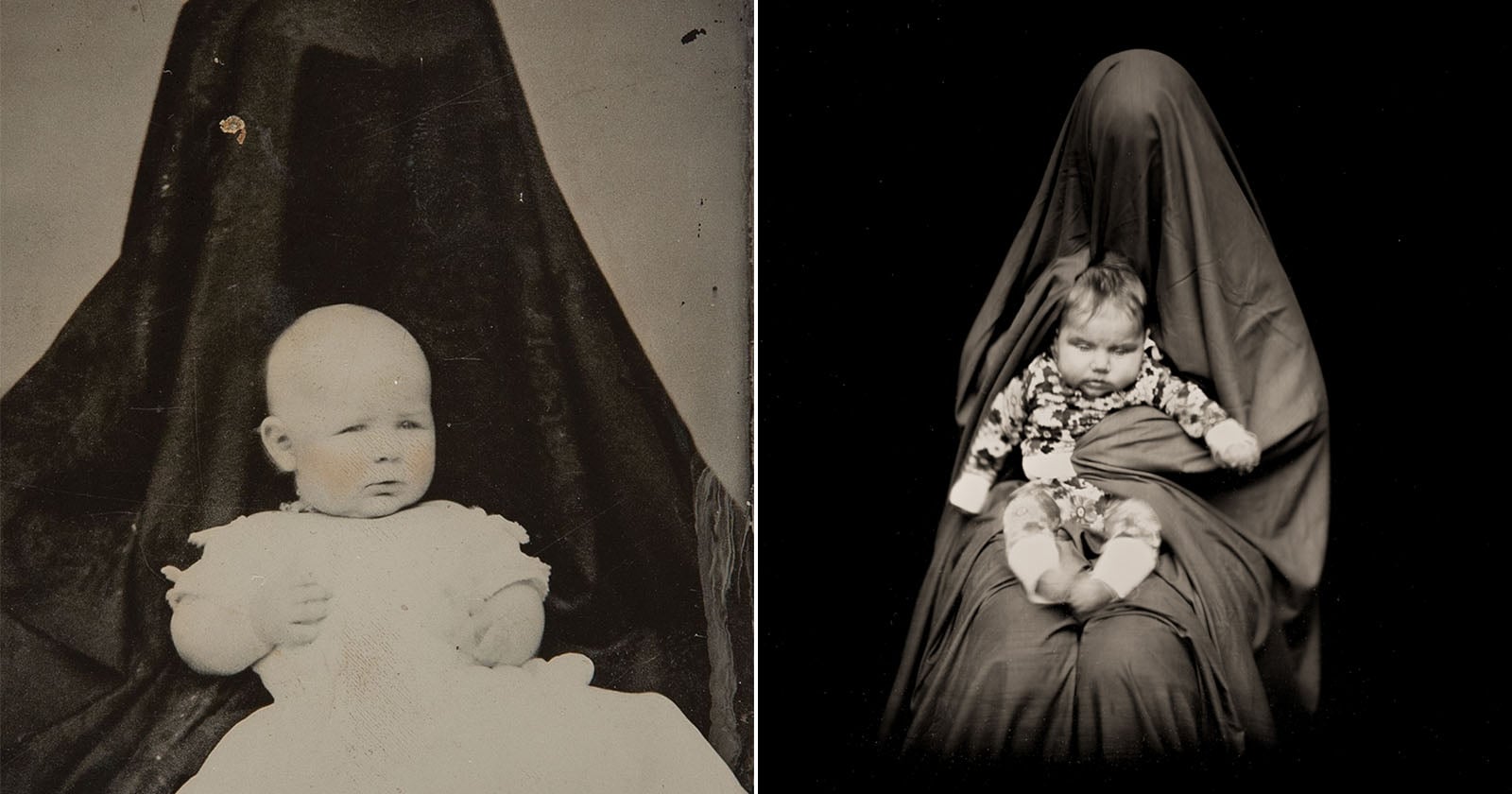
The genre of Hidden Mother photography emerged during the very infancy of the medium, with examples dating back as far as 1839, the year the daguerreotype was introduced to the public. During this period, and continuing through the reign of the wet plate collodion process in the 1850s and 60s, photography was a slow, arduous endeavor. Unlike the millisecond shutter speeds of today, early photographers required exposures that lasted anywhere from several seconds to several minutes. For an adult, remaining perfectly still for such a duration was a challenge; for a restless infant or a curious toddler, it was an impossibility. The "Hidden Mother" was the era’s ingenious, if visually startling, solution to the problem of motion blur.
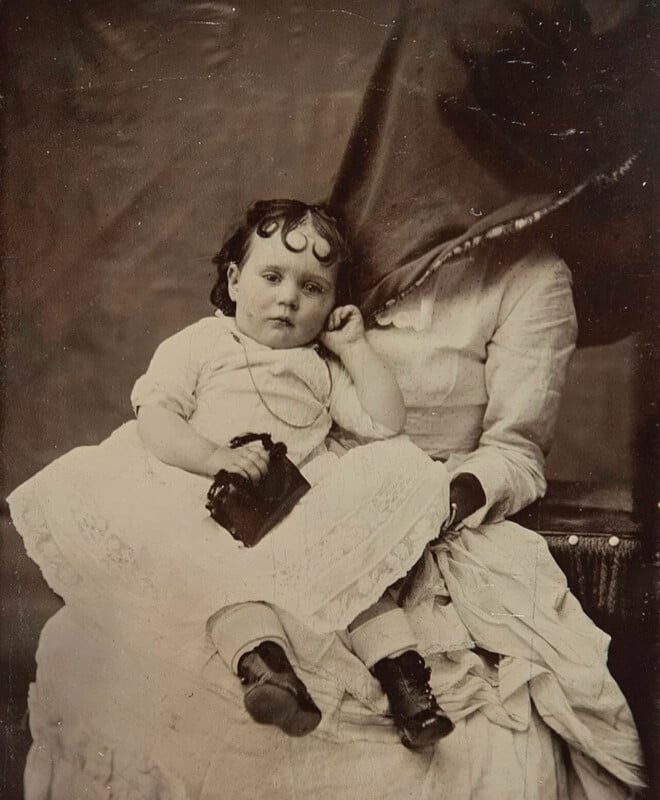
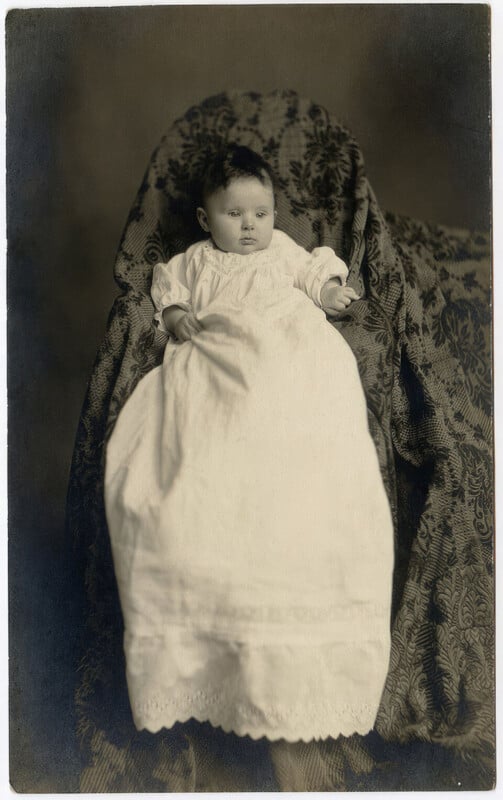
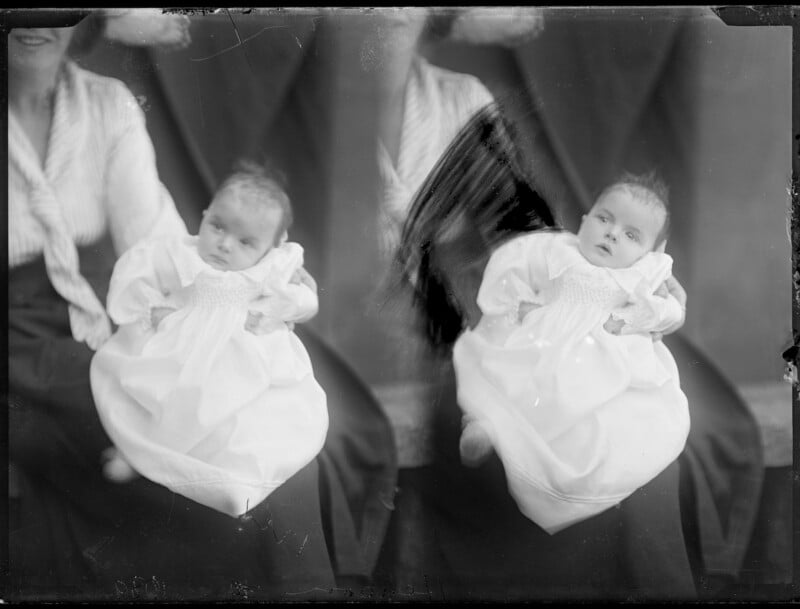
To achieve a sharp image of a child, a parent—usually the mother—would serve as a human stabilizer. She would sit in the frame, her body providing a familiar and firm foundation for the baby, but to ensure the child remained the sole focus of the commemorative portrait, she would be camouflaged. Methods varied based on the photographer’s preference and the tools at hand. In some instances, a heavy shroud or velvet sheet was thrown over the adult. In others, the mother might crouch behind a high-backed, cloaked chair, her arms reaching through the fabric to hold the child’s waist. Some photographers were more meticulous, attempting to blend the mother into the background drapery, while others were content with a more haphazard approach, knowing that the edges of the plate could be cropped or hidden behind a decorative brass matte once the photograph was framed.
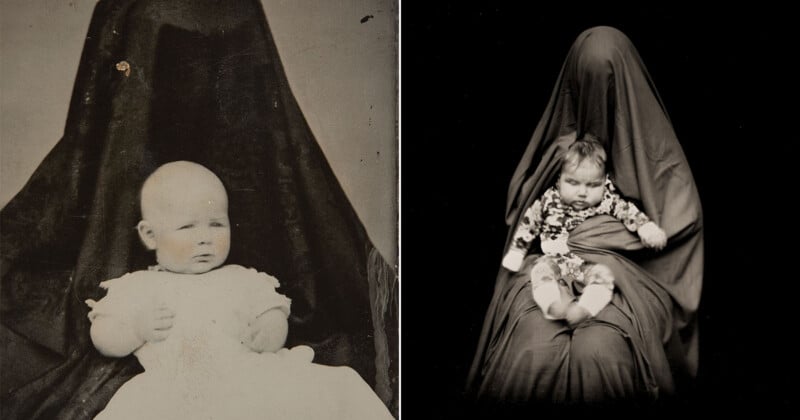
While these images were intended to be cherished family keepsakes, our modern sensibilities often struggle to see past the "spooky" aesthetic. We are conditioned to look for the human face, and when that face is replaced by a void of dark fabric, the result is often described as unnerving. However, for the Victorian parent, these photographs were a triumph of technology over nature. In an age where infant mortality was high, a clear photograph of a child was a precious, sometimes once-in-a-lifetime luxury. The viewer of the time was implicitly asked to perform a feat of mental editing: to overlook the shrouded figure in the background and see only the life and clarity of the child in the foreground.
Shane Balkowitsch, a modern-day practitioner of the wet plate collodion process, understands the necessity of this "game of hide-and-seek" better than most. Operating out of his Nostalgic Glass Wet Plate Studio, Balkowitsch eschews digital technology entirely, dedicating his craft to the historic method invented by Frederick Scott Archer in 1851. In his studio, the ghost of the 19th century is very much alive, and the technical hurdles faced by his predecessors remain his daily reality.
"The daguerreotype and the wet plate process are very slow and require the lens to be open for exorbitant amounts of time," Balkowitsch explains. "Sometimes as little as a few seconds, but sometimes subjects needed to hold perfectly still for minutes on end. These longer exposure times pushed the boundaries of what a human can endure."
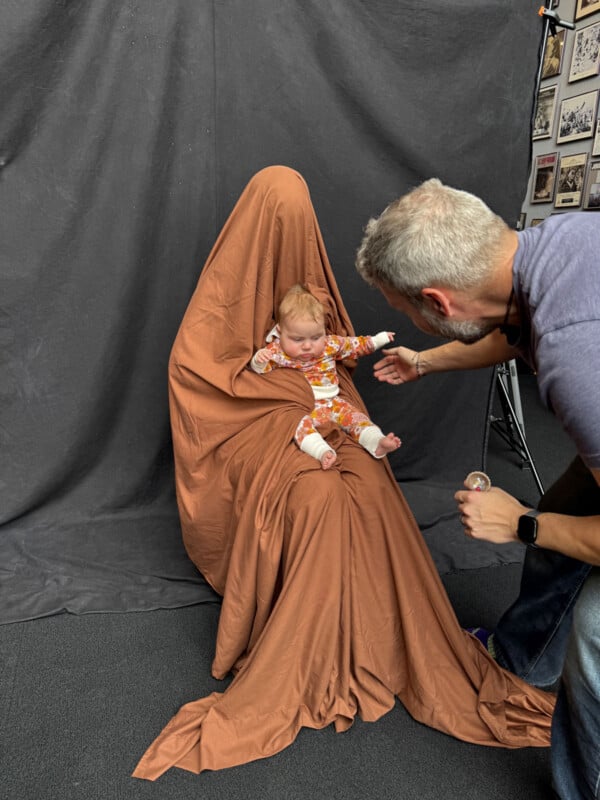
In his natural light studio, Balkowitsch notes that a typical exposure ranges between six and twelve seconds, depending on the season and the strength of the North Dakota sun. While six seconds may sound brief in a world of instant gratification, it feels like an eternity when one is required to remain absolutely motionless. When the subject is a baby, those seconds are an architectural challenge. This led Balkowitsch to pay homage to the Hidden Mother technique by attempting a modern recreation with a friend’s newborn daughter, Mazie.
The session provided a firsthand look at why the technique was so effective beyond mere physical stabilization. For the child, the experience of a photographic studio—with its large, intimidating cameras and chemical smells—can be frightening. By having her mother, Dana, present under the shroud, the infant remained calm. Mazie could still feel her mother’s touch and hear her comforting voice, providing a sense of security that allowed her to remain still enough for the silver to settle on the glass. The presence of Mazie’s father, Chris, just outside the frame with a favorite rattle, provided a "safe" focal point for the baby to watch.
The result of the session was "Mazie’s Hidden Mother," an 8×10-inch black glass ambrotype. Using an Alessandro Gibellini large format camera and a Carl Zeiss Tessar 250mm lens at f/4.5, Balkowitsch captured a sharp, hauntingly beautiful image. Despite the careful planning, the reality of working with children left its mark: Mazie kicked her legs in the final two seconds of the eight-second exposure, leaving a slight, ghostly blur at the bottom of the plate—a characteristic "artifact" that connects this modern plate to its 19th-century ancestors.
Beyond the use of shrouded mothers, the Victorian era employed other, more mechanical means of stabilization. Adults, too, struggled with the "eternal" wait of the lens. To assist them, photographers utilized posing stands or headbraces—heavy iron pedestals with adjustable clamps designed to cradled the back of a sitter’s skull. These devices allowed the subject to lean back slightly, taking the strain off their neck muscles and preventing the micro-sways that would ruin a portrait’s sharpness.
Today, these posing stands are the source of one of the most persistent myths in photographic history: the idea that they were used to prop up the deceased for "post-mortem" photography. Balkowitsch is quick to debunk this misconception. "The term ‘dead weight’ has a meaning, and there is no way that one of these metal stands could hold up someone deceased," he says. The stands were tools for the living, intended to help a breathing, pulsing human mimic the stillness of a statue. While post-mortem photography certainly existed in the 19th century as a way to grieve, the subjects were almost always photographed lying down or in natural, reclining positions, never bolted upright in a posing stand.
The scarcity of these original tools speaks to how quickly they became obsolete once photographic technology advanced. By the 1920s, faster lenses and more sensitive film stocks reduced exposure times to fractions of a second, rendering the Hidden Mother and the headbrace unnecessary. Original posing stands are now rare collector’s items, sometimes fetching upwards of $10,000 at auction. Balkowitsch himself uses a replica, cast at a modern foundry from a historical original, to ensure his sitters can withstand the rigors of his ten-second exposures.
The fascination with the Hidden Mother genre has only grown in the 21st century, fueled by a modern obsession with "creepypasta" aesthetics and the uncanny. This interest has translated into significant market value. In 2013, artist Linda Fregni Nagler published The Hidden Mother, a comprehensive volume featuring over 1,000 examples of the genre. The book has since become a cult classic, with rare copies now listed for nearly $2,000 on secondary markets. These photographs, once utilitarian solutions to a technical problem, are now viewed as significant pieces of folk art and social history.
As Balkowitsch reflects on his work and the history of the medium, he raises a poignant question about the future of our current photographic era. The wet plates he produces are made of silver on glass; they are chemically stable and, barring physical breakage, are designed to last for a thousand years. They require no software to "read" and no electricity to view. They are physical objects that occupy space in the real world.
In contrast, the vast majority of the billions of digital photographs taken today exist only as strings of binary code on volatile servers. "We must ask ourselves: will all the digital photographs we are taking today make it into the future?" Balkowitsch muses. "Surely the software and hardware these photographs rely on will become obsolete and be forgotten. A very small portion, far less than 1% of the digital photographs of today, are ever printed and brought into the real world."
The Hidden Mother photographs, for all their perceived eeriness, represent a period when a single image was a monumental achievement. They are the record of a time when a mother would literally disappear into the shadows so that her child could be seen by the future. In an age of disposable digital imagery, there is a profound irony in the fact that these "ghoulish" Victorian plates—created with such struggle and agony—will likely outlast the pristine, effortless pixels of the 21st century. Until then, we are left to peer into the past, seeking out these shrouded figures and appreciating the lengths to which our ancestors went to capture a moment in time.