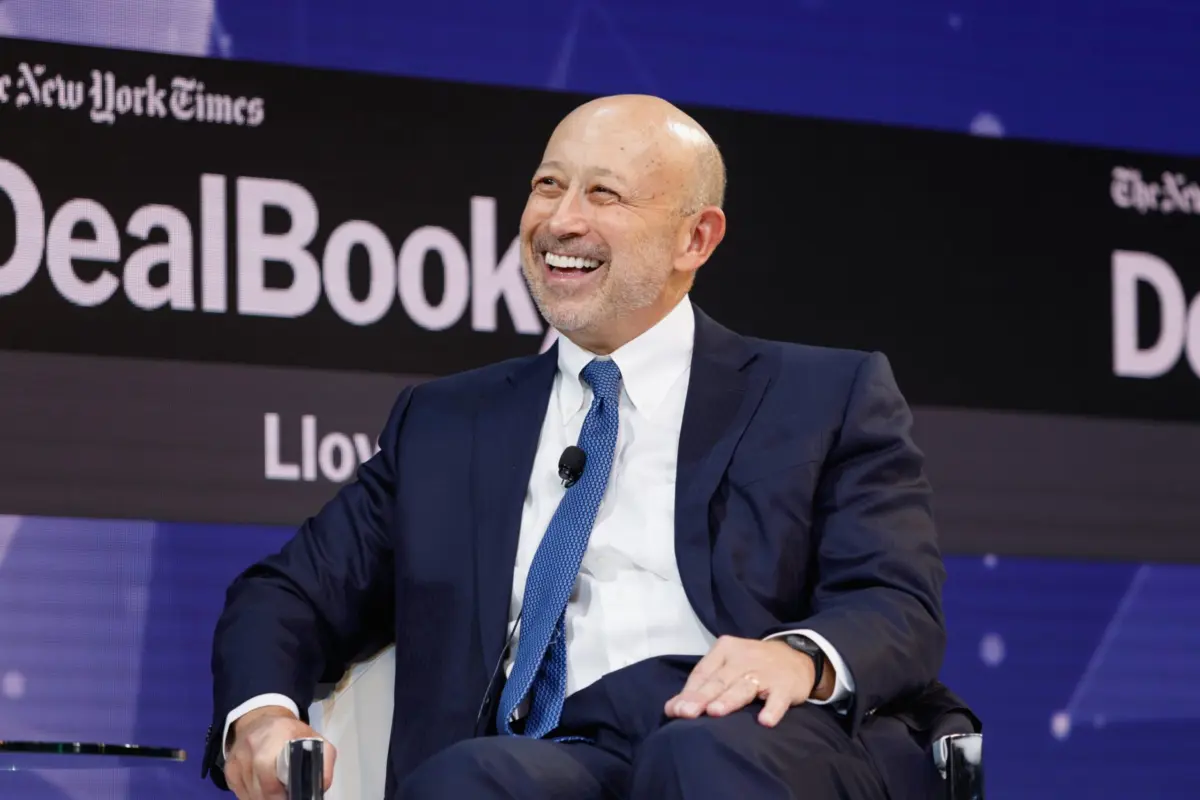
In an era where the traditional path to professional success is increasingly scrutinized by tech visionaries and the rising capabilities of artificial intelligence, Lloyd Blankfein is doubling down on a classic American tenet: the transformative power of a college education. The former chairman and CEO of Goldman Sachs, who navigated the global financial titan through some of its most turbulent years, remains a staunch advocate for the university experience, positioning it not merely as a credentialing exercise, but as the essential "accelerator" for social and economic mobility.
Blankfein’s perspective is deeply rooted in a personal narrative that mirrors the mid-century promise of the American Dream. Long before he was a billionaire finance leader, Blankfein was a young boy growing up in public housing in Brooklyn. His early years were defined by shared spaces and limited resources; he lived in a small New York City apartment where he shared a bedroom with either his grandmother or his sister until the day he left for university. The environment outside his home was equally challenging. During his formative years, his local high school was on the verge of being shut down—a detail Blankfein shared in a recent interview with CBS.
Despite the systemic hurdles of his upbringing, Blankfein adopted a rigorous discipline, "battening down the hatches" to focus on his studies. His academic commitment paid off when he became his high school’s class valedictorian, an achievement that served as his ticket out of the housing projects. At the exceptionally young age of 16, he was accepted into Harvard University. For Blankfein, Harvard was more than just a school; it was the launchpad for a career that eventually led him to a 12-year tenure at the helm of Goldman Sachs, one of the most powerful financial institutions in the world.
Now, five decades after he first stepped onto a college campus, Blankfein’s conviction has not wavered. Even as the rapid advancement of generative artificial intelligence threatens to automate many of the white-collar roles that have traditionally been the prize of a college degree, Blankfein maintains that schooling remains the ultimate wealth equalizer. "I think education is the real accelerator for most people into the middle and upper classes," he told CBS, reinforcing the idea that the value of a degree transcends the immediate technical skills it provides.
Blankfein argues college helps develop a ‘complete person’
The debate over the necessity of higher education has intensified in recent years, fueled by the astronomical rise in tuition costs and a growing "skills-first" movement in the labor market. Some prominent figures in the technology sector have become vocal critics of the university system, suggesting that the four-year model is an antiquated relic of a pre-digital age.
Among the most prominent of these skeptics is Peter Thiel, the cofounder of PayPal and Palantir. Thiel, despite being an alumnus of Stanford University and Stanford Law School, has famously characterized higher education as a "corrupt institution" that saddles young people with debt while stifling innovation. To back his rhetoric, Thiel established the Thiel Fellowship, which offers $200,000 grants to young entrepreneurs under the condition that they drop out of college—or skip it entirely—to "build new things."